

Gold has always occupied a unique place in global markets. It serves simultaneously as a commodity, monetary asset, inflation hedge, and a geopolitical haven. This multifaceted identity explains its volatility—and why today’s environment suits active management particularly well.
After strong performance with sharp pullbacks, gold typically experiences wide price swings from shifting interest-rate expectations, currency movements, central bank activity, and global uncertainty.
For investors, this volatility feels unsettling but also creates opportunity. In markets defined by dispersion rather than direction, active gold ETFs can add value by navigating complexities that passive strategies must accept.
Gold’s Current Volatile Environment
Gold has long served as a safe-haven asset class, considered the penultimate store of value that attracts investor interest during tough times. This explains why the yellow metal has surged roughly 40% over the last year.
However, the ride has not always been smooth or straight up. Investors in the precious metal have learned that the hard way over the last few months. According to BlackRock, the metal’s historic run higher has encountered historically rough waters.
The asset manager notes that gold advanced more than 70% from fall 2024 to fall 2025. However, in mid-October of last year, it plunged 10% in just a few days, only to recover half its loss by mid-November.
Gold’s volatility ranks among the widest in recent memory.
This chart from the CBOE illustrates that gold’s volatility ranks as the highest among significant asset classes and now trades four standard deviations above its long-term average. 1
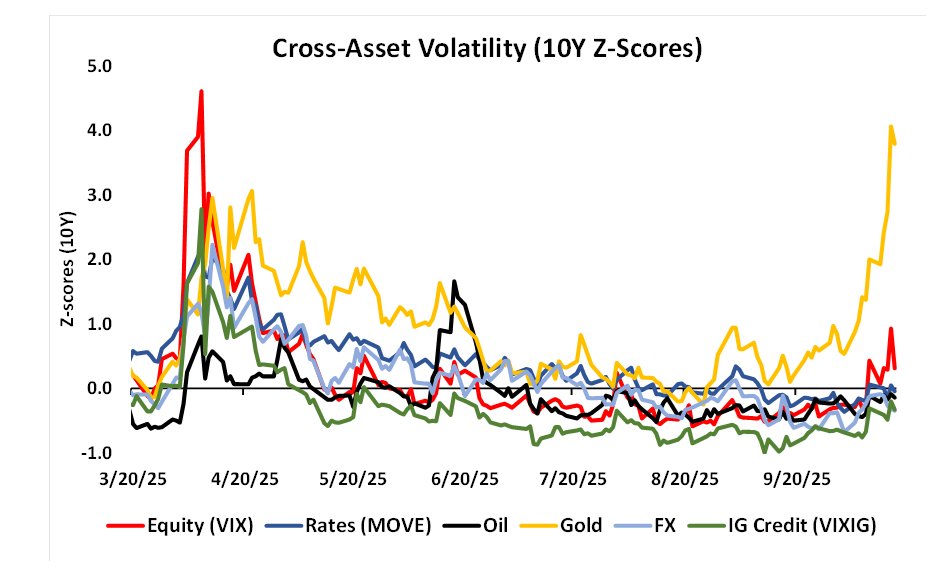
Source: CBOE
Gold’s recent volatility reflects competing macro forces pulling prices in different directions.
Persistent geopolitical tensions, rising sovereign debt levels, and ongoing central bank demand have supported gold prices. Meanwhile, fluctuating real interest rates, a resilient U.S. dollar at times, and shifting monetary policy expectations have introduced meaningful downside pressure.
Interest rates remain one of the most powerful drivers of gold’s price action. Gold generates no income, so changes in real yields directly affect its relative attractiveness. Rising real rates increase the opportunity cost of holding gold, often leading to pullbacks. Falling or uncertain real rates help gold regain favor. Over the past year, markets have repeatedly repriced expectations for rate cuts and inflation persistence, creating sharp rallies and reversals in gold prices.
Currency dynamics have added another layer of volatility. Priced globally, gold faces amplified swings from U.S. dollar movements. Dollar strength has pressured gold, while weakness has fueled rallies. These quick shifts create short-term dislocations that challenge buy-and-hold approaches.
Structural demand has remained strong at the same time. Central banks, particularly in emerging markets, have continued adding gold to reserves for diversification from traditional currencies. Investment demand has also resurfaced during market stress, reinforcing gold’s role as a portfolio hedge.
These factors produce a market of frequent regime shifts rather than smooth trends.
Active Management Matters in Gold
Frequent regime shifts aren’t necessarily bad. They mark environments where active strategies shine.
Gold investing often gets oversimplified as a binary decision: own it or don’t. In reality, gold exposure spans a spectrum of instruments, each with distinct risk and return characteristics. Physical gold offers purity but no income. Futures provide leverage and roll yield considerations. Mining stocks introduce operational risk, equity market sensitivity, and company-specific factors. Options add convexity and risk control but require skill to manage.
Passive gold ETFs typically focus on one segment of this spectrum, most commonly physical gold. While effective for long-term exposure, they offer no flexibility to adjust positioning when conditions change. Investors thus experience gold’s full volatility, with no mechanism to mitigate drawdowns or capitalize on short-term dislocations.
Active gold ETFs take a different approach. They let managers adjust exposure, shift between instruments, and manage risk dynamically. In volatile markets, this flexibility provides a meaningful advantage. Active managers can reduce exposure during heightened downside risk, increase it when conditions improve, or use derivatives to shape return profiles.
Active strategies also exploit relative value opportunities. For example, gold miners may lag or outperform the metal based on cost pressures, balance sheet strength, or regional factors. Royalty and streaming companies offer more stable cash flows and different sensitivities to price movements. Active managers rotate among these exposures to enhance returns while controlling risk.
In addition, active management addresses gold’s persistent timing challenge. Gold performs best during short, intense periods rather than sustained trends. Active strategies capture more of these periods, avoid prolonged drawdowns, and improve risk-adjusted returns over full cycles.
Active ETFs Can Prosper in Volatile Gold Markets
Given gold’s potential to continue marching higher—albeit at a bumpy pace—investors may want to rethink their approach to the yellow metal. Funds like the SPDR Gold Trust or iShares Gold Trust have a place in many portfolios, but new active ETF options abound in the space.
For example, some active ETFs focus on tactical allocation by adjusting exposure to physical gold or futures based on macro indicators, momentum, or valuation signals. Others blend physical gold with options strategies and use derivatives to generate income or downside buffers. These approaches smooth returns in sideways or volatile markets and address gold’s traditional shortcomings.
Active gold ETFs can serve multiple roles in portfolios, from tactical allocation to strategic diversifier. Investors need not simply endure the asset class’s volatility; they can profit from it.
Active Gold ETFs
These ETFs were selected based on their ability to provide access to gold via active management. They are sorted by their 1-year total return, which ranges from 42% to 76%. They have assets under management of $53M to $532M and expenses of 0.20% to 0.91%.
| Ticker | Name | AUM | 1Y Total Ret (%) | Yield (%) | Exp Ratio | Security Type | Actively Managed? |
|---|---|---|---|---|---|---|---|
| GDE | WisdomTree Efficient Gold Plus Equity Strategy Fund | $532M | 76.2% | 0.4% | 0.2% | ETF | Yes |
| IGLD | FT Vest Gold Strategy Target Income ETF | $447M | 51.7% | 27.4% | 0.85% | ETF | Yes |
| BGLD | FT Vest Gold Strategy Quarterly Buffer ETF | $53M | 36.2% | 42.6% | 0.91% | ETF | Yes |
Passive Physical Gold ETFs
These ETFs provide low-cost access to physical gold. Their 1-year total return stands around 69% with a dividend yield of 0%. Assets under management range from $2.5B to $148B, and expenses from 0.09% to 0.40%.
| Ticker | Name | AUM | 1Y Total Ret (%) | Yield (%) | Exp Ratio | Security Type | Actively Managed? |
|---|---|---|---|---|---|---|---|
| GLDM | SPDR Gold MiniShares | $25B | 69.5% | 0% | 0.10% | ETF | No |
| IAUM | iShares Gold Trust Micro | $6B | 69.5% | 0% | 0.09% | ETF | No |
| AAAU | Goldman Sachs Physical Gold ETF | $2.5B | 69.4% | 0% | 0.18% | ETF | No |
| IAU | iShares Gold Trust | $68B | 69.2% | 0% | 0.25% | ETF | No |
| OUNZ | VanEck Merk Gold Trust | $2.5B | 69.2% | 0% | 0.25% | ETF | No |
| GLD | SPDR® GOLD TRUST | $148B | 69% | 0% | 0.40% | ETF | No |
Gold’s current volatility reflects its role at the center of competing macro forces, not dysfunction. Passive exposure leaves investors vulnerable to sharp swings with little ability to adapt. Active gold ETFs offer flexibility, professional management, and structural efficiency to navigate uncertainty.
Bottom Line
As markets grapple with inflation, interest rates, and geopolitical risk, the volatility challenging gold investors makes active strategies in the sector especially compelling.
1 CBOE (October 2025). Gold Volatility Spikes to 5-Year High on Haven Demand
