

For much of the past year, investors believed inflation was largely under control. While price pressures cooled significantly from the multi-decade highs reached in 2022, the expectation was that inflation would continue drifting toward the Federal Reserve’s 2% target. That outlook helped support a bond rally and fueled expectations for multiple interest-rate cuts.
The story has become more complicated in recent months, however.
Recent inflation reports show that price pressures remain stubbornly persistent, particularly across services, housing, insurance, healthcare, and other core components of the economy. Meanwhile, resilient consumer spending, rising wages, growing federal deficits, tariffs, and geopolitical uncertainty all threaten to keep inflation elevated longer than many investors expected.
For investors, abandoning the fight against inflation is a poor decision, especially when one of the best tools for that fight may be too valuable to overlook.
Stubborn and Rising Inflation
What began as a temporary post-pandemic surge evolved into one of the most persistent inflationary episodes in decades. Although price pressures moderated from their 2022 peaks, inflation has remained surprisingly resilient, frustrating policymakers and investors who expected a quicker return to the Federal Reserve’s 2% target.
That quick return is now in the rearview mirror.
The latest Consumer Price Index report showed inflation rose 0.5% in May, reaching an annual rate of 4.2%—the hottest pace in nearly three years and one that erases much of the progress achieved through the Fed’s rate hikes.
While much of this spike has been attributed to the war in Iran and recent jumps in crude oil and energy prices, the data show that price increases have been broad-based. Core inflation, which strips out much of the effect of energy, still rose a high 2.9%. Meanwhile, the Fed’s preferred gauge—the Personal Consumption Expenditures Index (PCE)—also posted a significant 4.1% increase, a measure designed to more closely reflect what the average American actually spends their income on each month.
For bond investors, these continued inflationary pressures create a real challenge.
Traditional bonds provide fixed interest payments, so if inflation rises faster than expected, those payments lose purchasing power over time. Investors may receive every dollar they were promised, but those dollars will buy less than originally anticipated.
A Tip On TIPS
This conundrum is exactly what Treasury Inflation-Protected Securities, or TIPS, were designed to solve. These U.S. government bonds are built specifically to protect investors from inflation.
Like traditional Treasury bonds, TIPS are backed by the full faith and credit of the U.S. government, making them among the safest investments available from a credit perspective. The key difference lies in how they pay investors.
Their principal value adjusts based on changes in the Consumer Price Index (CPI). As inflation rises, the principal increases, and because the coupon payment is calculated as a percentage of the adjusted principal, investors receive larger interest payments. If inflation declines, the principal can adjust downward during the life of the bond. However, investors who hold individual TIPS to maturity are guaranteed to receive at least the bond’s original principal value.
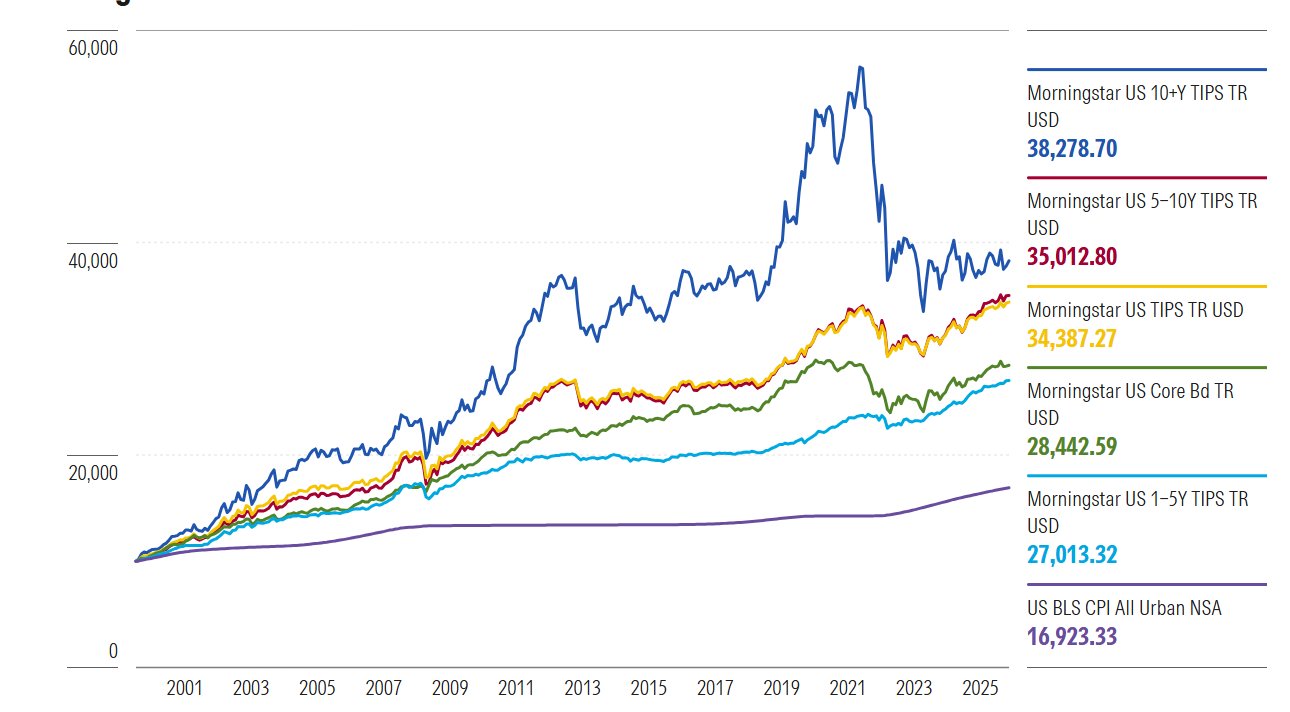
TIPS work effectively to combat inflation. Issued by the U.S. Treasury with maturities of 5, 10, or 30 years, all three varieties have beaten inflation over the long haul. This chart from Morningstar highlights their performance—the bottom line represents inflation. As you can see, all three varieties have beaten that metric, with many also outperforming standard core bonds. 1
Source: Morningstar
Why TIPS Look Attractive Today
Like every asset class, the entry point matters for TIPS. Several factors combine to make TIPS particularly appealing in today’s market.
The most significant of these is the so-called real yields.
The real yield is the return on a bond after accounting for inflation. A 10-year Treasury is a nominal bond that pays its 4% to 5% coupon regardless of inflation, while the real yield equals that coupon minus inflation. Because of the CPI adjustment and changes in market values, TIPS generally beat inflation by a set amount—typically around 1% to 1.5% for a 10-year TIPS.
Today, that figure is closer to 2.15%, and other TIPS maturities tell a similar story: a 30-year TIPS carries a real yield of around 2.7%, while a 5-year offers roughly 1.91%. These figures represent excess return over inflation compared with a comparable nominal Treasury bond, and by both historical and current standards, they are very attractive rates for inflation protection.
They look even better when you consider that inflation is unlikely to disappear soon. Several structural trends continue supporting higher prices: government deficits remain historically large; reshoring and near-shoring initiatives are raising manufacturing costs; labor markets remain relatively tight; healthcare costs keep rising; and artificial intelligence (AI) is generating enormous demand for data centers, electricity, and construction materials.
None of these factors guarantee a new inflation surge, but they do suggest inflation could remain above historical averages longer than many investors expect. Given the high real yields in these assets, adding a layer of portfolio protection against longer inflationary trends makes sense.
There are several ways to buy TIPS in a portfolio.
The individual TIPS market is large and liquid, making direct purchases easy through Treasury Direct or a brokerage account. The Treasury also holds several auctions—both new and reopenings—throughout the year. Investors can use these to build a TIPS ladder, a series of maturing bonds that deliver inflation-protected cash flows over a set number of years.
Given the size of the TIPS market, numerous ETFs and funds hold these bonds. TIPS ETFs can provide inflation protection, but not in the same way as direct ownership—they constantly roll over holdings to maintain their mandates and are therefore subject to market conditions, investor selling, and interest rate changes. Their advantage appears during sudden inflation spikes. They won’t deliver the same steady, inflation-protected cash flows as buying and holding individual TIPS, but for many investors, they offer an easy path to inflation protection.
TIPS ETFs
These funds were selected based on their exposure to Treasury Inflation-Protected Securities (TIPS) and are sorted by YTD total return, which ranges from 2% to 3.5%. Expenses range from 0.03% to 0.20%, assets under management from $727M to $52B, and current yields from 2.4% to 4%.
| Ticker | Name | AUM | YTD Total Ret (%) | Yield (%) | Exp Ratio | Security Type | Actively Managed? |
|---|---|---|---|---|---|---|---|
| LTPZ | PIMCO 15+ Year U.S. TIPS Index Exchange-Traded Fund | $727M | 3.5% | 3.5% | 0.20% | ETF | No |
| DFIP | Dimensional Inflation-Protected Securities ETF | $797M | 2.8% | 3.7% | 0.12% | ETF | Yes |
| TIP | iShares TIPS Bond ETF | $15.5B | 2.7% | 2.44% | 0.19% | ETF | No |
| SCHP | Schwab U.S. TIPS ETF | $11.3B | 2.5% | 2.9% | 0.03% | ETF | No |
| TIPX | SPDR Bloomberg 1-10 Year TIPS ETF | $1.37B | 2.4% | 3.5% | 0.15% | ETF | No |
| TDTT | FlexShares iBoxx 3-Year Target Duration TIPS Index Fund | $1.9B | 2.3% | 4% | 0.19% | ETF | No |
| VTIP | Vanguard Short-Term Inflation-Protected Securities Index Fund | $51.8B | 2% | 2.65% | 0.03% | ETF | No |
Inflation may no longer dominate financial headlines as it did several years ago, but the risk has not disappeared. Persistent price pressures, large fiscal deficits, evolving global supply chains, geopolitical tensions, and infrastructure investment all suggest inflation could remain a recurring challenge for investors.
TIPS offer a straightforward solution.
By combining the credit quality of U.S. Treasuries with principal adjustments tied directly to inflation, TIPS provide a unique way to protect purchasing power without sacrificing the stability many investors seek from fixed-income.
Bottom Line
As inflation risks evolve rather than disappear, TIPS may prove to be one of the smartest additions investors can make to their fixed-income allocations.
1 Morningstar (June 2026). How to Use TIPS in Your Portfolio
