

For much of the past decade, fixed-income investing felt frustrating. Compressed yields and scarce income forced investors to stretch for returns by taking more duration risk, more credit risk, or abandoning bonds altogether.
That era has changed. Today, fixed-income investors once again face an opportunity that has largely disappeared: earning attractive, meaningful returns simply by clipping coupons.
Yields across many bond market segments remain well above long-term averages, letting investors generate high income without precise interest-rate forecasts or heroic macroeconomic calls. Here, patience and discipline—not prediction—offer the most effective strategies.
Many Bonds Still Offer Above-Average Yields
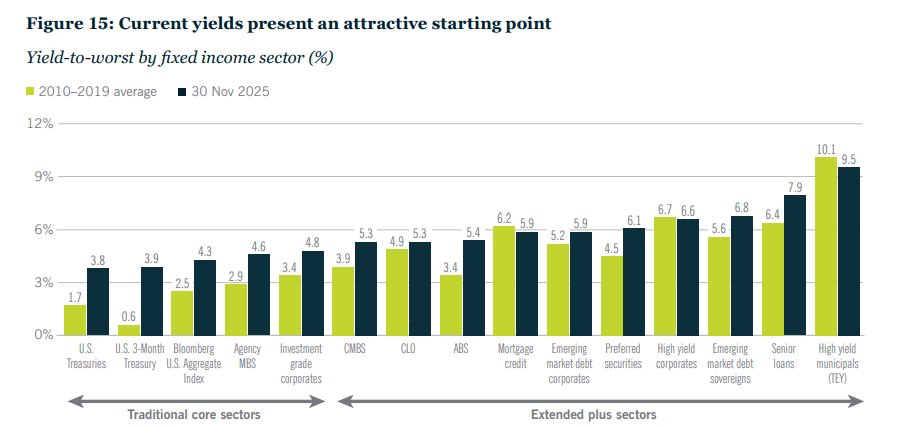
Despite recent rate volatility and expectations of monetary easing, yields across much of the bond market remain elevated above historical standards. Investment-grade corporate bonds, high-yield bonds, securitized credit, municipal bonds, and parts of the government curve continue to offer income levels extraordinary just a few years ago.
This chart from asset manager Nuveen highlights yield opportunities across fixed income sub-asset classes. In many cases, yields exceed 10-year averages.
Source: Nuveen
This distinction matters for fixed-income markets and investors.
Although prices fluctuate daily and headlines stress rate cuts or economic data, investors can lock in compelling yields today. Even with modest rate declines over time, many bonds offer coupons compressing years of forward returns into current income, shifting the math for fixed-income investors.
Yield Can Drive Steady, Reliable Returns
BlackRock’s fixed-income team says these yields suit sitting back to “coupon clip.”
Clipping coupons is not glamorous, but it is powerful. The idea harkens back to a time when investors would literally mail in little stubs attached to their bond certificates to claim the interest payment on the bond. But it works, and right now could be the best time in years to do so.
Bond returns consist of two primary components: income and price movement. In low-yield periods, investors rely heavily on price appreciation from falling rates, which demands correct macro calls and risks disappointment if rates move unexpectedly.
When yields are high, the equation flips. Income becomes the dominant driver of return. Even if bond prices move sideways or even decline modestly the steady stream of coupon payments can still deliver attractive total returns over time. This is especially true for investors with longer horizons who can reinvest income and benefit from compounding.
Historically, starting yield has been one of the strongest predictors of future bond returns. When yields are high, future returns tend to be higher- not because investors correctly time interest rates, but because income does most of the work.
Data supports this. Since its 1976 launch, the Bloomberg U.S. Aggregate Index’s starting yield has nearly matched its five-year forward returns. BlackRock says the Agg’s current yield should produce 6.3% average annual returns over the next three years, including coupon. 1
BlackRock suggests that now is a perfect time to just let compounding do its magic. One of the greatest temptations for investors- especially after years of unusual market behavior -is to believe that success depends on correctly forecasting interest rates, inflation, or economic cycles. In reality, such forecasts are notoriously difficult and often counterproductive.
Clipping coupons shifts the focus back to what bonds do best, and that’s deliver steady income. By prioritizing yield over prediction, investors can build portfolios that are resilient across a range of economic outcomes. If rates fall, bond prices may rise, enhancing returns. If rates remain stable, income continues to accrue. If rates rise modestly, higher starting yields help absorb price declines.
Additionally, today’s high yields also reduce volatility in realized outcomes. Income is contractual. Unlike equity dividends, bond coupons do not depend on earnings growth or management discretion. As long as issuers remain solvent, investors receive scheduled payments. This predictability is a valuable feature in uncertain markets.
Higher yields protect against reinvestment risk and inflation uncertainty. Investors locking in attractive coupons today face lower risk from rolling into subpar yields later, with income streams enduring even if inflation eases or rates fall.
The point is that bond investors needn’t do anything, except sitting back, collecting their interest, and let the high yields do the heavy lifting.
Clip Coupons in Portfolios
With yields so high and the opportunity to gain valuable returns by just collecting interest, investors may want to give bonds a go and potentially overweight fixed income in the year ahead. By locking in high yields today, investors can score high income for potentially years to come. Going “long bonds” does not have to mean making an aggressive bet on falling interest rates. Instead, it can mean committing to the asset class with the understanding that income- not market timing- will drive returns.
For certain segments of the bond market- like treasuries- buying individual bonds makes a lot of sense. But for other, more esoteric asset classes, it pays to go with an ETF or other broad investment vehicle. The best part is that today’s elevated yields are not confined to a single niche of the bond market. Investors can choose from a broad menu of options depending on risk tolerance, duration preference, and tax considerations. This flexibility allows portfolios to be constructed around income rather than speculation.
Investment-Grade Bond ETFs
These ETFs were selected based on their low-cost exposure to core bonds, Treasuries, investment-grade corporate bonds, and mortgage-backed securities. They are sorted by their YTD total return, which ranges from -0.5% to 0.6%. They have expense ratios between 0.03% and 0.36% and assets under management between $55M and $314B. They are currently yielding between 3.6% and 4.8%.
| Ticker | Name | AUM | YTD Total Ret (%) | Yield (%) | Exp Ratio | Security Type | Actively Managed? |
|---|---|---|---|---|---|---|---|
| VCRB | Vanguard Core Bond ETF | $110M | 0.6% | 3.8% | 0.10% | ETF | Yes |
| HCRB | Hartford Core Bond ETF | $223M | 0.3% | 4.3% | 0.29% | ETF | Yes |
| BND | Vanguard Total Bond Market Index Fund | $314B | 0.2% | 3.6% | 0.03% | ETF | No |
| FIGB | Fidelity investment-grade Bond ETF | $55.4M | 0.1% | 4.2% | 0.36% | ETF | Yes |
| IUSB | iShares Core Total USD Bond Market ETF | $27.9B | 0% | 3.9% | 0.06% | ETF | No |
| AVIG | Avantis Core fixed-income ETF | $691M | -0.3% | 4.8% | 0.15% | ETF | Yes |
| AGG | iShares Core U.S. Aggregate Bond ETF | $105B | -0.4% | 3.7% | 0.03% | ETF | No |
| SPAB | SPDR® Portfolio Aggregate Bond ETF | $7.65B | -0.4% | 3.9% | 0.03% | ETF | No |
| GBF | iShares Government/Credit Bond ETF | $330M | -0.5% | 3.8% | 0.20% | ETF | No |
Core-Plus and Dynamic Income ETFs
These ETFs were selected based on their low-cost exposure to active bond management within the unconstrained, dynamic, and core-plus sectors. They are sorted by their YTD total return, which ranges from -1.2% to 2.5%. They have expenses ranging from 0.10% to 0.71% and assets ranging from $63M to $18B. They currently yield between 4.2% and 5.5%.
| Ticker | Name | AUM | YTD Total Ret (%) | Yield (%) | Exp Ratio | Security Type | Actively Managed? |
|---|---|---|---|---|---|---|---|
| BOND | PIMCO Active Bond ETF | $5.5B | 2.5% | 5.3% | 0.71% | ETF | Yes |
| TOTL | SPDR DoubleLine Total Return Tactical ETF | $3.5B | 2.3% | 5.1% | 0.55% | ETF | Yes |
| FBND | Fidelity Total Bond ETF | $18.1B | 2.2% | 5% | 0.36% | ETF | Yes |
| BINC | BlackRock Flexible Income ETF | $8.14B | 2.1% | 5.5% | 0.52% | ETF | Yes |
| JCPB | JPMorgan Core Plus Bond ETF | $5.78B | 2.8% | 5.3% | 0.40% | ETF | Yes |
| VPLS | Vanguard Core Plus Bond ETF | $138M | 2.5% | 4.8% | 0.2% | ETF | Yes |
| FIXD | First Trust TCW Opportunistic fixed-income ETF | $4.32B | 2.1% | 4.3% | 0.65% | ETF | Yes |
| DBND | DoubleLine Opportunistic Bond ETF | $413M | 2% | 4.8% | 0.45% | ETF | Yes |
| DFCF | Dimensional Core fixed-income ETF | $243M | 2% | 4.6% | 0.19% | ETF | Yes |
| CGCP | Capital Group Core Plus Income ETF | $4.5B | 1.8% | 4.8% | 0.34% | ETF | Yes |
| AVIG | Avantis Core fixed-income ETF | $1B | 2.2% | 5% | 0.15% | ETF | Yes |
| VCRB | Vanguard Core Bond ETF | $63M | -1.2% | 4.2% | 0.10% | ETF | Yes |
Fixed-income investors need not play heroes in today’s market or predict interest rates, inflation, or economic growth to succeed. Instead, they can focus on bonds’ renewed strength: generating income. Yields remain above historical averages across many sectors, so clipping coupons delivers steady returns that meet portfolio objectives without excess risk.
Bottom Line
By emphasizing yield over speculation and using diversified bond exposure—often implemented through ETFs—investors can build resilient fixed-income portfolios designed to perform across a wide range of outcomes. In a market environment filled with noise and uncertainty, the simple act of collecting income may once again be the most effective strategy of all.
1 BlackRock (November 2025). Clip coupon income and concentrate the upside
