

In recent years, few areas of fixed-income have captured as much attention as private credit. Once a niche corner of institutional portfolios, private credit has exploded into a multi-trillion-dollar asset class, attracting investors with the promise of higher yields, steady income, and insulation from public-market volatility. The appeal is easy to understand: in a world where investors spent much of the last decade starved for income, private credit offered a compelling alternative.
However, as the asset class has grown, so too have questions. Liquidity concerns, valuation opacity, rising defaults, and structural complexities are now forcing investors to take a closer look.
At the same time, traditional liquid bonds—long overlooked during the low-rate era—are offering attractive yields, transparency, and flexibility. For many investors, the comparison is becoming clearer: while private credit has its place, liquid bonds may offer a more practical, efficient, and lower-risk solution for the majority of portfolios.
The Rise and Hype of Private Credit
Private credit refers to loans made outside public markets, typically to companies that cannot—or choose not to—access traditional bank financing or issue public bonds. These loans are often structured directly between lenders and borrowers or through pooled investment vehicles.
The growth of private credit has been driven by several structural factors. Following the 2008 financial crisis, banks pulled back from lending due to tighter regulations and capital requirements, creating an opening for private lenders to fill the gap.
At the same time, investors were searching for yield. With interest rates near zero for much of the 2010s, traditional bonds offered limited income, and private credit funds stepped in with an appealing proposition: higher yields, floating-rate structures, and relatively stable income streams.
That combination fueled rapid adoption. By the mid-2020s, private credit had become one of the fastest-growing asset classes globally, with assets ballooning from roughly $150 billion in 2010 to nearly $3 trillion today.
Growing Issues Facing Private Credit
Despite the narrative surrounding private credit’s advantages, the asset class is not without flaws—and one of its major disadvantages is on full display today: the lack of liquidity.
Private credit investments are not traded on public markets, so investors typically cannot access their capital on demand. Instead, they must adhere to fund-specific redemption schedules that may limit or delay withdrawals. That is the trade-off: investors receive higher yields in exchange for a different set of return expectations.
However, the lack of liquidity is a real issue, especially today.
Last summer, subprime auto lender Tricolor and auto parts supplier First Brands collapsed into bankruptcy as debt-fueled expansions became unsustainable—both were heavy users of private credit. More recently, several software firms have come under stress, with Insight Investment noting that more than 20% of private credit issuers and business development companies (BDCs) are exposed to software sector debt. 1
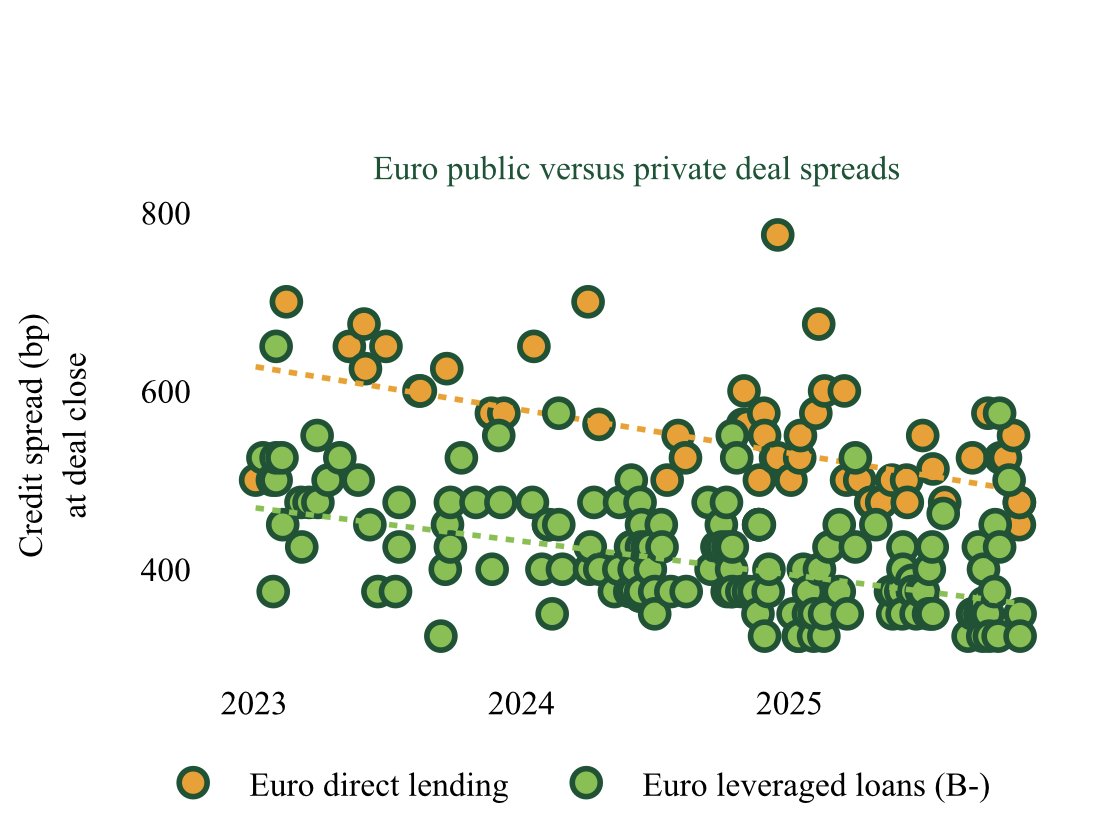
Insight notes that this rising credit risk is a concern for private credit, particularly given that investors have not been compensated for the illiquidity. Credit spreads have narrowed, meaning investors are receiving less extra yield despite bearing illiquidity risk. This chart from the investment highlights what is happening in Europe, and Insight notes that the United States paints a similar picture.
Source: Insight
Public Bonds May Be the Better Option
For many investors, the answer may simply be to stick with public bonds. It turns out the liquidity premium is worth something after all.
The public bond sector is less risky and features higher credit ratings. Today, just 26% of the leveraged loan market is rated BB, down from 48% 15 years ago, while B-rated loans now account for roughly 70% of the market. By contrast, the credit quality of the public high-yield market has continued to improve.
And yet yields on the two asset classes are broadly comparable today, meaning investors no longer need to stretch for top yields.
Moreover, liquid bonds are, by definition, liquid. Public bonds can be bought and sold daily, allowing investors to adjust their portfolios in response to changing market conditions. This flexibility is particularly valuable in uncertain environments, where the ability to reposition quickly can help manage risk—unlike private credit, which locks investors into long-term commitments and redemption gates.
The result: investors get less risky bonds, high yields, and the ability to exit positions at will.
Skip Private Credit
For many investors, private credit no longer makes sense. The illiquidity premium has eroded, investors are not being fairly compensated for the trade-off, and growing credit risks only compound the problem.
Under this scenario, it makes sense to skip these assets and focus on the public debt markets for exposure.
Passive Junk Bond ETFs
These funds were selected based on their exposure to the junk bond sector and yields, and are sorted by YTD total return, which ranges from 6.7% to 6.9%. Expense ratios range from 0.05% to 0.49%, assets under management fall between $3.9 billion and $24 billion, and current yields range from 5.7% to 7.3%.
| Ticker | Name | AUM | YTD Total Ret (%) | Yield | Exp Ratio | Security Type | Actively Managed? |
|---|---|---|---|---|---|---|---|
| USHY | iShares Broad USD High Yield Corporate Bond ETF | $23.8B | 6.9% | 6.9% | 0.08% | ETF | No |
| HYG | iShares iBoxx $ High Yield Corporate Bond ETF | $17.4B | 6.8% | 5.7% | 0.49% | ETF | No |
| JNK | SPDR Bloomberg High Yield Bond ETF | $7.9B | 6.8% | 6.5% | 0.40% | ETF | No |
| HYLB | Xtrackers USD High Yld Corporate Bd ETF | $3.93B | 6.8% | 6.6% | 0.05% | ETF | No |
| SPHY | SPDR Portfolio High Yield Bond ETF | $8.7B | 6.7% | 7.3% | 0.05% | ETF | No |
Active Junk Bond ETFs
These funds were selected for their ability to access high-yield bonds through an active approach, and are sorted by YTD total return, which ranges from 1.3% to 4.7%. Expense ratios range from 0.22% to 1.02%, AUM falls between $50M and $5.63B, and current yields range from 5.7% to 8.6%.
| Ticker | Name | AUM | YTD Total Ret (%) | Yield (%) | Exp Ratio | Security Type | Actively Managed? |
|---|---|---|---|---|---|---|---|
| FLHY | Franklin High Yield Corporate ETF | $268M | 4.7% | 5.7% | 0.40% | ETF | Yes |
| YLD | Principal Active High Yield ETF | $160M | 4.7% | 7.2% | 0.39% | ETF | Yes |
| HYBL | SPDR Blackstone High Income ETF | $136M | 4.4% | 8.2% | 0.70% | ETF | Yes |
| THYF | T. Rowe Price U.S. High Yield ETF | $50M | 4.1% | 7.5% | 0.56% | ETF | Yes |
| SRLN | SPDR Blackstone Senior Loan ETF | $5.63B | 3.8% | 8.6% | 0.70% | ETF | Yes |
| FTSL | First Trust Senior Loan Fund | $2.27B | 3.8% | 7.5% | 0.87% | ETF | Yes |
| BKHY | BNY Mellon High Yield Beta ETF | $292M | 3.4% | 6.9% | 0.22% | ETF | Yes |
| PHYL | PGIM Active High Yield Bond ETF | $124M | 3.4% | 8.2% | 0.39% | ETF | Yes |
| HYFI | AB High Yield ETF | $123M | 3.4% | 6.7% | 0.40% | ETF | Yes |
| HYLS | First Trust Tactical High Yield ETF | $1.43B | 1.3% | 6.4% | 1.02% | ETF | Yes |
Overall, private credit has earned its place in the investment landscape. Its growth reflects real structural changes in how companies access capital and how investors seek income, but that growth has brought increased complexity, risk, and scrutiny.
For many investors, the trade-offs are becoming clearer. Higher yields in private credit come with reduced liquidity, less transparency, and greater uncertainty, while liquid bonds offer attractive income, daily liquidity, and the ability to adapt to changing conditions.
Bottom Line
Private credit may continue to play a role—particularly for institutional investors with long time horizons—but for most portfolios, the case for staying liquid has rarely been stronger.
1 Insight Investment (March 2026). Fixed Income: Popular myths debunked
