

After more than a decade of ultra-low interest rates, rising inflation, and aggressive central bank tightening pushed yields across the bond market significantly higher. While this environment initially created volatility for bond prices, it also reset opportunities across the fixed-income landscape. Today, bonds are once again serving as a source of real income for a portfolio.
Nowhere is this more evident than within the investment-grade (IG) bond space.
IG corporate bonds are once again attracting investor attention for their combination of strong starting yields, high-quality issuers, and relatively stable return profiles. For income-focused investors navigating uncertain markets, these bonds offer a compelling mix of yield, diversification, and capital preservation.
Solid Returns in 2025
It was a good year to be boring—especially in bonds. Bread-and-butter IG bonds performed well relative to their riskier peers. According to asset manager Federated Hermes, the Bloomberg U.S. Credit Index delivered a total return—interest plus price gains—of 7.83% for the year, a strong result given the volatile macroeconomic backdrop of tariff uncertainty, geopolitical tensions, and a prolonged U.S. government shutdown. 1
Looking back, several factors contributed to these returns.
Corporate fundamentals remained strong, as many companies entered the period with healthy balance sheets, manageable debt levels, and solid earnings, sustaining investor confidence in the creditworthiness of investment-grade issuers. This stood in contrast to the fiscal pressures weighing on the Treasury and government debt.
Despite this backdrop, credit spreads—the additional yield investors receive for holding corporate bonds instead of Treasuries—remained relatively stable and wide.
The bond market also entered the year with higher starting yields than investors had seen in more than a decade. The rate-tightening cycle of recent years to combat inflation meant bonds were once again paying meaningful interest.
With these factors in place, investors eagerly accumulated IG bonds throughout the year.
Strong Yields Continue to Anchor Returns Now
After a solid 2025, the new year may bring more of the same. IG bonds are still offering attractive yields amid strong fundamentals and demand.
Just as in 2025, IG bonds are entering 2026 with high yields. Despite recent Federal Reserve rate cuts, yields on IG bonds remain above long-term averages and continue to generate substantial income.
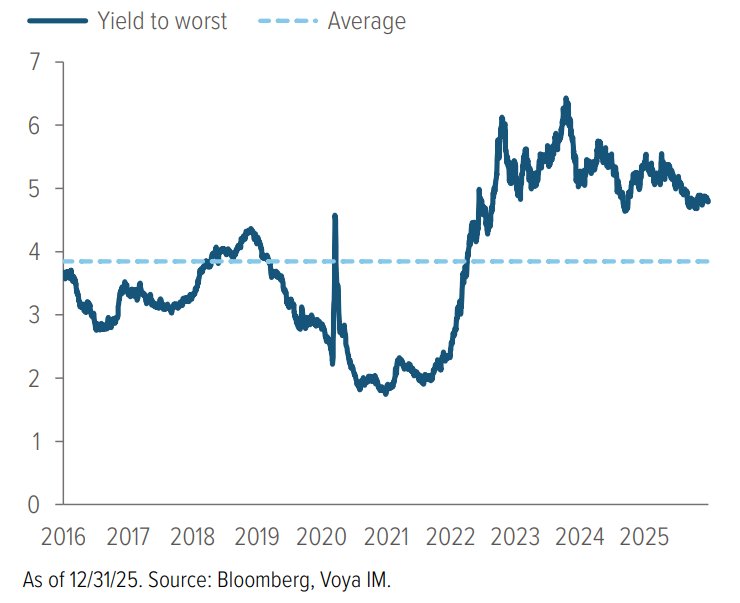
For example, the average yield of the Bloomberg U.S. Corporate Bond Index recently hovered around 5%—near the upper end of its 15-year range and well above its long-term average of roughly 3.6%.
As the chart from asset manager Voya illustrates, IG bonds are still paying meaningful income relative to their historic average.
Source: Voya
This high starting yield provides investors with an attractive rate of return, as coupon income alone—so-called carry—serves as a powerful return engine.
There is also reason to believe IG bond prices will remain steady throughout the year, sustaining a positive carry environment, as demand remains strong. According to Voya, demand for U.S. IG corporate bonds across investor channels—including domestic mutual funds and ETFs, insurance and pension investors, and foreign buyers—reached a robust $350 billion. Both Federated Hermes and Voya expect demand to stay robust as investors favor the improving credit quality of IG bonds over high yield, particularly compared to Treasury bonds amid rising fiscal concerns.
Since 2015, the Bloomberg U.S. Credit Index has grown by about 50%, yet its average credit quality has held steady at an A rating. That stability reflects a decline in the share of lower-rated BBB debt, which has lifted the overall credit profile of the index.
Combined with higher yields, this credit quality is compelling to many investors. Excess demand from new issuance should therefore be absorbed by the market, creating a strong environment to collect coupons and enjoy moderate capital appreciation—an outcome with broad appeal for conservative and income-seeking portfolios.
Attractive Yield-Focused Returns
With yields elevated and corporate fundamentals solid, IG bonds currently offer a compelling balance between risk and reward, making them an appealing alternative to both low-yielding government bonds and higher-risk credit sectors. Adding a core allocation of IG bonds to a portfolio makes considerable sense, as anchoring a portfolio here and collecting a strong yield can go a long way toward generating attractive risk-adjusted returns.
Investors have many ways to do just that.
Many IG corporate bonds have robust secondary markets, and any good brokerage firm should allow investors to buy bonds from blue chips like Microsoft. However, with over $8.5 trillion worth of bonds in the Bloomberg U.S. Credit Index, they may not achieve the level of diversification they want or need.
ETFs—both active and passive—have sliced the IG bond market in a variety of ways, with numerous funds covering all duration levels from a range of issuers. By using ETFs, investors can gain diversification and yield at a low cost.
Investment-Grade Corporate Bond ETFs
These funds were selected based on their low-cost exposure to investment-grade bonds, with expense ratios ranging from 0.03% to 0.44% and yields from 4.4% to 5.9%. Assets under management range from $390M to $31B. They are sorted by their YTD total return, which ranges from -2.2% to 1.3%.
| Ticker | Name | AUM | YTD Total Ret (%) | Yield (%) | Exp Ratio | Security Type | Actively Managed? |
|---|---|---|---|---|---|---|---|
| IGSB | iShares 1-5 Year investment-grade Corporate Bond ETF | $21.7B | 1.3% | 4.4% | 0.04% | ETF | No |
| USIG | iShares Broad USD investment-grade Corporate Bond ETF | $17B | 1.1% | 4.7% | 0.04% | ETF | No |
| SCHI | Schwab 5-10 Year Corporate Bond ETF | $10.8B | 1% | 4.9% | 0.03% | ETF | No |
| IGIB | iShares 5-10 Year investment-grade Corporate Bond ETF | $15.3B | 0.8% | 4.6% | 0.04% | ETF | No |
| CORP | PIMCO investment-grade Corporate Bond Index ETF | $1.33B | 0.7% | 5.2% | 0.36% | ETF | Yes |
| FSIG | First Trust Limited Duration investment-grade Corporate ETF | $1.5B | 0.4% | 4.6% | 0.44% | ETF | Yes |
| KORP | American Century Diversified Corporate Bond ETF | $393M | 0.2% | 5.0% | 0.29% | ETF | Yes |
| SPBO | SPDR Portfolio Corporate Bond ETF | $1.83B | -0.1% | 5.2% | 0.03% | ETF | No |
| LQD | iShares iBoxx $ investment-grade Corporate Bond ETF | $30.4B | -0.3% | 4.7% | 0.14% | ETF | No |
| VCLT | Vanguard Long-Term Corporate Bond ETF | $15.5B | -2.2% | 5.9% | 0.03% | ETF | No |
Investment-Grade Bond ETFs
These ETFs were selected based on their low-cost exposure to core bonds, Treasuries, investment-grade corporate bonds, and mortgage-backed securities. Sorted by YTD total return, they range from -0.5% to 0.6%, with expense ratios between 0.03% and 0.36%, assets under management between $55M and $314B, and current yields between 3.6% and 4.8%.
| Ticker | Name | AUM | YTD Total Ret (%) | Yield (%) | Exp Ratio | Security Type | Actively Managed? |
|---|---|---|---|---|---|---|---|
| VCRB | Vanguard Core Bond ETF | $110M | 0.6% | 3.8% | 0.10% | ETF | No |
| HCRB | Hartford Core Bond ETF | $223M | 0.3% | 4.3% | 0.29% | ETF | Yes |
| BND | Vanguard Total Bond Market Index Fund | $314B | 0.2% | 3.6% | 0.03% | ETF | No |
| FIGB | Fidelity investment-grade Bond ETF | $55.4M | 0.1% | 4.2% | 0.36% | ETF | Yes |
| IUSB | iShares Core Total USD Bond Market ETF | $27.9B | 0% | 3.9% | 0.06% | ETF | No |
| AVIG | Avantis Core fixed-income ETF | $691M | -0.3% | 4.8% | 0.15% | ETF | Yes |
| AGG | iShares Core U.S. Aggregate Bond ETF | $105B | -0.4% | 3.7% | 0.03% | ETF | No |
| SPAB | SPDR® Portfolio Aggregate Bond ETF | $7.65B | -0.4% | 3.9% | 0.03% | ETF | No |
| GBF | iShares Government/Credit Bond ETF | $330M | -0.5% | 3.8% | 0.20% | ETF | No |
After years of ultra-low yields, IG bonds once again offer investors meaningful income and attractive total return potential. Strong 2025 performance demonstrated how elevated yields can drive returns even in uncertain economic environments.
With yields still near the high end of their historical range and corporate fundamentals remaining solid, IG credit remains a compelling opportunity for income-focused investors.
Bottom Line
For investors seeking a balance of income, stability, and diversification, IG bonds remain one of the most attractive options in today’s fixed-income landscape.
1 Federated Hermes (January 2026). Investment-grade bonds get green light from investors
