

Fixed-income markets are challenging, to say the least. On one hand, yields across traditional bonds—Treasuries, investment-grade credit, and even high yield—are meaningfully higher than they were just a few years ago. On the other hand, uncertainty remains elevated. Inflation is still uneven, interest rates are volatile, and credit risks are growing more nuanced as economic growth slows. It’s a tough environment even for the most seasoned bond investor.
However, it doesn’t have to be.
In this environment, one segment of the market has quietly emerged as a standout: senior and AAA-rated collateralized loan obligation (CLO) tranches. These securities offer a rare combination of strong income, structural protection, and resilience across market cycles, making them increasingly attractive to both institutional and retail investors.
What Are CLOs?
To understand the appeal of senior CLO tranches, it’s important to first understand what a CLO is.
A CLO is a type of securitized bond backed by a pool of corporate loans—typically senior secured loans made to companies. These loans generate interest and principal payments, which are then passed through to investors.
CLOs are not simple pools, however. They are structured into layers, or “tranches,” each carrying different levels of risk and return, ranging from the safest (AAA-rated) at the top to the riskiest (equity) at the bottom.
The key feature of this structure is the cash flow waterfall, which distributes payments from the underlying loans in order of priority, starting with the most senior tranches and working downward.
This structure creates powerful protection for senior investors.
Senior and AAA CLO Tranches Stand Out
Among all parts of the CLO capital structure, senior and AAA tranches are widely viewed as the most attractive—and for good reason.
For starters, the tranche structure itself transforms risk profiles.
CLOs are backed by below-investment-grade loans, but because losses must first pass through multiple layers of subordinate tranches, the senior-most debt is effectively insulated from most credit events. This is why senior CLO tranches benefit from meaningful protection against loan market losses.
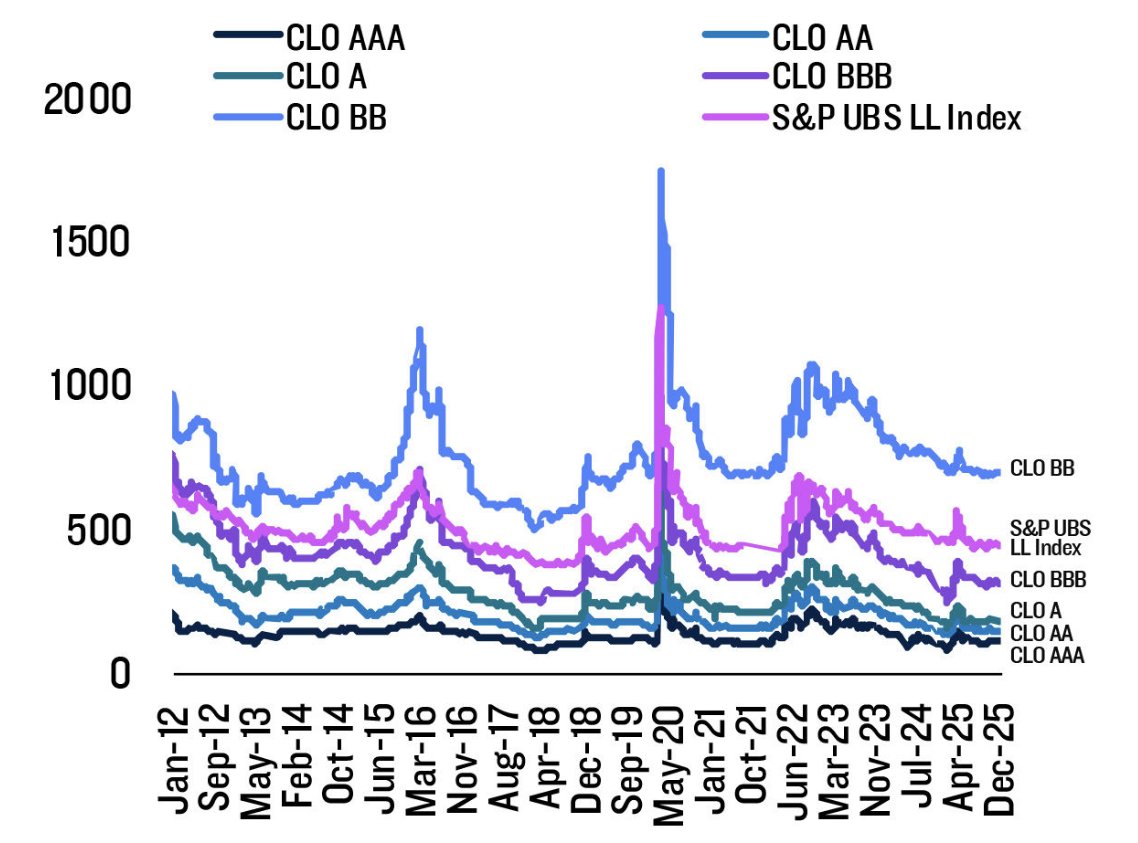
Even during periods of market stress—such as recent volatility tied to geopolitical concerns—AAA CLOs have proven particularly resilient, often outperforming lower-rated tranches.
This chart from PGIM highlights the low spread volatility of senior tranches versus lower-rated ones. PGIM notes that even when tariff concerns hit in April, AAA CLOs proved most resilient and outperformed lower-rated tranches.
Source: Prudential Investment
That steadfastness comes with a high yield. While spreads have remained steady, they remain wide compared to government and investment-grade corporate bonds. Today, senior and AAA CLOs are yielding around 5%—better than similarly rated bonds.
An added benefit is that senior CLOs carry minimal duration risk, with an average duration of less than 90 days. Because their coupons are tied to the Secured Overnight Financing Rate (SOFR)—or previously LIBOR—they are considered floating rate, offering interest rate protection as coupons rise alongside rates. This reduces interest rate sensitivity relative to fixed-rate debt. According to PGIM, this floating-rate nature makes these assets well-suited to today’s mixed interest rate environment and adds appeal within bond portfolios.
One lingering concern around structured credit has been liquidity, but that perception has shifted.
Senior CLO tranches now benefit from growing trading volumes and improving market depth, making them more liquid than many investors expect. Even during periods of market stress, they have maintained relatively stable trading conditions compared to other credit assets.
This combination of liquidity and resilience has helped position senior CLOs as a unique segment within fixed-income.
Time To Access Senior CLOs
Given the benefits of senior CLOs in today’s market environment, investors should consider the asset class. High yields, low volatility, and a top-notch credit profile make it worth purchasing.
Retail investors now have access to CLOs, which were once primarily the domain of institutional investors but are increasingly accessible through new active and passive ETFs tracking the sector. Many of these ETFs focus specifically on AAA-rated tranches, maintaining high credit quality while delivering consistent income.
CLO ETFs
These ETFs were selected for their ability to provide exposure to the CLO market and are sorted by one-year total return, ranging from 6.9% to 10.2%. They carry expense ratios of 0.19% to 0.50%, assets under management of $240 million to $16 billion, and current yields of 5.2% to 8.1%.
| Ticker | Name | AUM | 1-year Total Ret (%) | Yield (%) | Exp Ratio | Security Type | Actively Managed? |
|---|---|---|---|---|---|---|---|
| JBBB | Janus Henderson B-BBB CLO ETF | $1.35B | 10.2% | 8.1% | 0.50% | ETF | Yes |
| CLOI | VanEck CLO ETF | $749M | 8.1% | 6.3% | 0.40% | ETF | Yes |
| JAAA | Janus Henderson AAA CLO ETF | $15.6B | 7.3% | 6% | 0.22% | ETF | Yes |
| PAAA | PGIM AAA CLO ETF | $1.39B | 7.3% | 5.2% | 0.19% | ETF | Yes |
| CLOA | iShares AAA CLO Active ETF | $244M | 6.9% | 5.7% | 0.20% | ETF | Yes |
In today’s mixed fixed-income environment, investors are searching for assets that deliver income without excessive risk. Senior and AAA CLO tranches stand out as one of the few segments that can offer both.
With strong structural protections, floating-rate benefits, attractive yields, and demonstrated resilience across cycles, they represent a compelling opportunity within modern portfolios.
Bottom Line
As the fixed-income landscape evolves, one thing is becoming clear: CLOs—particularly at the senior end of the capital structure—are no longer a niche allocation. They are becoming a core consideration for income-focused investors.
