

They don’t call them junk bonds for nothing. Lending to the riskiest borrowers isn’t easy money, and rising defaults in high-yield bonds and private credit now reappear, reviving memories of past credit cycles and prompting questions about stress building beneath the surface. High-profile restructurings, private credit write-downs, and selective bankruptcies fuel concerns that credit markets may enter a more dangerous phase. For investors, these developments may feel unsettling—particularly after years of unusually low defaults.
Yet context matters.
While defaults rise, the broader health of high-yield and private credit markets remains relatively stable, with key indicators showing no full-blown credit crisis. For disciplined investors, today’s environment may still offer opportunity rather than reason to retreat.
Defaults Are Rising
Data doesn’t lie. Defaults have increased from unusually benign recent levels. According to Standard and Poor’s, the trailing 12-month default rate for speculative-grade debt reached 4.8% as of August 2025. Moody’s data illustrates a similar picture: through September 2025, the trailing 12-month issuer-weighted U.S. leveraged loan default rate was 5.9%. 1
Those default rates have risen significantly from lows in late 2020 through early 2023.
As higher interest rates filter through corporate balance sheets, weaker borrowers—especially those with aggressive capital structures—feel the strain. Rising financing costs, slower revenue growth, and tighter lending standards expose vulnerabilities masked by years of cheap capital.
Several well-publicized cases have drawn attention. First Brands Group’s bankruptcy highlighted how leveraged companies with limited flexibility struggle when refinancing costs rise. Similarly, Tricolor, a subprime auto lender in private credit channels, underscored risks in niche segments with looser underwriting and borrowers sensitive to economic shifts.
Beyond individual issuers, banks, such as regional Zions Bancorp and Western Alliance, plus some business development companies (BDCs), report write-downs on private credit and loan exposures.
Context Matters
Investors have reason to feel nervous. Neuberger Berman analysts note that corporate bond market stress often signals trouble for broader risk assets: early 2000 before the dotcom crash, 2007 before the Global Financial Crisis, 2015-2016 energy crash, and the recent 2021-2022 inflation shock.
Rising defaults do not mean the entire high-yield or private credit ecosystem deteriorates. Instead, they signal a return to normal credit differentiation, where weaker borrowers fail, and stronger ones adapt.
Credit spreads remain tight by historical standards. They represent the additional yield investors demand to hold riskier debt over safer alternatives. Wide spreads signal market stress and elevated default expectations. High-yield spreads have widened modestly from lows but stay far from distress levels. Investors thus view default risk as contained, not systemic.
This Charles Schwab chart illustrates how low credit spreads remain compared to other “bad” moments in recent history.
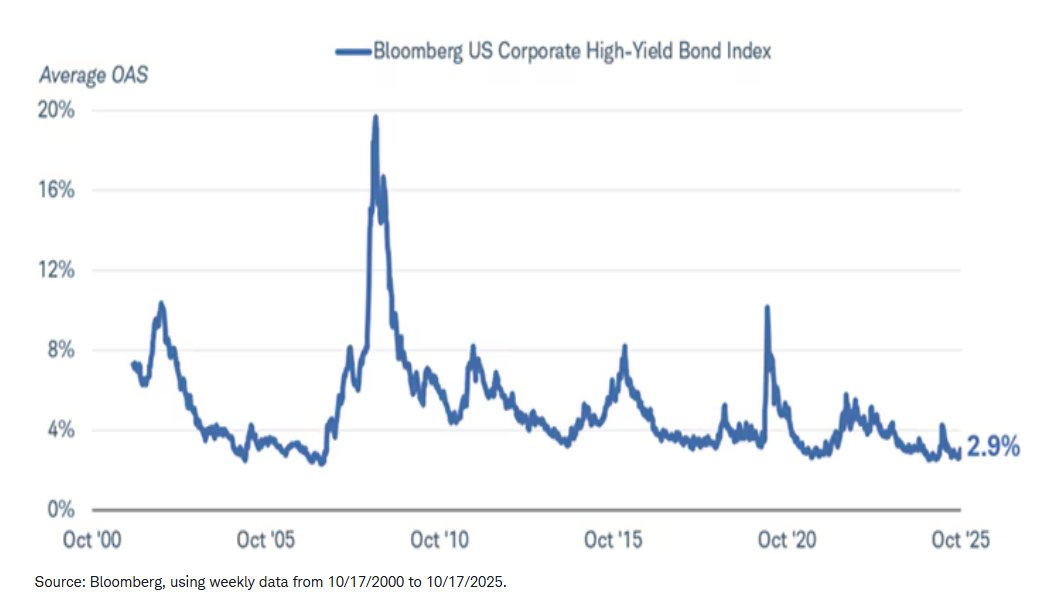
Source: Charles Schwab
The balance sheet health of many high-yield issuers remains solid. Although leverage has risen in some areas, many companies entered this cycle with extended maturities and ample liquidity. A large amount of debt was refinanced at favorable, low interest rates, successfully extending the maturity dates for several years into the future. This extension reduces near-term refinancing pressure and gives companies time to adjust operations, cut costs, or grow earnings. High-yield issuers’ debt-to-earnings ratio now sits lower than from 2015 through 2019, meaning more profit covers debts than in the previous decade.
Economic conditions have not collapsed. Defaults spike during recessions with sharp revenue and cash flow drops. Data confirms this: every significant credit default cycle in the last 30 years coincided with a recession or industry shock. Though growth has slowed, most economies expand, employment stays relatively strong, and corporate earnings have proven resilient. Analysts now predict 2% GDP growth this year and next, in line with historical norms.
Many private credit and high-yield bond write-downs are not true defaults. Recent markdowns often reflect valuation adjustments with higher discount rates and conservative assumptions. Distressed exchanges comprised 45%, 54%, and 52% of defaults in 2023, 2024, and 2025. In a distressed exchange, a struggling issuer renegotiates debt with lenders. Though a technical default for ratings, it differs from bankruptcy and typically involves maturity extensions, debt-for-equity swaps, covenant restructurings, and other items.
These factors show that private credit and high-yield markets continue humming along, with current defaults mainly from bad actors. Forensic analysis of First Brands illustrates it used the same receivables as collateral for multiple loans through its factoring arrangements. While defaults trouble us, we haven’t reached panic yet.
Investors May Want to Add High Yield Today
High-yield bonds still serve portfolios well as income assets with attractive risk-adjusted returns. Elevated yields offer a margin of safety, and modest default rates absorb through income over time.
For investors, the key is to interpret rising defaults correctly rather than ignore them. High-yield bonds continue to show market-wide resilience, with default rates near long-term averages rather than crisis levels. Private credit strategies focus on senior secured lending, which offers higher recovery potential in downside scenarios.
Investors should focus on diversified exposure rather than concentrated bets to reduce reliance on single issuers or sectors. Active management proves beneficial in this cycle phase, as skilled managers avoid deteriorating credits, emphasize issuers with strong balance sheets, and adjust exposure as conditions evolve. For investors using funds or ETFs, it mitigates downside risk while maintaining income.
Passive Junk Bond ETFs
These funds provide junk bond exposure and yields, sorted by 1-year total return from 6.7% to 6.9%. Expense ratios range from 0.05% to 0.49%, AUM from $3.9 billion to $24 billion. Current yields range from 5.7% to 7.3%.
| Ticker | Name | AUM | 1-year Total Ret (%) | Yield | Exp Ratio | Security Type | Actively Managed? |
|---|---|---|---|---|---|---|---|
| USHY | iShares Broad USD High Yield Corporate Bond ETF | $23.8B | 6.9% | 6.9% | 0.08% | ETF | No |
| HYG | iShares iBoxx $ High Yield Corporate Bond ETF | $17.4B | 6.8% | 5.7% | 0.49% | ETF | No |
| JNK | SPDR Bloomberg High Yield Bond ETF | $7.9B | 6.8% | 6.5% | 0.40% | ETF | No |
| HYLB | Xtrackers USD High Yld Corporate Bd ETF | $3.93B | 6.8% | 6.6% | 0.05% | ETF | No |
| SPHY | SPDR Portfolio High Yield Bond ETF | $8.7B | 6.7% | 7.3% | 0.05% | ETF | No |
Active Junk Bond ETFs
These actively managed funds provide high-yield bond exposure, sorted by 1-year total return from 1.3% to 4.7%. Expense ratios range from 0.22% to 1.02%, AUM from $50M to $5.63B. Current yields range from 5.7% to 8.6%.
| Ticker | Name | AUM | 1-year Total Ret (%) | Yield (%) | Exp Ratio | Security Type | Actively Managed? |
|---|---|---|---|---|---|---|---|
| FLHY | Franklin High Yield Corporate ETF | $268M | 4.7% | 5.7% | 0.40% | ETF | Yes |
| YLD | Principal Active High Yield ETF | $160M | 4.7% | 7.2% | 0.39% | ETF | Yes |
| HYBL | SPDR Blackstone High Income ETF | $136M | 4.4% | 8.2% | 0.70% | ETF | Yes |
| THYF | T. Rowe Price U.S. High Yield ETF | $50M | 4.1% | 7.5% | 0.56% | ETF | Yes |
| SRLN | SPDR Blackstone Senior Loan ETF | $5.63B | 3.8% | 8.6% | 0.70% | ETF | Yes |
| FTSL | First Trust Senior Loan Fund | $2.27B | 3.8% | 7.5% | 0.87% | ETF | Yes |
| BKHY | BNY Mellon High Yield Beta ETF | $292M | 3.4% | 6.9% | 0.22% | ETF | Yes |
| PHYL | PGIM Active High Yield Bond ETF | $124M | 3.4% | 8.2% | 0.39% | ETF | Yes |
| HYFI | AB High Yield ETF | $123M | 3.4% | 6.7% | 0.40% | ETF | Yes |
| HYLS | First Trust Tactical High Yield ETF | $1.43B | 1.3% | 6.4% | 1.02% | ETF | Yes |
Rising defaults in high yield and private credit deserve attention, but they do not signal systemic credit breakdown yet. Stress concentrates in weaker borrowers and aggressive structures, while broader market indicators—credit spreads, balance sheet health, and economic conditions—remain supportive. Today’s defaults reflect normalization after years of easy money rather than the start of a crisis. Investors who stay disciplined and selective may find compelling income and opportunity in high-yield bonds, even as the credit cycle matures.
Bottom Line
Investors rightly worry about rising defaults in high-yield and private credit markets. Yet structurally, these sectors remain sound, with issues limited to a few bad actors. High-yield bonds still offer substantial income and diversification for portfolios. Selectivity is key.
1 Charles Schwab (October 2025). High-Yield Defaults: Canary in the Coal Mine?
