

For years, global investors often dismissed European fixed-income. Ultra-low or negative interest rates, sluggish growth, and limited yields made euro-denominated bonds less attractive compared to U.S. alternatives. However, the landscape has undergone significant changes.
Today, European bonds offer meaningful income, improving macro fundamentals, and diversification potential amid uncertain global markets.
As we enter the new year, European fixed-income deserves renewed attention. Higher starting yields, a shifting rate environment in the eurozone, and signs of stabilizing economic growth create a compelling case. For investors looking beyond domestic markets, European bonds offer attractive total return potential and portfolio balance ahead.
The Evolving Rate Environment in Europe
Whipsaw best describes Europe’s bond market over the last five years. The Great Recession and Global Financial Crisis brought zero and negative rates in Europe. Like the U.S., the pandemic spurred inflation, with Europe being the first to feel those effects.
After years of accommodative policy, the European Central Bank (ECB) tightened rates aggressively to combat inflation. That cycle pushed yields sharply higher across government and corporate bonds, restoring long-absent income potential.
Now, the policy environment enters a new phase.
With inflation pressures moderating from peaks, the ECB and other sovereign banks now signal a more balanced policy approach, including rate cuts at the start of 2025. The ECB has cut rates eight times so far, pushing benchmark rates to 2%.
Improving Economic Fundamentals Across the Region
This quick rate policy shift dramatically boosts the region’s economic potential and bond market.
Europe’s macroeconomic backdrop appears more constructive than a year ago. Growth remains uneven across member states, but indicators signal gradual improvement: recovering consumer sentiment as inflation eases, stabilized industrial activity in key economies, and significantly declined energy price volatility.
Germany, France, Italy, and Spain have faced different challenges, yet the broader eurozone economy shows resilience. Labor markets remain relatively stable and support domestic consumption. Structural investments in renewable energy, digital infrastructure, defense, and industrial modernization now filter into economic activity. As a result, the eurozone should increase GDP by 1.4% in 2026 and 1.6% in 2027—with some nations faring much better. Overall, this improving growth bolsters corporate earnings stability and credit fundamentals. 1
Stronger growth brings hefty income potential for investors.
The key lies in the quick rate changes and high starting yields of many European bonds. In past easing cycles, low yields left investors with limited income to offset volatility. Today, investors can lock in globally competitive yields, especially in high-quality corporate and peripheral sovereign markets. Even with modest rate declines, the income cushion in today’s bonds provides meaningful return support.
Another factor supports European bonds: the declining greenback. This Morningstar chart illustrates the USD’s recent 9% drop against a basket of currencies.
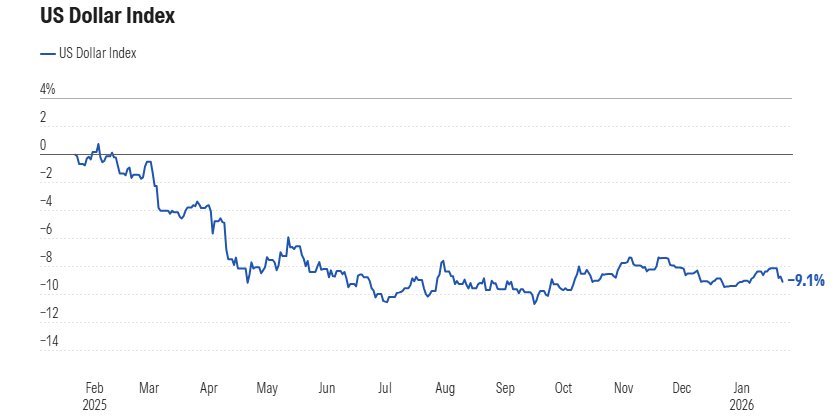
Source: Morningstar
That drop represents a huge win for European bonds. As the USD declines, it boosts the dollar value of foreign income payments and principal. A weakening dollar makes foreign currencies appreciate, yielding higher returns for U.S. investors in non-US local-currency fixed income. Essentially, currency changes deliver more income from the same interest payments and yields.
The win stems from expectations that the U.S. dollar will keep falling and stay low relative to other currencies amid ongoing U.S. fiscal uncertainty. This makes global bonds especially attractive and could drive additional capital gains as investors eye higher income potential.
How Investors Can Use European Bonds in Their Portfolios
European bonds can boost a portfolio’s yield and total returns, so investors should consider adding the region’s IOUs. They also provide great diversification and reduce concentration risk in portfolios heavy in U.S. Treasuries or domestic credit. If policy paths diverge or growth differs, European exposure adds stability—which bonds should deliver.
Pure exposure remains the tricky part.
Many top brokerages let investors buy ECB and Eurobonds directly; for example, German Bunds trade frequently. Building a full portfolio requires substantial capital, however. Funds and ETFs offer a better option. No dedicated European bond ETFs exist anymore—just broader international bond funds, which suit most investors well.
Investors seeking higher income can allocate selectively to European high-yield strategies through actively managed vehicles that emphasize credit research and risk control. Active management proves valuable in credit markets, where issuer dispersion creates security selection opportunities.
International Bond ETFs
These ETFs tap various international and global bond sectors at low cost. We sorted them by one-year total return, ranging from 2.2% to 9.4%. Expense ratios span 0.05% to 0.50%, with AUM from $31M to $86B. They currently yield 1.4% to 7.3%.
| Ticker | Name | AUM | 1-Year Total Ret (%) | Yield (%) | Exp Ratio | Security Type | Actively Managed? |
|---|---|---|---|---|---|---|---|
| PGHY | Invesco Global ex-U.S. High Yield Corporate Bond ETF | $134M | 9.4% | 7.35% | 0.35% | ETF | No |
| HYXU | iShares Global ex USD High Yield Corporate Bond ETF | $50M | 7.5% | 3.49% | 0.40% | ETF | No |
| GHYG | iShares U.S. and Intl High Yield Corp Bond ETF | $131M | 7.1% | 6.5% | 0.40% | ETF | No |
| BNDX | Vanguard Total International Bond ETF | $85.7B | 5% | 2.1% | 0.07% | ETF | No |
| IHY | VanEck International High Yield Bond ETF | $31M | 5% | 5.42% | 0.4% | ETF | No |
| IBND | SPDR® Bloomberg International Corporate Bond ETF | $168M | 4.3% | 2.3% | 0.50% | ETF | No |
| BWZ | SPDR® Bloomberg Short Term International Treasury Bond ETF | $131M | 4.2% | 2.2% | 0.35% | ETF | No |
| IGOV | iShares International Treasury Bond ETF | $470M | 2.5% | 1.40% | 0.35% | ETF | No |
| ISHG | iShares 1-3 Year International Treasury Bond ETF | $77M | 4.2% | 2.5% | 0.35% | ETF | No |
| IBND | SPDR Bloomberg International Corporate Bond ETF | $235M | 3.5% | 2.7% | 0.50% | ETF | No |
| BNDW | Vanguard Total World Bond ETF | $670M | 3.2% | 2.8% | 0.05% | ETF | No |
| BWX | SPDR® Bloomberg International Treasury Bond ETF | $970M | 2.2% | 1.9% | 0.35% | ETF | No |
Investors willing to broaden their geographic perspective will find that European bonds offer income, diversification, and balanced total returns in an uncertain global environment. Though risks persist, the region’s improving fundamentals position European fixed-income as a key part of globally diversified portfolios.
Bottom Line
European fixed-income has transformed quietly from a yield desert into an opportunity-rich landscape. Higher starting yields, stabilizing rates, improving economics, and competitive income in sovereign and corporate markets make a strong case for renewed attention next year.
1 Franklin Templeton (January 2026). European fixed income outlook—cautious optimism
