

For decades, “junk bonds” have carried a stigma. The term evokes highly leveraged companies, fragile balance sheets, and elevated default risk—investments for aggressive yield seekers who tolerate significant volatility. Historically, that perception was not entirely misplaced. Earlier high-yield market eras featured deeply indebted issuers, cyclical businesses, and companies with limited access to capital. Defaults spiked quickly as economic conditions deteriorated, reinforcing junk bonds’ speculative image.
Markets evolve—that is their beauty.
Over the past decade, high-yield credit quality has steadily improved, reshaping investor expectations for the asset class. Structural shifts in financing, healthier corporate balance sheets, declining interest-rate sensitivity, and higher-quality “fallen angel” issuers have driven this transformation. Today’s high-yield market differs materially from its junk-labeled past and increasingly resembles a core fixed-income segment rather than a purely opportunistic trade.
A Quiet Upgrade in Credit Quality
One of the most important developments in high-yield and junk bonds has been the migration toward higher average credit ratings. Ever since the launch of the modern junk bond market, high-yield bonds have represented bonds issued by non-investment-grade borrowers or those with credit ratings below BB+ from Standard and Poor’s and Fitch, or Ba1 or below from Moody’s. However, the band of credit ratings below this investment-grade threshold is wide and covers a varied range of actual default risk.
Today, more junk bonds cluster at the top of the spectrum.
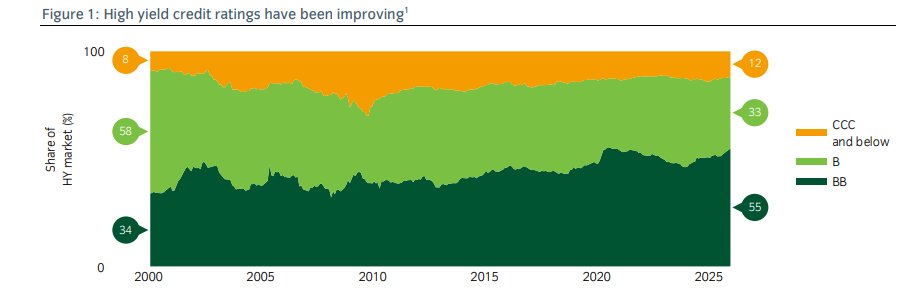
The share of BB-rated bonds—the highest tier within the high-yield spectrum—has risen meaningfully over time, while the proportion of deeply distressed CCC-rated debt has generally declined outside of recessionary spikes. According to data provided by BNY Mellon’s Insight Investment subsidiary, the share of top-tier non-investment-grade bonds has grown from 34% of the broader high-yield bond universe to 55%. The lowest-rated debt now makes up just 12% of the index. 1
This Insight Investment chart highlights the shifting mix of higher-quality junk bonds.
Source: Insight
Why Is the Junk Market Getting Stronger?
For fixed-income investors and junk bond market participants, this shift is certainly interesting. The question is why the high-yield market has gotten better, and several factors could explain the shift.
For one thing, the rise of private credit could be a significant factor. Highly leveraged buyouts and riskier corporate borrowers—once common in public high-yield markets—are increasingly financed through private lending channels instead. Private credit funds often specialize in bespoke financing for leveraged transactions, middle-market companies, or issuers that may not meet the disclosure, scale, or liquidity requirements of public bond markets. As these borrowers migrate away from public high yield, the remaining bond universe becomes naturally higher quality.
In effect, private credit acts as a risk filter that siphons off the most leveraged deals and leaves behind issuers with stronger balance sheets and broader capital-market access.
Additionally, corporate fundamentals have improved in the years after the Great Recession and the COVID-19 pandemic. Many high-yield issuers entered the current cycle after years of cheap refinancing, extended maturities, and stronger liquidity buffers. Even with higher borrowing costs today, near-term default pressure has remained contained because companies pushed significant maturities further into the future.
At the same time, profitability across many sectors has held up better than feared, supporting interest-coverage ratios and cash-flow stability. This doesn’t eliminate default risk—high yield will always carry cyclical sensitivity—but it does mean the starting point is healthier than in many past downturns.
The pandemic and post-COVID years have also spurred the rise of more fallen angel bonds in the high-yield space. Fallen angels are securities downgraded from investment-grade to high yield. Since the pandemic, the number of these firms that have migrated down into junk status has increased. More than 80% of the fallen angels market currently has a BB rating, the top level of junk. This has improved the overall credit rating of the junk bond market in a meaningful way.
From Tactical Trade to Core Allocation
For portfolios, this shift of the overall junk bond market is significant. Historically, BB issuers have exhibited lower default rates and stronger recovery values than lower-rated peers. However, this creates a positive paradox for investors: yields in the junk bond space remain high, reflecting the asset class’s historical reputation for risk and liquidity characteristics, and yet actual credit risk has moderated, driven by structural improvements in issuer quality.
That combination of high income with improving fundamentals is one reason institutional allocations to high-yield securities have become more stable over time. As the composition of the market tilts toward these higher-quality borrowers, the overall risk profile of the high-yield market improves. Investors are effectively earning elevated yields from a pool of issuers that, on average, are financially stronger than in prior cycles.
For BNY’s Insight, this means that junk isn’t junky anymore and actually deserves a core allocation in a bond portfolio rather than a satellite position for the riskiest investors.
The surge in ETFs—both passive and active—now offers more ways than ever to add high yield to portfolios.
Passive Junk Bond ETFs
These funds were selected based on their exposure to the junk bond sector and yields. They are sorted by their YTD total return, which ranges from 2.7% to 6.9%. They have expenses ranging from 0.05% to 0.49% and assets under management between $1.7 billion and $24 billion. They are currently yielding between 5.7% and 7.3%.
| Ticker | Name | AUM | YTD Total Ret (%) | Yield | Exp Ratio | Security Type | Actively Managed? |
|---|---|---|---|---|---|---|---|
| USHY | iShares Broad USD High Yield Corporate Bond ETF | $23.8B | 6.9% | 6.9% | 0.08% | ETF | No |
| HYG | iShares iBoxx $ High Yield Corporate Bond ETF | $17.4B | 6.8% | 5.7% | 0.49% | ETF | No |
| JNK | SPDR Bloomberg High Yield Bond ETF | $7.9B | 6.8% | 6.5% | 0.40% | ETF | No |
| HYLB | Xtrackers USD High Yld Corporate Bd ETF | $3.93B | 6.8% | 6.6% | 0.05% | ETF | No |
| SPHY | SPDR Portfolio High Yield Bond ETF | $8.7B | 6.7% | 7.3% | 0.05% | ETF | No |
| FALN | iShares Fallen Angels USD Bond ETF | $1.7B | 2.7% | 6% | 0.25% | ETF | No |
Active Junk Bond ETFs
These funds are selected based on their ability to access high-yield bonds with an active touch. They are sorted by their YTD total return, which ranges from 0.9% to 4.7%. Their expense ratio ranges from 0.22% to 1.05%, while they have AUMs between $123M and $5.63B. They are currently yielding between 5.7% and 8.6%.
| Ticker | Name | AUM | YTD Total Ret (%) | Yield (%) | Exp Ratio | Security Type | Actively Managed? |
|---|---|---|---|---|---|---|---|
| FLHY | Franklin High Yield Corporate ETF | $268M | 4.7% | 5.7% | 0.40% | ETF | Yes |
| YLD | Principal Active High Yield ETF | $160M | 4.7% | 7.2% | 0.39% | ETF | Yes |
| HYBL | SPDR Blackstone High Income ETF | $136M | 4.4% | 8.2% | 0.70% | ETF | Yes |
| THYF | T. Rowe Price U.S. High Yield ETF | $50M | 4.1% | 7.5% | 0.56% | ETF | Yes |
| SRLN | SPDR Blackstone Senior Loan ETF | $5.63B | 3.8% | 8.6% | 0.70% | ETF | Yes |
| FTSL | First Trust Senior Loan Fund | $2.27B | 3.8% | 7.5% | 0.87% | ETF | Yes |
| BKHY | BNY Mellon High Yield Beta ETF | $292M | 3.4% | 6.9% | 0.22% | ETF | Yes |
| PHYL | PGIM Active High Yield Bond ETF | $124M | 3.4% | 8.2% | 0.39% | ETF | Yes |
| HYFI | AB High Yield ETF | $123M | 3.4% | 6.7% | 0.40% | ETF | Yes |
| HYLS | First Trust Tactical High Yield ETF | $1.43B | 1.3% | 6.4% | 1.05% | ETF | Yes |
| PHB | Invesco Fundamental High Yield Corp Bd ETF | $378M | 0.9% | 6.2% | 0.50% | ETF | Yes |
The transformation of the high-yield bond market ranks among modern investing’s most important—and underappreciated—developments. Once viewed primarily as a risky fixed-income corner, it has evolved into a higher-quality, income-rich, and structurally resilient bond universe segment.
Private credit absorbs the weakest borrowers while duration risk nears historic lows, balance sheets strengthen, and fallen angels elevate credit quality. Together, these forces challenge the outdated notion that high yield equals excessive risk.
Bottom Line
For investors seeking durable income, diversification, and improved risk-adjusted returns, high yield looks less like “junk” and more like a core portfolio building block—especially when accessed through diversified ETFs that balance opportunity with discipline.
1 BNY Insight Investment (January 2026). Systematic Insights: Is high yield less risky than ever?
