

For much of the past decade, fixed-income investors faced a frustrating reality. Interest rates hovered near historic lows, yields were compressed, and bonds offered limited income and return potential. In that environment, many investors were pushed further out on the risk spectrum, allocating more heavily to equities and alternative assets in search of returns.
That landscape has now changed—dramatically.
The rapid rise in interest rates over the past few years, combined with a gradual moderation in inflation, has reset the foundation of the bond market. What was once a low-yield, low-return asset class now offers compelling income and the potential for meaningful total returns. For investors who had largely written off bonds, the asset class is once again becoming central to portfolio construction.
A More Balanced Bond Backdrop
For fixed-income investors, these could be a return to the halcyon days. After years of subpar and even negative real returns, bonds are truly back. Today’s market is defined by a more balanced set of economic forces. Inflation, while still present, has moved off its peak and is trending toward more sustainable ranges, while economic growth has remained resilient, avoiding the sharp downturn many feared during the tightening cycle.
This combination—moderating inflation alongside steady growth—has created a more stable macro backdrop for fixed-income.
This major transformation in the bond market can be traced back to the aggressive tightening cycle undertaken by the Federal Reserve.
In response to inflation levels not seen since the 1980s, the Fed raised interest rates at one of the fastest paces in decades, moving policy rates from near zero to levels not seen since before the Global Financial Crisis. This rapid adjustment pushed yields higher across the entire fixed-income spectrum, from short-term Treasury bills to longer-duration bonds and credit markets.
While painful in the short term—particularly for bond prices, as evidenced by the 13% decline in 2023—the rise in rates ultimately created a healthier foundation for the asset class. Higher yields mean investors are now compensated more appropriately for the risks they take, whether in duration or credit exposure.
After an extended period of tightening, the Federal Reserve has shifted to a more cautious stance, pausing rate hikes as it evaluates the impact of its previous actions. When rates rise rapidly, bond prices typically face downward pressure, but once tightening slows or stops, that headwind begins to fade. Markets can then focus more on economic fundamentals and less on policy uncertainty—fundamentals that include a stable inflationary environment, which justifies current rate trends and stability.
A Great Environment for Bonds
All of this—lower yet steady inflation, higher starting yields, and the Fed’s pause—has also restored the traditional role of bonds within portfolios. Rather than serving as low-return ballast, fixed-income can once again provide meaningful income and diversification.
The most important factor is the level of yields. Starting yield has historically been one of the strongest predictors of future bond returns, and with yields now significantly higher than they were just a few years ago, the return outlook has improved accordingly.
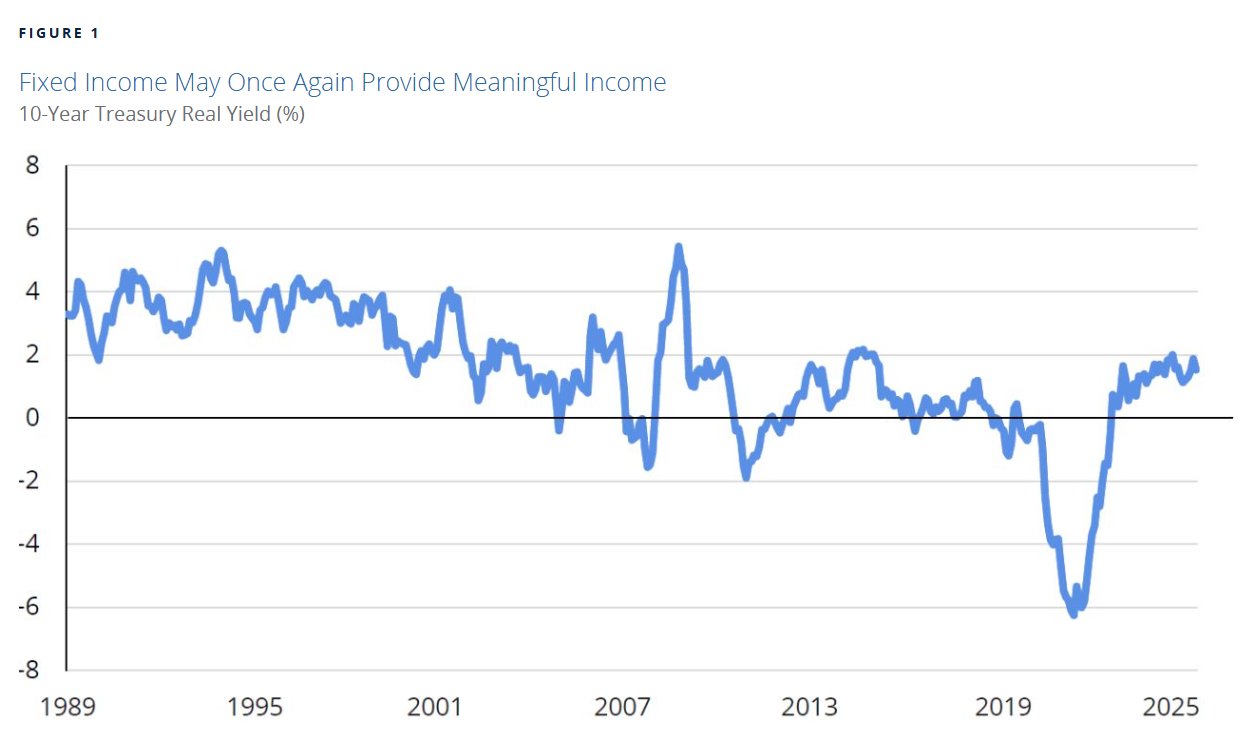
Income is once again a central component of bond investing. Investors can earn meaningful yields across a range of fixed-income assets—from Treasuries to corporate bonds and securitized credit—providing a steady return stream that can help offset market volatility. This chart from Hartford Funds highlights the real yield—i.e., post-inflation—available from Treasuries.
Source: Hartford
This positive real yield matters because investors can once again earn inflation-beating income from fixed-income without taking on excess risk. Given current equity market behavior, this makes bonds more competitive with stocks.
For years, equities were the primary source of returns while bonds played a secondary role, but today that gap has narrowed. Higher yields allow bonds to deliver returns more comparable to equities, with lower volatility and greater predictability. With high equity valuations, rising index concentration in a handful of stocks, and lower dividend yields, equities’ margin of safety has diminished, while bonds have only grown more attractive.
Looking at the S&P 500’s earnings yield versus the 10-year Treasury yield, analysts at Hartford note that investors can now get more yield from bonds than earnings from the S&P 500—a feat that hasn’t occurred since 2001 and makes bonds very attractive relative to equities. 1
Take Advantage of Bonds Today
With the bond market offering renewed opportunities, the time to add a meaningful allocation to bonds could be now. They offer a top way to provide income and safety within a portfolio, reclaiming their former role, and given the current market environment, they could deliver strong total returns over the long haul relative to stocks.
Adding bonds is straightforward, with numerous ETFs—both active and passive—covering the market and various fixed-income sub-sectors. Investors can start by building a core allocation in high-quality bonds, such as U.S. Treasuries and investment-grade corporate debt, which provide stability and consistent income. From there, they can enhance returns through exposure to credit sectors, including high yield bonds, securitized assets, and emerging market debt.
The combination of high yields and lower inflation provides a strong environment for the asset class.
Top Active Bond and Core-Plus ETFs
These ETFs were selected for their low-cost exposure to active bond management within the unconstrained, dynamic, and core-plus sectors. Sorted by YTD total return, they range from -1.2% to 2.8%, with expense ratios from 0.10% to 0.71%, assets from $63M to $18B, and current yields between 4.2% and 5.5%.
| Ticker | Name | AUM | YTD Total Ret (%) | Yield (%) | Exp Ratio | Security Type | Actively Managed? |
|---|---|---|---|---|---|---|---|
| JCPB | JPMorgan Core Plus Bond ETF | $5.78B | 2.8% | 5.3% | 0.40% | ETF | Yes |
| BOND | PIMCO Active Bond ETF | $5.5B | 2.5% | 5.3% | 0.71% | ETF | Yes |
| VPLS | Vanguard Core Plus Bond ETF | $138M | 2.5% | 4.8% | 0.2% | ETF | Yes |
| TOTL | SPDR DoubleLine Total Return Tactical ETF | $3.5B | 2.3% | 5.1% | 0.55% | ETF | Yes |
| FBND | Fidelity Total Bond ETF | $18.1B | 2.2% | 5% | 0.36% | ETF | Yes |
| AVIG | Avantis Core Fixed-Income ETF | $1B | 2.2% | 5% | 0.15% | ETF | Yes |
| BINC | BlackRock Flexible Income ETF | $8.14B | 2.1% | 5.5% | 0.52% | ETF | Yes |
| FIXD | First Trust TCW Opportunistic Fixed-Income ETF | $4.32B | 2.1% | 4.3% | 0.65% | ETF | Yes |
| DBND | DoubleLine Opportunistic Bond ETF | $413M | 2% | 4.8% | 0.45% | ETF | Yes |
| DFCF | Dimensional Core Fixed-Income ETF | $243M | 2% | 4.6% | 0.19% | ETF | Yes |
| CGCP | Capital Group Core Plus Income ETF | $4.5B | 1.8% | 4.8% | 0.34% | ETF | Yes |
| VCRB | Vanguard Core Bond ETF | $63M | -1.2% | 4.2% | 0.10% | ETF | Yes |
Passive Bond ETFs
These ETFs were selected for their low-cost exposure to passive bond management, with expense ratios between 0.03% and 0.20% and assets between $137M and $360B. Sorted by YTD total return, they range from 6.8% to 8.4% and currently yield between 3.6% and 4.2%.
| Ticker | Name | AUM | YTD Total Ret (%) | Yield (%) | Exp Ratio | Security Type | Actively Managed? |
|---|---|---|---|---|---|---|---|
| IEF | iShares 7-10 Year Treasury Bond ETF | $38.5B | 8.4% | 3.6% | 0.15% | ETF | No |
| UTEN | U.S. Treasury 10 Year Note ETF | $224M | 8.3% | 3.9% | 0.15% | ETF | Yes |
| MBB | iShares MBS ETF | $42B | 8% | 4.2% | 0.04% | ETF | No |
| SPMB | SPDR Portfolio Mortgage Backed Bond ETF | $6.4B | 7.9% | 3.7% | 0.05% | ETF | No |
| VMBS | Vanguard Mortgage-Backed Securities ETF | $17.4B | 7.7% | 3.9% | 0.03% | ETF | No |
| AGG | iShares Core U.S. Aggregate Bond ETF | $132B | 7.3% | 3.9% | 0.03% | ETF | No |
| SPTI | SPDR Portfolio Intermediate Term Treasury ETF | $9.25B | 7.3% | 3.7% | 0.06% | ETF | No |
| BND | Vanguard Total Bond Market Index Fund ETF | $360B | 7.2% | 3.8% | 0.03% | ETF | No |
| VGIT | Vanguard Intermediate-Term Treasury Index Fd ETF | $42B | 7.2% | 3.7% | 0.04% | ETF | No |
| GBF | iShares Government/Credit Bond ETF | $137M | 6.8% | 3.6% | 0.20% | ETF | No |
The bond market has entered a new era. After years of low yields and limited returns, higher interest rates and moderating inflation have fundamentally reshaped the opportunity set. Bonds are once again capable of delivering meaningful income and attractive total returns, while providing diversification and stability within portfolios.
For investors, this shift is significant, marking a return to a more balanced landscape where fixed-income plays a central role rather than a supporting one. In an uncertain world, the ability to generate consistent income while preserving capital is more valuable than ever—and for the first time in years, bonds are well positioned to deliver exactly that.
Bottom Line
Higher interest rates and moderating inflation have fundamentally reset the bond market, creating a more attractive environment for investors. Elevated starting yields now provide meaningful income and the potential for price appreciation if rates stabilize or decline, giving fixed-income a compelling total return profile once again.
1 Hartford Funds (March 2026). How Higher Rates and Lower Inflation Are Helping Bond Investors
