

Fixed-income investors are navigating one of the most unusual market environments in decades. On the surface, the bond market appears attractive: yields are significantly higher than they were throughout much of the 2010s, creating income opportunities many investors have not seen in years. Yet beneath that attractive income story lies a growing challenge, as traditional bond sectors have become increasingly difficult to navigate.
The result is a fixed-income market where opportunities exist, but finding the right balance between yield, risk, and total return has become increasingly difficult.
One area that continues to stand out as a compelling risk/return balance is fallen angel bonds. Historically, fallen angels have occupied a unique place within fixed-income markets, and today the case appears particularly compelling. For investors seeking an alternative to traditional investment-grade or high-yield bonds, fallen angels may deserve a much closer look.
What Are Fallen Angel Bonds?
The concept of fallen angel bonds is straightforward.
A fallen angel is a corporate bond originally issued with an investment-grade credit rating that was subsequently downgraded to below-investment-grade status. In other words, these companies were once considered investment-grade borrowers before experiencing business challenges, economic pressure, industry disruption, or a temporary deterioration in financial metrics.
When a bond loses its investment-grade rating, it often triggers forced selling.
Many institutional investors, pension plans, insurance companies, and investment-grade bond funds are prohibited from holding below-investment-grade securities, so once a downgrade occurs, those investors must often sell regardless of the company’s long-term prospects.
This forced selling can create pricing inefficiencies.
Rather than reflecting fundamental value, bond prices may temporarily reflect technical selling pressure, which means fallen angels often enter the high-yield market at attractive valuations and wider spreads than comparable bonds.
And that’s where the opportunity lies.
Fallen Angels Have Historically Outperformed
Fallen angel bonds have long generated returns in excess of the broader high-yield market while often exhibiting lower default rates. This chart from BlackRock highlights the sector’s outperformance.
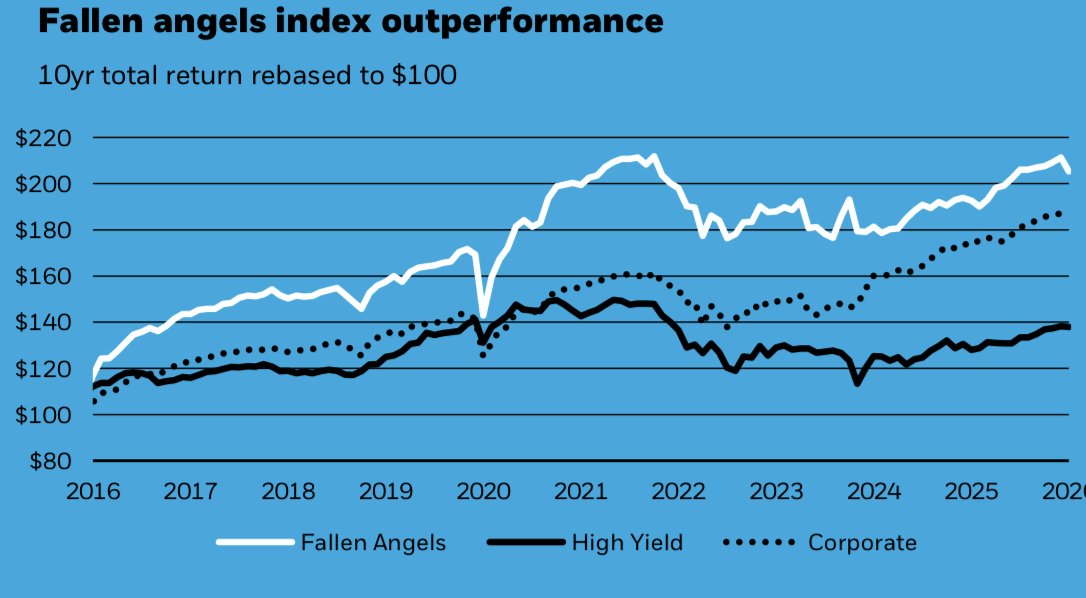
Source: BlackRock
The reason is relatively straightforward.
Most fallen angels were investment-grade companies before being downgraded, so they often enter the high-yield universe with stronger balance sheets, larger market positions, and higher-quality business models than many traditional high-yield issuers.
Historically, BB-rated bonds have demonstrated lower default rates than lower-rated high-yield issuers while still providing attractive income. Because many fallen angels enter the market with BB ratings, investors may benefit from a more favorable balance between yield and credit risk.
In practice, there is little difference in actual credit quality between the bottom rungs of investment-grade and the top tiers of the high-yield market.
The downgrade itself frequently reflects a temporary challenge rather than a permanent impairment, and many fallen angels remain concentrated in the upper tiers of the high-yield spectrum, particularly among BB-rated securities.
According to research by BlackRock and BNY, the combination of elevated yields, forced-selling discounts, and improving fundamentals has proven to be a powerful driver of returns.
The Opportunity Looks Attractive Today
The current market environment appears particularly supportive for fallen angels.
According to VanEck’s recent analysis, yields within the fallen angel universe remain highly attractive, approaching 7% in many cases. That income profile compares favorably with much of the investment-grade market while maintaining exposure to issuers that often possess stronger credit characteristics than the average high-yield company. 1
The asset class continues to receive fresh additions. During the first quarter, two firms entered the fallen angel index: Paramount and FS KKR. While downgrades may seem negative at first glance, VanEck notes that the index’s slow, steady growth benefits investors by keeping yields high, credit quality strong, and returns intact.
For investors, fallen angel bonds represent a strong way to generate high income without taking on excessive risk.
Historically, building a diversified portfolio of fallen angel bonds required institutional resources and specialized expertise.
ETF growth has changed that, making the asset class far more accessible to individual investors. Today, several ETFs focus specifically on fallen angel strategies, providing diversified exposure across dozens or even hundreds of securities.
Fallen Angel Bond ETFs
These funds were selected based on their exposure to fallen angel bonds and are sorted by year-to-date (YTD) total return, which ranges from -0.6% to 2.7%. They carry expense ratios between 0.15% and 1.02%, assets under management between $34 million and $3 billion, and current yields between 4.5% and 6.3%.
| Ticker | Name | AUM | YTD Total Ret (%) | Yield (%) | Exp Ratio | Security Type | Actively Managed? |
|---|---|---|---|---|---|---|---|
| FALN | iShares Fallen Angels USD Bond ETF | $1.7B | 2.7% | 6% | 0.25% | ETF | No |
| XBB | BondBloxx BB Rated USD High Yield Corporate Bond ETF | $56M | 2.1% | 6.3% | 0.20% | ETF | No |
| ANGL | VanEck Fallen Angel High Yield Bond ETF | $3.03B | 1.8% | 6.3% | 0.25% | ETF | No |
| HYLS | First Trust Tactical High Yield ETF | $1.5B | 0.4% | 6.2% | 1.02% | ETF | Yes |
| LQDB | iShares BBB Rated Corporate Bond ETF | $34M | -0.6% | 4.5% | 0.15% | ETF | No |
The bond market remains a difficult landscape for investors. Treasury volatility remains elevated, corporate bond spreads have tightened, and traditional high-yield sectors do not always provide adequate compensation for risk.
Fallen angel bonds offer a compelling alternative.
Their combination of forced-selling discounts, attractive yields, improving credit profiles, and historically strong performance has made them one of fixed-income’s most successful segments. The continued addition of newly downgraded issuers keeps the opportunity set fresh, while today’s yield levels remain highly attractive relative to competing bond sectors.
Bottom Line
For investors seeking a smarter way to generate income and diversify fixed-income exposure, fallen angels may represent one of the most compelling opportunities available today.
1 Van Eck (April 2026). Attractive Setup in Fallen Angels: 7% Yield and New Downgrades
