

Emerging markets (EMs) have long held a powerful allure for investors. The promise is simple: faster economic growth, an expanding middle class, and rising global influence should translate into strong investment returns. From China and India to Brazil and Indonesia, these economies represent the future of global demand and production. Investors have poured capital into EM equities for decades, hoping to capture that growth.
However, the reality has often fallen short. Despite strong GDP growth, EM equities have frequently underperformed expectations, weighed down by currency volatility, political risk, governance concerns, and market concentration. In many cases, investors have absorbed significant volatility without adequate compensation in returns.
That disconnect has led many investors to reconsider how they access EM, and increasingly the answer may lie not in equities but in EM debt. With higher yields, lower volatility, and surprisingly strong long-term returns, EM bonds may offer a more efficient and reliable way to tap into global growth.
The Problem with Emerging Market Equities
It’s easy to see why investors have fallen in love with emerging markets. Just as early adopters of transformative companies reap outsized rewards, identifying the next major economy early can yield similar—if not better—results. With nations just beginning their economic journeys, growing middle-class wealth, and abundant natural resources, EMs have attracted many portfolios seeking to capitalize on future growth.
However, the promise and the actual returns have not always lived up to the hype.
Over the past 10 to 15 years, repeated headwinds have suppressed returns and dampened enthusiasm for EM equities. These economies faced significant challenges from decelerating global growth after the financial crisis, steep commodity price declines, escalating geopolitical tensions, ongoing trade disputes, recurrent currency crises, and persistent U.S. dollar strength that pressured local currencies.
The result has been a volatile and often unrewarding ride. Since the Great Recession ended, the MSCI Emerging Markets Index has gained only about 0.9% annually—a return that a basic savings account would have matched or beaten.
A Better In-Road Into Emerging Markets
EMs offer compelling long-term tailwinds on one hand, yet poor and volatile returns on the other. The challenge for investors is capturing the potential upside without the accompanying downside and volatility.
The answer may be EM debt.
What was once an obscure asset class has grown into a behemoth. According to J.P. Morgan, EM debt has expanded into a $31 trillion market over the past two decades, with its share of the global bond market rising from 2% in 2000 to 28% in 2025. It turns out that bonds may be a better entry point into EMs than equities.
At its core, EM debt is built on income generation rather than capital appreciation alone. Bonds provide contractual payments that create a more stable return profile and reduce reliance on market sentiment. EM debt also typically offers a significant yield premium over developed market debt, reflecting the additional risks of the asset class.
This yield advantage delivers a steady income stream that can be reinvested and compounded over time, while also acting as a buffer during periods of market volatility to help stabilize returns.
For long-term investors, this combination has proven highly effective. The pairing of high yields and steady payouts has allowed EM debt to outperform EM equities over the long haul.
Recent research from asset manager GMO underscores this point. Over the past 30 years, EM debt delivered an 8.6% annualized return, compared to 5.1% annually from EM equities. For context, U.S. junk bonds returned only 7% over the same period. 1
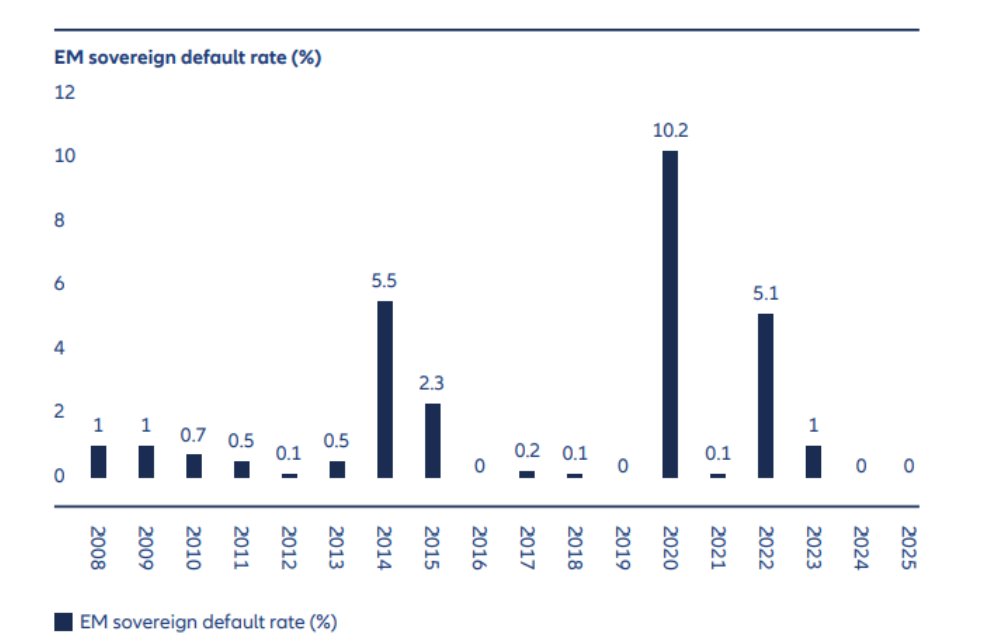
What’s particularly notable is that many EM debt offer higher yields than U.S. junk bonds, yet have historically posted lower default rates—generally under 2% annually—with meaningful recovery rates when defaults do occur. The past two years have seen zero defaults. This chart from Allianz highlights the low default rate for EM debt.
Source: Allianz
Importantly, many losses in EM debt are mark-to-market rather than permanent. Price declines are often driven by temporary credit spread widening rather than fundamental deterioration, and as long as issuers continue meeting their obligations, investors can collect income and recover losses over time.
All of these factors combine to make EM debt a compelling asset class—one that compares favorably to EM equities and may offer exposure to EM growth without the accompanying volatility and risk.
How to Implement Emerging Market Debt in a Portfolio
The potential of EMs is vast, and now remains a good time to consider adding them to a portfolio. The current macroeconomic environment strengthens the case further, and bonds are the better vehicle for that allocation. Fortunately, adding EM debt has never been easier.
The growth of ETFs has made the asset class far more accessible. These vehicles provide diversified exposure across a broad range of countries and issuers, allowing investors to enter the asset class without taking on concentrated risk.
Investors can choose between different market segments, including hard currency debt, typically denominated in U.S. dollars, and local currency debt, which offers additional return potential through currency appreciation. Each approach has its advantages, and combining the two can provide balanced exposure.
Active management can also play an important role, as EM debt is a complex and diverse asset class with significant variation across countries and issuers.
Broad Emerging Market Bond ETFs
These ETFs provide exposure to emerging markets via local or USD-denominated bonds. Sorted by year-to-date total return (from 13.7% to 18.9%), they feature expense ratios between 0.15% and 1.59%, AUM from $228M to $16B, and yields between 4.8% and 10.4%.
| Ticker | Name | AUM | YTD Total Ret (%) | Yield (%) | Exp Ratio | Security Type | Actively Managed? |
|---|---|---|---|---|---|---|---|
| EMLC | VanEck J.P. Morgan EM Local Currency Bond ETF | $4.1B | 18.9% | 5.9% | 0.31% | ETF | No |
| EMD | Western Asset Emerging Markets Debt Fund | $651M | 17.2% | 10.2% | 1.59% | MF | Yes |
| PCY | Invesco Emerging Markets Sovereign Debt ETF | $1.33B | 16.8% | 5.9% | 0.50% | ETF | No |
| EBND | SPDR® Bloomberg Emerging Markets Local Bond ETF | $2.2B | 16% | 6.4% | 0.30% | ETF | No |
| EMB | iShares J.P. Morgan USD Emerging Markets Bond ETF | $15.7B | 14.2% | 4.8% | 0.39% | ETF | No |
| EMHC | SPDR Bloomberg Emerging Markets USD Bond ETF | $228M | 14.2% | 10.4% | 0.23% | ETF | No |
| VWOB | Vanguard Emerging Markets Government Bond Index Fund | $5.87B | 13.7% | 5.6% | 0.15% | ETF | No |
EMs will continue to play a central role in the global economy, but how investors access that growth matters. While equities have traditionally been the preferred vehicle, they have often fallen short of expectations, delivering volatile and inconsistent returns.
EM debt offers a compelling alternative. With higher yields, lower volatility, and strong long-term performance, it provides a more reliable way to capture the benefits of EM growth.
Bottom Line
EM debt offers a compelling alternative to EM equities, delivering higher yields, more consistent income, and historically stronger risk-adjusted returns—all with less volatility.
1 GMO (February 2026). Three Reasons to Consider Dedicated Emerging Market Debt Exposure
