

For decades, many investors viewed their bond allocations through a distinctly American lens. U.S. Treasuries, investment-grade corporate bonds, mortgage-backed securities, and municipal bonds formed the foundation of countless portfolios. Given the size and depth of the U.S. bond market, that approach seemed reasonable.
Today’s market environment, however, is forcing investors to rethink some long-held assumptions. In many respects, the U.S. fixed-income market has become increasingly concentrated around a narrow set of risk factors.
Global bond markets may offer opportunities that many U.S.-centric investors are overlooking. International bonds represent one of the most underutilized tools available for improving diversification, enhancing income, and reducing portfolio concentration risk.
Risks Are Rising in U.S. fixed-income
The traditional case for U.S. bonds remains intact in many respects. Treasuries remain the global benchmark for safety and liquidity, corporate bonds provide income and exposure to some of the world’s strongest companies, and municipal bonds offer tax advantages for many investors—all while paying yields not seen in decades.
Yet the domestic bond market faces several growing challenges.
Interest-rate volatility has grown significantly, with the past several years demonstrating that Treasury bonds are not immune to large price swings. Inflation surprises, shifting Federal Reserve expectations, fiscal policy concerns, and economic uncertainty have all contributed to significant fluctuations in bond prices.
Monetary policy uncertainty has added another layer of complexity, as the Federal Reserve faces a difficult balancing act among controlling inflation, supporting economic growth, and maintaining financial stability.
This volatility has surprised many investors who traditionally viewed fixed-income as a stable portion of their portfolios.
At the same time, credit spreads remain relatively tight by historical standards. While investors are earning attractive nominal yields, much of that income comes from higher Treasury rates rather than generous credit premiums, meaning investors may be receiving less compensation for taking additional credit risk than they have historically enjoyed.
For investors heavily concentrated in domestic fixed-income, these risks can create challenges that are not always immediately apparent.
A Multipolar World Creates New Opportunities
One of the more persistent features of investing remains so-called hometown bias, yet the United States does not exist in a vacuum. The global bond market extends far beyond U.S. borders—roughly 69% of total market value lies outside them. 1
The global bond market includes sovereign debt, corporate bonds, agency securities, and other fixed-income instruments issued across Europe, Asia, Latin America, Canada, Australia, and emerging markets, collectively representing trillions of dollars in investment opportunities.
Increasingly, this broad opportunity set is relevant for portfolios, as the world becomes more multipolar. Economic growth is no longer driven primarily by the United States, with Europe, Asia, emerging markets, and other regions playing growing roles in global economic activity.
While the Federal Reserve may be tightening policy, other central banks could be easing. Inflation pressures may be elevated in one region while moderating in another, and growth may accelerate in some countries even as others experience slower expansion. These differences create opportunities for bond investors.
Global bond investors gain exposure to multiple interest-rate cycles, monetary policy regimes, and economic environments, which can help reduce dependence on any single country’s policy decisions or economic outlook.
Historically, going global with a bond portfolio has delivered additional returns, lower volatility, higher income, and better diversification than focusing on the U.S. alone.
This holds today. According to LPL, with the 10-year Treasury yielding around 4.30%, many international sovereign bonds offer competitive returns. Solid local yields combined with positive currency hedges present attractive income and return opportunities for portfolios, as this chart from LPL’s research illustrates.
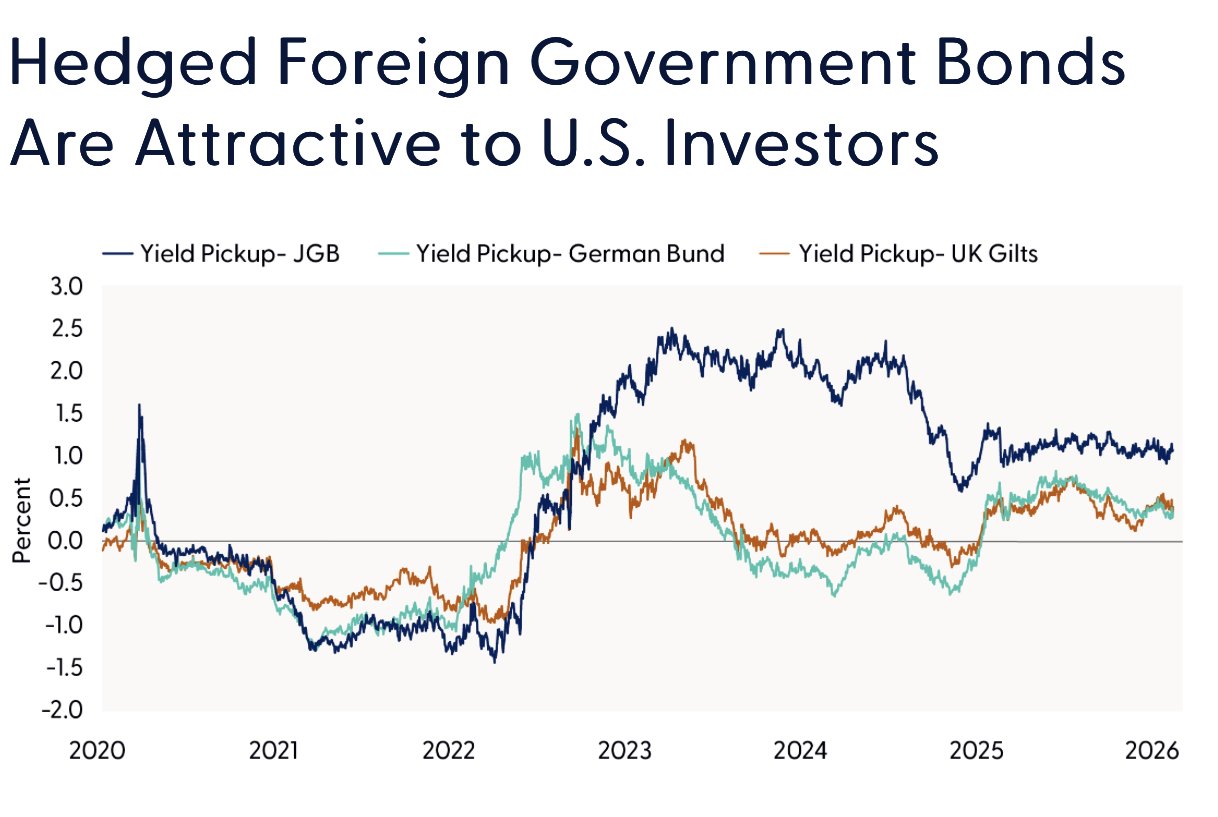
Source: LPL
How Investors Can Access International Bonds
It is easy to understand why hometown bias—especially in bond markets—has persisted. In the past, gaining access to these assets without being an institutional investor was difficult.
However, there is no excuse today.
ETF innovation has dramatically expanded access to global fixed-income markets, giving investors a wide variety of products across international bond subcategories. It is just as easy to purchase emerging market junk bonds as U.S. ones via an ETF.
Many active managers have embraced global fixed-income because the broader opportunity set creates more chances to add value through security selection, country allocation, duration management, and currency positioning.
For investors seeking simplicity, diversified global bond ETFs can provide broad exposure through a single investment vehicle.
International Bond ETFs
These ETFs are selected for their ability to access various international and global bond sectors at low cost, sorted by one-year total return ranging from -2.2% to 9.5%. Expense ratios range from 0.05% to 0.85%, AUM falls between $50M and $86B, and current yields range from 2.1% to 5.31%.
| Ticker | Name | AUM | 1-year Total Ret (%) | Yield (%) | Exp Ratio | Security Type | Actively Managed? |
|---|---|---|---|---|---|---|---|
| FEMB | First Trust Emerging Markets Local Currency Bond ETF | $132M | 9.5% | 5.31% | 0.85% | ETF | Yes |
| HYXU | iShares Global ex USD High Yield Corporate Bond ETF | $50M | 7.5% | 3.49% | 0.40% | ETF | No |
| CEMB | iShares Emerging Markets Corporate Bond ETF | $422M | 5.2% | 4.84% | 0.50% | ETF | Yes |
| BNDX | Vanguard Total International Bond ETF | $85.7B | 5% | 2.1% | 0.07% | ETF | No |
| IBND | SPDR Bloomberg International Corporate Bond ETF | $235M | 3.5% | 2.7% | 0.50% | ETF | No |
| BNDW | Vanguard Total World Bond ETF | $670M | 3.2% | 2.8% | 0.05% | ETF | No |
| BWX | SPDR Bloomberg International Treasury Bond ETF | $836M | -2.2% | 2.1% | 0.35% | ETF | No |
While U.S. bonds remain an important foundation of most portfolios, rising volatility, tighter spreads, and growing policy uncertainty are encouraging many investors to rethink traditional fixed-income allocations and look beyond domestic markets.
International bonds provide a compelling solution.
By offering exposure to different economies, central banks, interest-rate cycles, and income sources, they can help build more balanced and resilient portfolios. In an increasingly multipolar world, limiting fixed-income to a single country may no longer be the most effective approach.
Bottom Line
For investors seeking diversification, income, and a broader opportunity set, global bonds may deserve a much larger role in portfolio construction than they currently receive.
1 LPL (May 2026). Rethinking Fixed Income Allocation in a Multi‑Polar World
