

In today’s investment landscape, income investors are navigating a delicate balance between yield and safety. Traditional safe-haven assets like U.S. Treasuries provide stability but often fall short on meaningful income, while riskier segments, such as high-yield bonds, introduce elevated credit risk and volatility. This has left many investors searching for a middle ground—an asset class that offers both dependable income and a strong credit foundation.
Mortgage-backed securities (MBS) are increasingly emerging as that solution.
Supported by a resilient housing market, favorable supply-demand dynamics, and attractive yields relative to other high-quality bonds, MBS offer a compelling combination of income and safety. In the current environment—marked by economic uncertainty, shifting interest rates, and persistent demand for yield—MBS may represent one of the most attractive opportunities within the fixed-income space.
What Are Mortgage-Backed Securities?
MBS are bonds backed by pools of residential or commercial mortgage loans. Banks, lenders, or the government trio of Freddie Mac, Fannie Mae, and Ginnie Mae combine thousands of mortgages through securitization into MBS, which are then sold to investors.
When homeowners make monthly mortgage payments, the principal and interest are passed through to investors who hold these securities.
One defining feature of MBS is that they are collateralized by real assets: homes and properties. This collateral backing provides a level of security often absent in other forms of credit, and government support adds another layer of reduced credit risk for some mortgage-backed securities.
In essence, MBS allows investors to gain exposure to the housing and commercial real estate markets without directly owning real estate.
Mortgage-Backed Securities Make Sense Today
For investors, the safety of MBS and several powerful tailwinds are aligning to make mortgage-backed securities particularly attractive in the current environment.
One of the most compelling reasons to consider MBS today is its yield.
MBS often offer higher yields than comparable U.S. Treasuries, reflecting their structural complexities and prepayment risks.
Current coupon MBS yields are significantly above those of comparable-duration government bonds, providing investors with an income premium without materially higher credit risk—especially for agency MBS. Across the full market spectrum, MBS are yielding over 6% today, while agency bonds are yielding close to 5%. 1
That strong income base is particularly advantageous given several other trends.
The supply-demand balance in the MBS market also warrants attention.
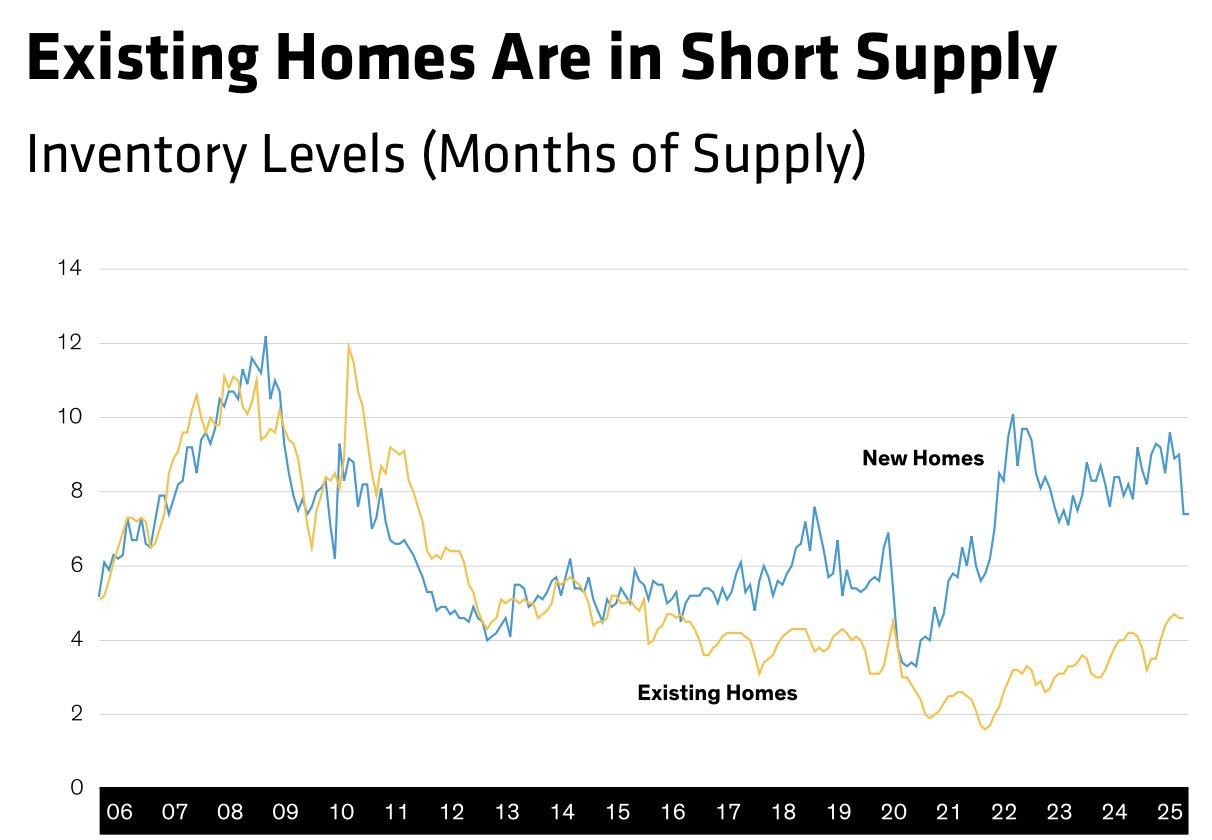
Despite higher mortgage rates, the housing market remains resilient. Inventory is tight, and home prices have stayed relatively stable, even as transaction volumes have slowed—driven in part by the “lock-in effect,” where homeowners who secured historically low rates are reluctant to sell.
This chart from AllianceBernstein highlights the tight U.S. housing market.
Source: AB
According to AB, this dynamic is favorable for MBS assets. A limited housing supply supports home values and reduces the risk of widespread defaults, resulting in stronger collateral backing and lower credit risk for MBS investors.
Another potential benefit? Capital gains.
As interest rates stabilize or decline, bond prices generally rise, and MBS could benefit from this trend—particularly if spreads relative to Treasuries narrow over time.
AB data shows that current spreads between agency and non-agency MBS remain above historical averages, suggesting room for spread compression and price appreciation as markets normalize. This could add another layer of return to the MBS market, especially as institutional investors seek higher yields.
MBS Are a Compelling "Middle Ground" Investment
For investors, the most attractive aspect of MBS is their ability to sit between traditional safe and risky assets, offering high yields and strong credit quality. Given these potentially strong tailwinds, MBS bonds make considerable sense for portfolios.
Getting exposure is straightforward. As one of the largest bond categories, MBS are widely traded, but given the complexities of their types, the task is best left to professionals. ETFs—both active and passive—make short work of it.
Mortgage-Backed Securities (MBS) ETFs
These funds are selected for their ability to access MBS at low cost and are ranked by year-to-date total return, which ranges from 3.2% to 5.4%. Expense ratios range from 0.04% to 0.66%, yields range from 3.23% to 4.31%, and AUM falls between $290M and $26B.
| Ticker | Name | AUM | YTD Total Ret (%) | Yield (%) | Exp Ratio | Security Type | Actively Managed? |
|---|---|---|---|---|---|---|---|
| LMBS | First Trust Low Duration Opportunities ETF | $4B | 5.4% | 3.82% | 0.66% | ETF | Yes |
| JMBS | Janus Henderson Mortgage-Backed Securities ETF | $1.9B | 4.6% | 4.31% | 0.28% | ETF | Yes |
| GNMA | iShares GNMA Bond ETF | $290M | 4.5% | 3.39% | 0.11% | ETF | No |
| MBB | iShares MBS ETF | $25.9B | 4% | 3.38% | 0.05% | ETF | No |
| VMBS | Vanguard Mortgage-Backed Securities ETF | $17.4B | 3.5% | 3.25% | 0.04% | ETF | No |
| SPMB | SPDR Portfolio Mortgage Backed Bond ETF | $4.3B | 3.2% | 3.23% | 0.05% | ETF | No |
In a market defined by uncertainty, MBS stand out as a compelling option for investors seeking both yield and safety. Backed by a resilient housing market, favorable supply-demand dynamics, and attractive yields, MBS offer a unique combination of income, credit quality, and diversification.
For investors seeking to strengthen their fixed-income allocations without taking on excessive risk, MBS—particularly when accessed through ETFs—may be among today’s most attractive opportunities.
Bottom Line
MBS offer a rare combination of income, quality, and stability in today’s uncertain market. With yields that remain attractive relative to Treasuries, strong support from a resilient housing market, and reduced prepayment risk, MBS provide a compelling middle ground between safety and return.
1 AllianceBerstein (February 2026). Why Today’s Environment Favors Mortgage-Backed Securities
