

Investors of all stripes are facing a difficult balancing act today. On one hand, traditional safe-haven assets, such as government bonds, still offer relatively modest yields when adjusted for inflation, while uncertainty about interest rate policies and growing fiscal woes have heightened volatility. Equity investors aren’t off the hook either. With geopolitical uncertainty rising, economic growth slowing, and inflation remaining stubborn in parts of the global economy, the stock market is fraught with risk. Investors may feel caught between a rock and a hard place.
In this environment, preferred stocks could be the middle ground that investors are craving.
Preferred securities offer income levels that often exceed those of traditional bonds while generally providing more stability than common stocks. They sit between debt and equity in a company’s capital structure, combining elements of both asset classes. For investors seeking steady income without excessive risk, preferred stocks can offer an appealing solution.
A Unique Asset Class
Preferred stocks occupy a unique position in a company’s financial hierarchy. Unlike common stocks, which represent ownership and voting rights, preferred shares function as a hybrid between stocks and bonds, with holders typically receiving a fixed dividend set at issuance.
These dividends are usually paid quarterly and are often significantly higher than those paid on common stock. Because of this income focus, preferred securities are particularly popular among income-oriented investors, such as retirees, pension funds, and income-focused portfolios.
In the event of financial distress, preferred shareholders rank higher than common shareholders in the capital structure, meaning they must be paid before common shareholders receive dividends. However, preferred stockholders still rank below bondholders, so they carry more risk than traditional corporate debt.
Many preferred shares are issued with a fixed dividend rate and may be callable by the issuer after a certain period, allowing the company to redeem shares at a predetermined price—typically when interest rates fall and refinancing at a lower cost becomes possible.
For investors, the result is a market segment that offers attractive income potential while providing exposure to some of the largest and most established institutions in the economy.
Preferred Stocks Are Attractive Today
The blend of stock and bond attributes makes preferred stocks particularly well-suited for today’s risk-laden market.
The primary appeal of preferred stocks is their income potential. Preferred securities often offer yields significantly higher than those available from government bonds or investment-grade corporate debt. This yield premium exists because preferred shareholders take on slightly more risk than bondholders, though that additional risk is often modest compared with the volatility of common stocks.
Today, yields are among the highest in the fixed-income space, with the ICE BofA Hybrid Preferred Securities Index currently paying 6.51%—on par with junk bonds. This chart from State Street illustrates how preferred stock yields compare to other segments of the fixed-income market.
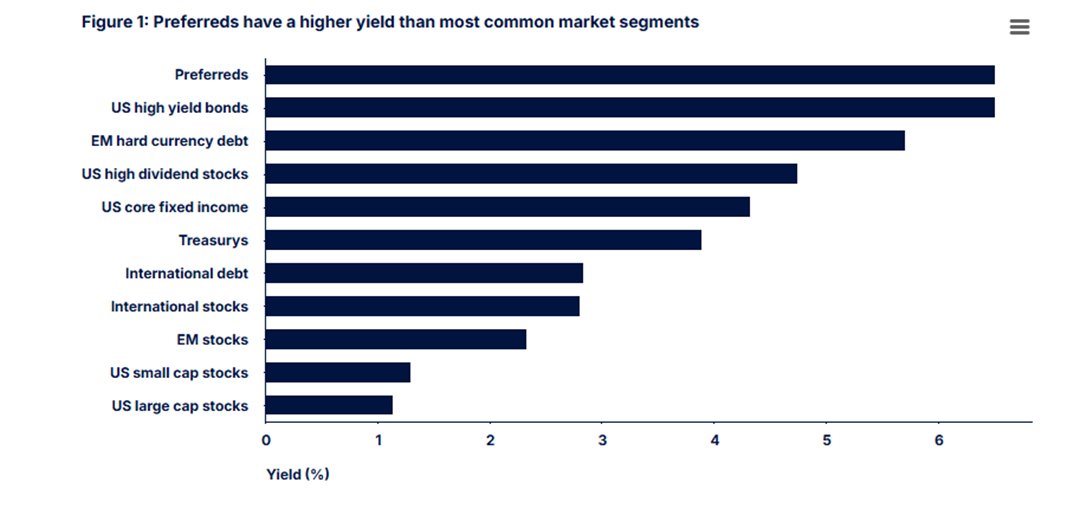
Source: State Street
It should also be noted that this high yield comes with tax advantages. Many preferred securities pay dividends counted at qualified dividend income (QDI) rates, which enhances after-tax yield.
That high yield also performs well on the equity side of the equation. At 6% to 8%, it delivers a stock-like return for portfolios, while preferred stock’s placement in the bankruptcy ladder and par values provide less volatility and risk than equities. Looking at the historical median rolling 36-month standard deviation of returns over the last 15 years, State Street found that preferred stocks produced a standard deviation of just 6.34, compared with 15.18 for the S&P 500. 1
Given the growing risks facing equity investors—high valuations, geopolitical issues, and broader economic concerns—preferred stocks offer a chance to achieve equity-like returns without much of the associated risk profile.
This risk reduction also applies to the bond side. With high starting yields, preferred stocks perform well in both dovish and hawkish environments. When interest rates rise, preferred prices don’t decline as sharply as other asset classes, thanks to the higher yield cushion and call potential. As rates decrease, preferred stocks trade closer to or above par as investors seek more income. The result is an asset class well-suited to any rate environment.
Preferred Stocks as a Portfolio Tool
Given the growing risks across both equity and fixed-income markets, preferred stocks make for a strong portfolio addition today.
Individual preferred shares can be purchased through any good brokerage firm, though many don’t trade frequently, and finding solid research on individual issues can be difficult.
With that in mind, one of the easiest ways for individual investors to gain exposure to preferred securities is through exchange-traded funds (ETFs), which provide access to diversified portfolios of preferred shares issued by a variety of companies.
ETFs offer several advantages, including diversification across multiple issuers, sectors, and geographic regions, which reduces single-company risk. They also provide liquidity and transparency, making it easier for investors to manage their exposure. Many also distribute income monthly, making them attractive for investors who rely on regular cash flow. Active management can provide additional alpha and yield when using ETFs to access the asset class.
Preferred Stock ETFs
These funds are selected based on their ability to tap into preferred stock and their assets under management, sorted by one-year total return, which ranges from 5.2% to 9.7%. Expense ratios range from 0.2% to 0.85%, AUM falls between $0.5B and $13B, and yields range from 4.3% to 7.4%.
| Ticker | Name | AUM | YTD Total Ret (%) | Yield (%) | Exp Ratio | Security Type | Actively Managed? |
|---|---|---|---|---|---|---|---|
| PFXF | VanEck Preferred Securities ex Financials ETF | $1.2B | 9.7% | 7.3% | 0.41% | ETF | No |
| PFF | iShares Preferred and Income Securities ETF | $12.7B | 9% | 7.38% | 0.46% | ETF | No |
| PGX | Invesco Preferred ETF | $4.4B | 6.8% | 7.2% | 0.50% | ETF | No |
| PREF | Principal Spectrum Preferred Securities Active ETF | $587M | 5.9% | 4.31% | 0.55% | ETF | Yes |
| PFFD | Global X U.S. Preferred ETF | $2.2B | 5.3% | 6.48% | 0.23% | ETF | No |
| FPE | First Trust Preferred Securities and Income ETF | $5.1B | 5.2% | 6.09% | 0.85% | ETF | Yes |
Preferred stocks are often overlooked, yet they may offer a compelling solution for income investors navigating today’s challenging environment. With traditional bonds facing interest rate uncertainty and equities carrying elevated volatility, preferred securities provide a valuable middle ground.
Their attractive yields, hybrid characteristics, and exposure to large financial institutions make them a unique asset class. As interest rates stabilize and income remains a priority, preferred securities could become an increasingly important component of diversified portfolios.
Bottom Line
For investors seeking reliable income without excessive risk, preferred stocks—and the ETFs that hold them—may represent one of the most appealing opportunities in today’s market.
1 State Street (January 2026). Preferred securities: What they are and how they work
