

After several years of aggressive monetary tightening, the investment landscape is shifting. Inflation has moderated from its peak, economic growth has slowed but remains resilient, and central banks increasingly focus on supporting stability rather than fighting overheating demand. Markets now operate in a rate-cutting environment, or one where policy direction turns decisively lower.
This shift proves significant for fixed-income investors.
Bonds that struggled during the hiking cycle now stand positioned to play central roles in portfolios again. With yields still elevated, price sensitivity shifting from headwind to tailwind, and diversification benefits reemerging, fixed-income offers compelling opportunities if investors position thoughtfully.
Understanding the Current Rate-Cutting Environment
The Federal Reserve’s rate-cutting phase marks a meaningful shift in monetary policy after years of restrictive policy to curb elevated inflation. Throughout 2025, the Fed trimmed its policy rate in multiple steps—bringing the federal funds target to roughly 3.50%–3.75% by year-end after three quarter-point cuts—as policymakers judged inflation nearing target and downside risks to growth and employment rising.
Markets and many economists expect the easing cycle to continue, though at a more measured pace in 2026. Forward-looking forecasts from market pricing and professional strategists indicate one to three additional cuts throughout the year, potentially bringing the target rate toward the ~3.0% to 3.25% range by late 2026. 1
Importantly, the Fed’s decision to cut rates reflects not crisis conditions but a proactive response to a shifting balance of risks. A rate-cutting environment does not mean rates fall rapidly or in a straight line. Instead, it reflects a transition from restrictive policy toward accommodation.
Fixed-Income Benefits When Rates Are Cut
Rate-cutting environments benefit bond investors. Even modest Fed reductions create outsized effects on bond markets. When policy shifts from restrictive to neutral or accommodative, fixed-income investors reprice interest-rate and credit risks, tightening credit spreads and driving favorable price action in certain bond segments.
Fixed-income performs well in easing cycles for several reasons. First, falling rates directly boost bond prices. Longer-duration bonds benefit most because their cash flows extend further into the future and prove more sensitive to discount rate changes. Even modest yield declines produce meaningful price gains.
Second, the decline in interest rates increases the value of income streams. Investors who secure today’s higher yields will benefit from coupon payments that soon become more attractive compared to yields offered by new bond issues. Declining rates raise reinvestment risk for cash or short-term holders, while existing bondholders gain a yield advantage.
Third, bonds regain their role as diversifiers. Rising rates cause bonds and equities to move together, undermining diversification. In rate-cutting environments—especially those driven by slowing growth—high-quality bonds perform well when risk assets struggle, restoring portfolio balance.
Taken together, these dynamics create a supportive backdrop for fixed-income.
Implementing a Fixed-Income Strategy This Year
Columbia Threadneedle analysts recommend playing this environment. For many investors, this year offers a chance to rebuild core fixed-income allocations reduced or shortened during the hiking cycle. Modestly extending duration, locking in attractive yields, and reemphasizing quality restores fixed-income’s traditional role.
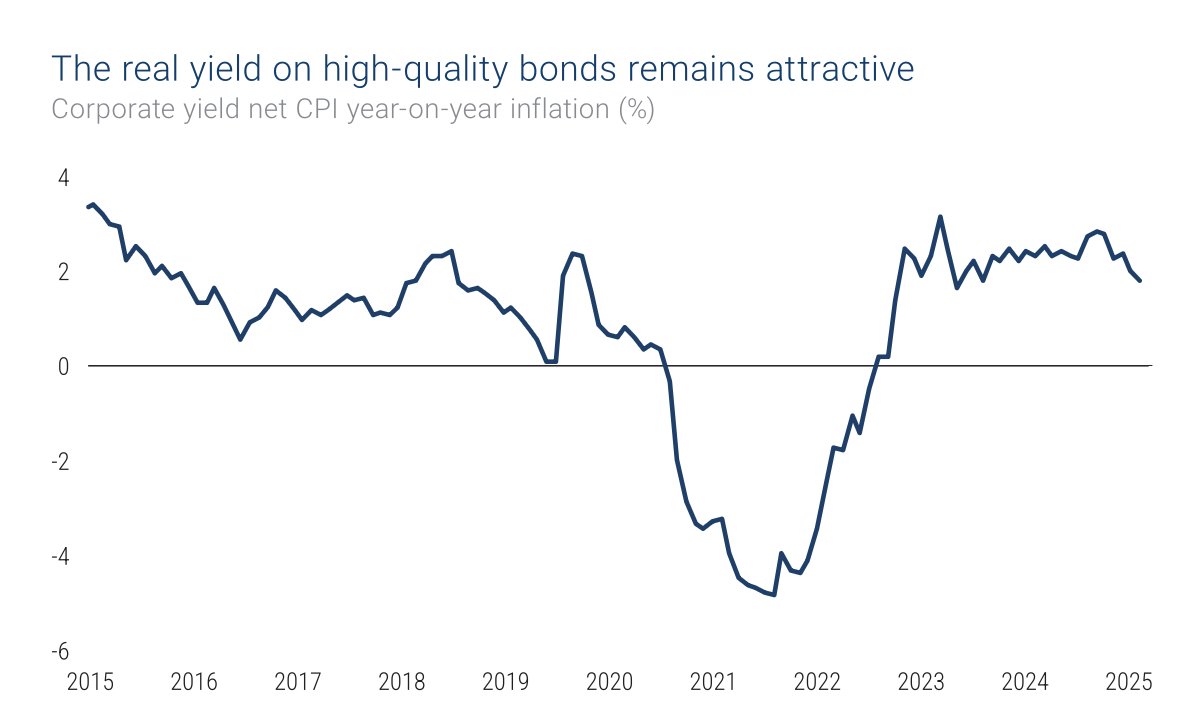
For example, the asset manager notes that even as rates fall, yields across many bond sectors remain attractive by historical standards. This allows investors to generate strong returns without relying solely on price appreciation. The 10-year Treasury currently yields around 4%, while investment-grade credit yields near 5%. This chart from Columbia still illustrates the strong yields available.
Source: Columbia Threadneedle
Additionally, Columbia suggests diversification for wins. Different bond sectors respond differently to changes in rates, growth, and risk sentiment. Spreading exposure across multiple types reduces reliance on any single outcome. Duration management likewise helps investors capture more yield in longer-dated bonds.
Investment-Grade Bond ETFs
These low-cost ETFs provide exposure to core bonds, Treasuries, investment-grade corporate bonds, and mortgage-backed securities. Sorted by YTD total return (-0.5% to 0.6%), they have expense ratios of 0.03-0.36% and AUM from $55M to $314B. They currently yield 3.6-4.8%.
| Ticker | Name | AUM | YTD Total Ret (%) | Yield (%) | Exp Ratio | Security Type | Actively Managed? |
|---|---|---|---|---|---|---|---|
| VCRB | Vanguard Core Bond ETF | $110M | 0.6% | 3.8% | 0.10% | ETF | No |
| HCRB | Hartford Core Bond ETF | $223M | 0.3% | 4.3% | 0.29% | ETF | Yes |
| BND | Vanguard Total Bond Market Index Fund | $314B | 0.2% | 3.6% | 0.03% | ETF | No |
| FIGB | Fidelity investment-grade Bond ETF | $55.4M | 0.1% | 4.2% | 0.36% | ETF | Yes |
| IUSB | iShares Core Total USD Bond Market ETF | $27.9B | 0% | 3.9% | 0.06% | ETF | No |
| AVIG | Avantis Core fixed-income ETF | $691M | -0.3% | 4.8% | 0.15% | ETF | Yes |
| AGG | iShares Core U.S. Aggregate Bond ETF | $105B | -0.4% | 3.7% | 0.03% | ETF | No |
| SPAB | SPDR® Portfolio Aggregate Bond ETF | $7.65B | -0.4% | 3.9% | 0.03% | ETF | No |
| GBF | iShares Government/Credit Bond ETF | $330M | -0.5% | 3.8% | 0.20% | ETF | No |
Core-Plus and Dynamic Income ETFs
These ETFs provide low-cost exposure to active bond management in unconstrained, dynamic, and core-plus sectors. Sorted by YTD total return (ranging from -1.2% to 2.5%), they have expense ratios from 0.10% to 0.71% and assets from $63M to $18B. They currently yield between 4.2% and 5.5%.
| Ticker | Name | AUM | YTD Total Ret (%) | Yield (%) | Exp Ratio | Security Type | Actively Managed? |
|---|---|---|---|---|---|---|---|
| BOND | PIMCO Active Bond ETF | $5.5B | 2.5% | 5.3% | 0.71% | ETF | Yes |
| TOTL | SPDR DoubleLine Total Return Tactical ETF | $3.5B | 2.3% | 5.1% | 0.55% | ETF | Yes |
| FBND | Fidelity Total Bond ETF | $18.1B | 2.2% | 5% | 0.36% | ETF | Yes |
| BINC | BlackRock Flexible Income ETF | $8.14B | 2.1% | 5.5% | 0.52% | ETF | Yes |
| JCPB | JPMorgan Core Plus Bond ETF | $5.78B | 2.8% | 5.3% | 0.40% | ETF | Yes |
| VPLS | Vanguard Core Plus Bond ETF | $138M | 2.5% | 4.8% | 0.2% | ETF | Yes |
| FIXD | First Trust TCW Opportunistic fixed-income ETF | $4.32B | 2.1% | 4.3% | 0.65% | ETF | Yes |
| DBND | DoubleLine Opportunistic Bond ETF | $413M | 2% | 4.8% | 0.45% | ETF | Yes |
| DFCF | Dimensional Core fixed-income ETF | $243M | 2% | 4.6% | 0.19% | ETF | Yes |
| CGCP | Capital Group Core Plus Income ETF | $4.5B | 1.8% | 4.8% | 0.34% | ETF | Yes |
| AVIG | Avantis Core fixed-income ETF | $1B | 2.2% | 5% | 0.15% | ETF | Yes |
| VCRB | Vanguard Core Bond ETF | $63M | -1.2% | 4.2% | 0.10% | ETF | Yes |
A rate-cutting environment marks a turning point for fixed-income. With yields still elevated, duration becoming supportive, and diversification benefits reemerging, bonds can once again contribute meaningfully to portfolio outcomes. Investors can capitalize on this setup by managing duration exposure, harvesting income, and diversifying across bond types without relying on heroic forecasts.
Bottom Line
This year is not about bold bets but about positioning fixed-income to do what it does best: deliver income, stability, and balance as markets transition into the next phase of the cycle.
1 Columbia Threadneedle (December 2025). 2026 Fixed-Income Outlook: Seizing Opportunities in a Rate-Cutting Cycle
