

Utility stocks have long occupied a unique place in equity portfolios. They rarely grow the fastest, seldom excite the most, and usually do not attract speculative enthusiasm. Yet generations of investors have valued utilities for reliable income, steady cash flow, and resilience across economic cycles more than excitement. In an era of volatility, shifting interest rates, and uncertain equity returns, these characteristics draw attention again.
At the same time, investors’ access to utilities is evolving.
Rather than buying individual stocks alone, many income-focused investors turn to closed-end funds (CEFs) as a potentially more powerful vehicle for the sector. The CEF structure—particularly its ability to use modest leverage and distribute enhanced income—pairs naturally with regulated utilities’ predictable financial profile. The result offers higher income, diversification, and long-term stability compared with traditional approaches.
Why Utility Stocks Remain Powerful Income Generators
The appeal of utility companies begins with their business model. They provide essential services—electricity, natural gas, and water—that households and businesses rely on regardless of economic conditions. Demand fluctuates slightly with weather or industrial activity, but rarely disappears. This essential-service characteristic creates stable, predictable revenue that few industries match.
That stability pairs with the regulated framework under which most utilities operate. Regulators let utilities recover operating costs and earn reasonable returns on invested capital, especially for investments supporting grid reliability, safety, or long-term infrastructure. While regulation limits explosive profit growth, it also reduces competitive pressure and revenue uncertainty. Utilities thus trade rapid expansion for visibility and consistency—a trade-off conservative investors welcome.
Utilities also benefit from high fixed-cost structures and long-lived assets. Power plants, transmission lines, pipelines, and distribution networks require significant upfront investment but generate revenue for decades. Once regulators approve these assets, they produce durable cash flows that support operations and shareholder distributions.
These structural features—essential demand, regulated pricing, and long-lived infrastructure—translate directly into dividend stability. Utility companies rank among the most consistent dividend payers in public markets, with many boasting long histories of annual increases. Investors seeking dependable income over uncertain capital gains find this reliability central to the sector’s appeal.
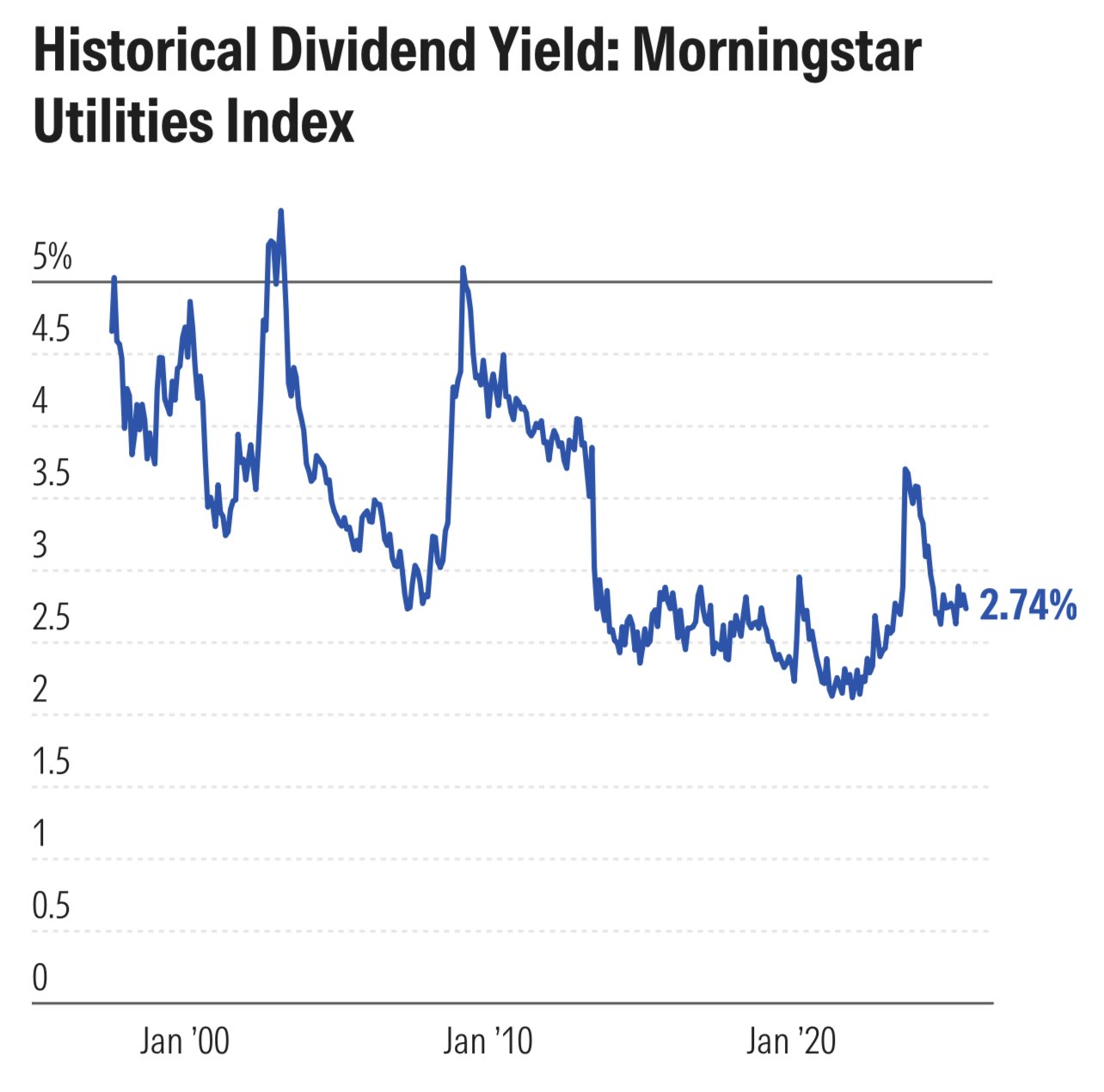
The rub: In recent years, utilities’ market-beating dividends have fallen. Investors now seek growth from the sector amid AI power demand, not operational changes. Share prices have risen, but yields have dropped. This Morningstar chart highlights the decline.
Source: BlackRock
CEFs offer income-focused investors in the sector an additional layer of opportunity as yields compress. Unlike open-end mutual funds or ETFs, CEFs maintain a fixed pool of capital and trade on exchanges like stocks. This structure lets managers employ strategies—most notably modest leverage—that enhance income potential.
Utilities pair effectively with the CEF structure due to their predictability. Their relatively stable cash flows and consistent dividends provide a dependable base for closed-end funds. Prudent leverage—borrowing at lower short-term rates to invest in higher-yielding utility equities—amplifies distributable income without excessive instability. CEFs often produce distribution yields meaningfully above those from owning utilities directly; for example, the average utility and infrastructure-focused CEF yields over 6%.
In volatile sectors, leverage magnifies losses and distribution risk. Utilities show lower earnings volatility and steadier dividends, suiting them for leveraged income strategies. This does not eliminate risk—interest-rate shifts and market drawdowns matter—, but it supports responsible leverage. CEFs maintain consistent distributions since they face no daily redemptions like mutual funds. Managers thus avoid selling holdings in stress periods, aligning with utilities’ slow, steady nature. Buy-and-hold stocks fit inside buy-and-hold funds.
Then there is net asset value (NAV) benefits to consider. CEFs can trade at discounts to NAV, occasionally allowing investors to purchase a diversified portfolio of utility stocks for less than the underlying market value. This lets investors buy “extra” yield and boost income potential without additional risks.
CEFs also provide instant diversification. Investors gain exposure to a broad mix of utilities across regions, energy types, and regulatory environments, rather than relying on a single company or jurisdiction. This reduces company-specific risk while preserving the sector’s overall income profile.
Together, leverage, stable distributions, potential discounts, and diversification make the CEF structure uniquely suited to utility investing.
How Investors Can Implement Utility Closed-End Funds in a Portfolio
With utility equities still providing ample income and the CEF structure enhancing it, investors may want to combine the two in a portfolio. For many, utility CEFs function best as part of an income allocation within equities or multi-asset portfolios. Their relatively high yields and defensive nature complement growth-oriented holdings, balancing overall portfolio volatility and cash flow.
Luckily, many asset managers recognize that utility stocks and closed-end funds pair well together. Numerous choices in the sector offer exposure.
Utility and Infrastructure CEFs
These CEFs provide exposure to the utility and infrastructure sectors, sorted by 1-year total returns ranging from 16.1% to 28.8%. They have AUM between $550M and $3.44B and currently yield between 5.4% and 6.8%. They have expense ratios ranging from 1.08% to 3.34%.
| Ticker | Name | AUM | 1-Year Total Ret (%) | Yield | Exp Ratio | Security Type |
|---|---|---|---|---|---|---|
| XDPGX | Duff & Phelps Utility and Infrastructure Fund | $551M | 28.8%% | 5.4% | 3.34% | CEF |
| XBUIX | BlackRock Utilities. Infrastructure & Power Opportunities Trust | $624M | 27.7%% | 6.2% | 1.08% | CEF |
| XUTFX | Cohen & Steers Infrastructure Fund | $2.86B | 23.7% | 6.7% | 2.19% | CEF |
| XUTGX | Reaves Utility Income Fund | $3.44B | 22.4% | 6.3% | 1.23% | CEF |
| XPDTX | John Hancock Premium Dividend Fund | $1.08B | 16.1% | 6.8% | 1.82% | CEF |
Utility stocks have always offered investors a rare combination of essential demand, regulated stability, and dependable dividends. In today’s uncertain market, those qualities remain as valuable as ever. Yet the method of owning utilities can meaningfully affect the income and diversification that investors receive.
CEFs align uniquely with the steady nature of utility businesses. Through prudent leverage, consistent distribution policies, diversified holdings, and potential discounts to NAV, utility-focused CEFs transform reliable dividend payers into enhanced income-producing portfolio anchors.
Bottom Line
For investors seeking durable cash flow, moderated volatility, and long-term stability, pairing utilities with CEFs offers one of the most compelling income strategies.
