

Financial markets have entered a period defined by heightened uncertainty, rapid swings in sentiment, and sharper dispersion in asset-class performance. Traditional balanced portfolios, which once relied on bonds to offset equity volatility, have not offered the same resilience as in past cycles. It’s certainly been stormy seas for many investors. Against this backdrop, investors are seeking ways to stabilize returns, preserve capital during market pullbacks, and improve the consistency of income.
Closed-end funds (CEFs), with their unique structural features, may offer a compelling solution.
Thanks to their combination of discounts to net asset value (NAV), actively managed nature, and high distribution rates, they are perfect in this environment to help reduce portfolio drawdowns and provide more predictable cash flow during turbulent markets. As such, the humble CEFs shouldn’t be ignored by investors.
A Volatile Market Environment Demands New Tools
It’s been a wild ride, to say the least, over the last five years or so. The past several years have delivered an unusual mix of macroeconomic instability and market turbulence. Inflation, despite moderating from peak levels, remains sticky in many parts of the world. Interest rates have risen dramatically, leading to one of the worst bond market drawdowns in modern history. Equity markets have become increasingly concentrated, with performance tied heavily to a narrow group of large-cap growth companies, leaving the broader market more susceptible to shocks. Meanwhile, geopolitical disruptions- from supply-chain realignment to energy uncertainty- have created persistent price volatility across asset classes.
And that’s nothing to say about events like the pandemic and conflict in Ukraine and Gaza.
With this environment in tow, many investors have rediscovered the importance of downside protection. Wild swings and enhanced volatility have become the relative norm. To that end, traditional portfolio diversification approaches have struggled because stocks and bonds have occasionally moved downward in tandem. At the same time, cash yields have risen, prompting investors to question how to generate income efficiently without taking excessive risk.
The resulting broad spectrum of solutions has introduced various potential issues concerning the appropriate method for securing downside portfolio protection.
An Old School Solution
CEFs, though often associated primarily with income generation, offer structural advantages that can help manage drawdowns more effectively when compared to conventional investment vehicles.
The key is in their structure.
One of the most compelling aspects of CEFs is their ability to trade at market prices that differ from their net asset value. CEFs launch at an IPO and issue a fixed number of shares. Because CEFs do not offer daily creation or redemption like ETFs or open-end funds, their share prices fluctuate based on supply and demand rather than strictly reflecting the underlying portfolio value. This is a key advantage during market drawdowns.
When CEFs trade at discounts to NAV, investors can purchase assets for less than the value of the securities the fund actually holds, creating a large safety margin. A Closed-End Fund’s (CEF) market price, often already discounted (e.g., 10%), may already reflect a modest decline in its Net Asset Value (NAV). As a result, market-price drawdowns may be more muted compared to comparable ETFs or mutual funds that always trade at or near NAV. The discount can cushion the impact of market declines because the fund begins from a lower valuation baseline.
Another potential win and drawdown reducer is a hefty cash return.
Thanks to their structure, CEFs have traditionally been income vehicles, providing higher distribution rates than many traditional income vehicles. This chart from BlackRock shows the average yields on several asset classes in CEFs compared to open-end funds, like ETFs and mutual funds.
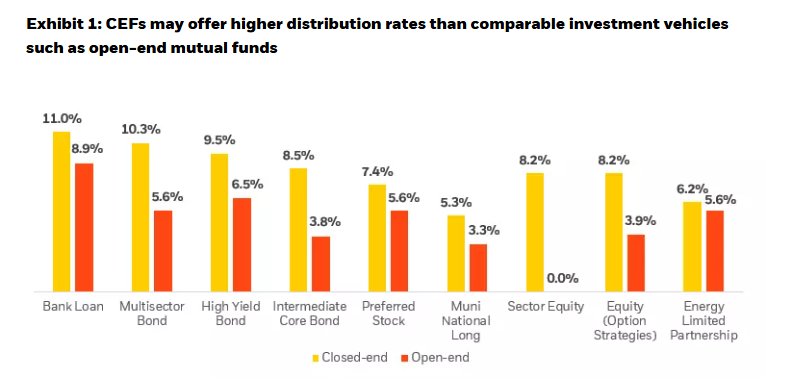
Source: BlackRock
These higher distributions of CEFs play a critical role in enhancing investor experience and improving portfolio returns. A steady stream of income helps offset price declines and reduces the reliance on capital appreciation for total return. After all, if an investor knows that they’ll get 6% to 7% in cash before anything else, they tend not to sell the investment. Distributions reduce the psychological burden of volatility.
High distribution rates also allow CEF investors to redeploy income opportunistically. For instance, when CEF discounts widen sharply during market stress, reinvesting distributions into the same fund at a deeper discount can accelerate long-term recovery once markets stabilize. Additionally, this immediate liquidity can be held as cash to prevent the need to sell assets.
The result is that these structural features of closed-end funds allow investors a smoother ride when the markets get choppy.
Supporting Drawdown Management With CEFs
The closed-end fund structure itself contributes to stability in ways that ETF and mutual fund structures do not. Because CEFs do not face daily redemptions, managers are not forced to sell assets during periods of investor panic. This protects the portfolio from fire-sale liquidation and enables managers to stay fully invested, maintain income production, and manage leverage more strategically.
With that in mind, it makes sense to include CEFs in a portfolio during today’s current environment. The way to do that is pretty easy. Numerous CEFs cover various income and equity sectors. Simply pairing a CEF with a more traditional open-ended fund could make sense. This way, investors get a higher yield from a portion of an asset class, reducing drawdowns and creating a higher cash return. Additionally, several multi-asset CEFs can provide total market coverage and provide a base for drawdown protection.
Popular CEFs
These CEFs are sorted by their YTD total returns, which range from -2.3% to 15.8%. They have AUM between $100M and $1.65B and expenses between 0.86% and 4.3%. They are currently yielding between 6.1% and 13.1%.
| Ticker | Name | AUM | YTD Total Ret (%) | Yield (%) | Exp Ratio | Security Type |
|---|---|---|---|---|---|---|
| XAGIX | abrdn Global Infrastructure Income Fund | $610M | 15.83% | 12.66% | 2.04% | CEF |
| XAEFX | abrdn Emerging Markets ex-China Fund | $344M | 13.02% | 10.4% | 2.04% | CEF |
| XIAFX | abrdn Australia Equity Fund | $130M | 12.07% | 10.4% | 1.94% | CEF |
| XJEQX | abrdn Japan Equity Fund | $93M | 11.97% | 6.09% | 0.83% | CEF |
| XBGRX | BlackRock Energy Resources Trust | $380M | 9.6% | 6.1% | 1.29% | CEF |
| XJQCX | Nuveen Credit Strategies Income Fund | $790M | 9.2% | 13.1% | 2.67% | CEF |
| XJFRX | Nuveen Floating Rate Income Fund | $1.22B | 8.7% | 12.8% | 3.4% | CEF |
| XBGTX | BlackRock Floating Rate Income Trust | $285M | 8.2% | 12.1% | 3.05% | CEF |
| XBDJX | BlackRock Enhanced Equity Dividend Trust | $1.65B | 7.3% | 9.1% | 0.86% | CEF |
| XJLSX | Nuveen Mortgage and Income Fund | $104M | 7% | 10.8% | 1.57% | CEF |
| XBDJX | BlackRock Enhanced Equity Dividend Trust | $1.5B | 6.68% | 8.55% | 0.85% | CEF |
| XBOEX | BlackRock Enhanced Global Dividend Trust | $627M | 6.59% | 8.8% | 1.07% | CEF |
| XJPCX | Nuveen Preferred Income Opportunities Fund | $783M | 6.5% | 9.3% | 2.68% | CEF |
| XIGAX | Voya Global Advantage & Premium Opportunity Fund | $154M | 6.07% | 10.16% | 1.1% | CEF |
| XBITX | BlackRock Multi-Sector Income Trust | $615M | 6% | 10.17% | 4.28% | CEF |
| XFFAX | First Trust Enhanced Equity Income Fund | $401M | 1.93% | 6.9% | 1.12% | CEF |
| XETVX | Eaton Vance Tax-Managed Buy-Write Opportunities Fund | $1.6B | -1.1% | 8.77% | 1.08% | CEF |
| XDIAX | Nuveen Dow 30 Dynamic Overwrite Fund | $517M | -2.34% | 8.47% | 0.92% | CEF |
All in all, closed-end funds provide a set of structural tools that can help investors navigate today’s volatile markets with greater resilience. Discounts to NAV offer a margin of safety and the potential for mean reversion, allowing CEF investors to enter positions at low valuations that can cushion price declines. High distribution rates deliver steady cash flow that offsets volatility and smooths the total-return experience. This truly helps portfolios remain intact and income-focused even as broader markets struggle.
Bottom Line
For investors seeking to reduce drawdowns, stabilize income, and capitalize on dislocations in the market, CEFs present an attractive, often underappreciated solution. In uncertain times, the combination of discounts, income, and structural advantages makes CEFs a powerful addition to diversified portfolios.
