

For income-focused investors, the current investment landscape presents a difficult challenge. While interest rates have risen from the historic lows of the past decade, many traditional income-producing assets still offer limited yields relative to inflation and rising living costs. Government bonds may provide stability, but often fail to generate meaningful income. Dividend-paying stocks can offer higher payouts, but they come with increased volatility and market risk. Many investors—particularly retirees and income-oriented portfolios—find themselves searching for ways to generate reliable cash flow without taking on excessive risk.
Closed-end funds (CEFs) have long been popular among income investors for their ability to generate higher yields while providing access to a diversified mix of income-producing assets. Through their unique structure and flexible investment strategies, CEFs can deliver a combination of income sources that are difficult to replicate with individual securities alone, making them an important tool for investors seeking to diversify income streams and enhance portfolio cash flow.
A Quick Primer on Closed-End Funds
CEFs are among the oldest fund types in market history, with some still in operation dating back to the 1850s. The key to their longevity remains their uniqueness.
CEFs share characteristics with both mutual funds and exchange-traded funds (ETFs). Like mutual funds, they are professionally managed portfolios investing in a range of securities, such as stocks, bonds, and other income-producing assets. Unlike mutual funds, however, CEFs do not continuously issue or redeem shares based on investor demand.
Instead, CEFs raise capital through an initial public offering and then trade on stock exchanges like individual stocks. Once launched, the number of shares typically remains fixed, and investors buy and sell shares in the secondary market rather than directly with the fund.
This structure offers several important advantages.
Because managers do not need to meet daily investor redemptions, they can focus on long-term portfolio management without concern about sudden cash outflows. This allows them to invest in less liquid assets or hold positions through market volatility without being forced to sell.
Another defining feature of CEFs is that their shares can trade above or below the value of their underlying holdings, known as net asset value (NAV). When a fund trades below NAV, investors can effectively purchase the underlying portfolio at a discount.
Closed-End Funds Are Powerful Income Assets
Perhaps the most notable characteristic of CEFs—especially for income investors—is their ability to generate relatively high distributions. Their unique structure lends itself to producing a high and diversified level of income for portfolios, one that behaves differently from the asset classes the fund holds.
One of the primary attractions of CEFs is their relatively high distribution rates. Many funds distribute income on a monthly or quarterly basis, providing investors with a steady stream of cash flow.
These distributions often exceed the yields available from individual bonds or dividend-paying stocks because CEFs actively manage portfolios designed to generate income. Managers can invest across a variety of high-yielding asset classes, combining different income sources within a single fund.
This chart from BlackRock highlights the higher yields available in CEFs versus the underlying asset classes or funds that hold them.
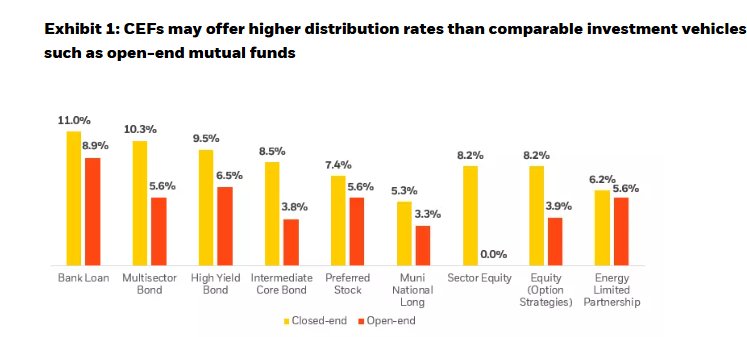
Source: BlackRock
Those high yields are largely attributable to CEFs’ ability to employ leverage.
Leverage is essentially borrowing money to buy more assets, boosting returns, or increasing distributions. Because CEFs face no redemption pressure, they maintain a more stable asset base, allowing managers to borrow against it and increase the total capital they deploy. When managed carefully, this strategy enhances the overall income generated by the portfolio, producing the larger yields CEFs are known for.
The combination of these two factors makes closed-end funds a powerful choice for enhancing portfolio yield.
Enhancing Income Diversification
Beyond the higher yields that CEFs can provide, the asset class offers additional advantages for investors willing to use them. One of the most significant is the ability to deliver income diversification benefits.
CEFs invest in a wide variety of securities—bank loans, municipal bonds, dividend stocks/sectors, junk bonds, and more. This asset-class diversification allows investors to generate income from multiple sources simultaneously, so if one asset class weakens, others may continue producing income and help stabilize the overall distribution.
Diversification is further enhanced through sources that carry different tax benefits. For example, muni bonds are generally tax-free, while preferred stock dividends may qualify for lower qualified dividend rates.
Many CEFs use managed distribution plans, which allow a fund to pay actual and expected capital gains throughout the year rather than as a single year-end distribution, enabling the fund to monetize total returns today rather than later.
As a result, not all distributions come from net investment income and capital gains—some are returned to investors as an untaxed return of capital. Return of capital reduces an investor’s cost basis, deferring the tax owed until the security is sold or the cost basis reaches $0, potentially years down the line. As an added benefit, fund managers can offset losses against gains, and as long as they meet their targeted distribution, investors can receive total returns untaxed.
Implementing Closed-End Funds in an Income Portfolio
For investors seeking diversified income, closed-end funds can play an important role within a broader portfolio strategy.
One approach is to allocate a portion of an income-focused portfolio specifically to CEFs, selecting funds that target different income-generating sectors within that allocation.
Popular CEFs
These CEFs are sorted by YTD total returns, which range from -1.4% to 25%. They have AUM between $100M and $3B, expense ratios between 0.85% and 5.5%, and current yields between 6.7% and 12.6%.
| Ticker | Name | AUM | YTD Total Ret (%) | Yield (%) | Exp Ratio | Security Type |
|---|---|---|---|---|---|---|
| XBGRX | BlackRock Energy Resources Trust | $441M | 24.7% | 6.7% | 1.33% | CEF |
| XAEFX | abrdn Emerging Markets ex-China Fund | $382M | 13.8% | 8.2% | 1.27% | CEF |
| XAGIX | abrdn Global Infrastructure Income Fund | $741M | 10.9% | 11.6% | 2.04% | CEF |
| XIAFX | abrdn Australia Equity Fund | $147M | 2.9% | 9.9% | 1.55% | CEF |
| XIGAX | Voya Global Advantage and Premium Opportunity Fund | $164M | 2.8% | 9.7% | 1.1% | CEF |
| XJPCX | Nuveen Preferred Income Opportunities Fund | $3B | 0.7% | 9.3% | 1.81% | CEF |
| XJLSX | Nuveen Mortgage and Income Fund | $106M | 0.7% | 9.6% | 1.57% | CEF |
| XBDJX | BlackRock Enhanced Equity Dividend Trust | $1.76B | 0.3% | 7.6% | 0.85% | CEF |
| XBITX | BlackRock Multi-Sector Income Trust | $785M | 0% | 10.8% | 1.70% | CEF |
| XETVX | Eaton Vance Tax-Managed Buy-Write Opportunities Fund | $1.83B | -0.1% | 7.6% | 1.08% | CEF |
| XDIAX | Nuveen Dow 30 Dynamic Overwrite Fund | $632M | -0.3% | 7.1% | 0.92% | CEF |
| XJQCX | Nuveen Credit Strategies Income Fund | $813M | -0.4% | 10.9% | 5.48% | CEF |
| XJFRX | Nuveen Floating Rate Income Fund | $1.35B | -0.6% | 11.1% | 2.2% | CEF |
| XBOEX | BlackRock Enhanced Global Dividend Trust | $733M | -0.8% | 7.8% | 1.07% | CEF |
| XFFAX | First Trust Enhanced Equity Income Fund | $478M | -1% | 6.5% | 1.12% | CEF |
| XBGTX | BlackRock Floating Rate Income Trust | $340M | -1.4% | 12.6% | 1.61% | CEF |
In a world where reliable income is increasingly difficult to generate, CEFs offer a powerful solution for diversification and yield. By combining multiple income-producing assets, employing leverage, and actively managing portfolios, they deliver income streams that often exceed those of traditional investments.
For investors seeking to build a diversified income sleeve, CEFs provide access to a wide range of opportunities—from municipal bonds and corporate debt to REITs and dividend-paying stocks.
Bottom Line
When used thoughtfully, CEFs can transform a portfolio from one reliant on a single income source into a diversified engine of cash flow—an increasingly valuable attribute in today’s uncertain market environment.
