

For many investors, closed-end funds (CEFs) occupy the mental category of “yield vehicles.” That is, they most often are associated with high-yield strategies, monthly distributions, and income-focused retirees. At their core, many believe that CEFs are tools designed to produce a consistent paycheck rather than drive long-term capital appreciation.
However, investors may want to throw out this narrow viewpoint.
The truth is, many CEFs can serve as a compelling growth engine, especially for investors who understand how structural leverage, active management, and discount dynamics can magnify long-term returns. When reframed and used intentionally, CEFs can help investors build a portfolio with differentiated growth potential compared to conventional exchange-traded funds (ETFs) or mutual funds.
Easy To See The Income Advantages
The reputation of CEFs as income machines comes from their unique structures. Thanks to their fixed share count, closed-end fund managers can do some things that ETFs and mutual funds cannot. This includes allowing managers to pursue less liquid, higher-yielding securities without worrying about redemptions. Managers can simply buy and hold to maturity. That structural stability and the lack of “fleeing capital” also allow managers to employ leverage to boost returns and yields.
This combination supports income generation.
CEFs’ moniker as income generation tools also stems from their distribution policies. Many CEFs pay out large monthly or quarterly dividends, sometimes over 8–10% annually due to leverage and their ability to hold illiquid securities. Likewise, many funds have adopted managed distribution policies designed to pay out a set percentage or yield, boosting their appeal as dividend plays.
As a result, many retirees and income seekers have long been the major buyers of closed-end funds to pad their portfolio’s yield and supplement their incomes.
Not Just For Income
These days, growth is on the menu for CEFs, as many are now adopting a different approach to generating returns, focusing on stocks, options, and other sectors designed for growth.
Today, CEFs pursue aggressive strategies that are rarely feasible in traditional open-end funds. Many equity CEFs target sectors with significant long-term growth potential, such as technology, healthcare innovation, or global emerging markets. These sectors and regions are known for their short-term volatility but long-term returns and promise. By placing them in a CEF, managers can hold them for the long term and not worry about investors selling when things get dicey, just like they can with various fixed-income securities.
Additionally, many CEFs now focus on specialized corners of the equity or alternative asset landscape, including convertible bonds, covered-call equities, and even master limited partnerships. Distributions from these funds tend to consist of capital gains, option-writing proceeds, or even return of capital. When viewed through the lens of total return rather than headline yield, some of the best-performing long-term equity CEFs compare favorably with traditional growth ETFs, especially when measured across a full market cycle.
Then there is the private sector to consider. Thanks to regulatory changes to CEFs under the 1940 Investment Company Act, the fund type can now own private assets. This can provide growth characteristics—like venture-capital-like allocations—not easily replicated elsewhere.
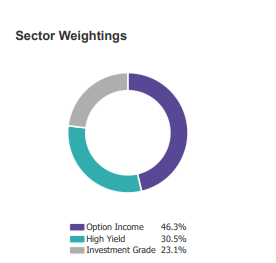
The reality is that most CEFs are now falling under this umbrella. Examining the S-Network Composite Closed-End Fund Index—which is one of the main benchmarks for the closed-end fund universe—reveals that over 46% of its holdings now fall under option income/stock-driven funds.
Source: VettiFi
There is potentially an added growth bonus when looking at CEFs. A net asset value (NAV) discount narrowing over time effectively boosts total return, allowing an investor to earn growth not only from the underlying portfolio but also from market pricing dynamics. In this sense, the structure of a CEF offers a second dimension of potential return that is rarely discussed in mainstream investing literature.
The reality is that closed-end funds are no longer just for income. A thoughtfully selected and properly implemented CEF can serve as a compelling growth engine.
Implementing CEFs as a Growth Strategy
Clearly, CEFs are not just for income anymore, and they can serve as a top-notch growth element for a portfolio. As such, many want to consider them when building their asset allocation. They can fit nicely as a “satellite” position and complement a core and broad-based holding.
And just like income-focused CEFs, buying a closed-end fund for growth is easy. Running our screen here at Dividend.com can unearth many top choices. Effective implementation requires a rigorous evaluation of both NAV performance and market price behavior.
Top-Performing CEFs
These CEFs are sorted by their year-to-date (YTD) total returns, which range from -2.3% to 15.8%. They have assets under management (AUM) between $100 million and $2.35 billion and expenses between 0.83% and 16%. They are currently yielding between 6% and 13%.
| Ticker | Name | AUM | YTD Total Ret (%) | Yield (%) | Exp Ratio | Security Type |
|---|---|---|---|---|---|---|
| XAGIX | abrdn Global Infrastructure Income Fund | $610M | 15.83% | 12.66% | 2.04% | CEF |
| XAEFX | abrdn Emerging Markets ex-China Fund | $344M | 13.02% | 10.4% | 2.04% | CEF |
| XIAFX | abrdn Australia Equity Fund | $130M | 12.07% | 10.4% | 1.94% | CEF |
| XJEQX | abrdn Japan Equity Fund | $93M | 11.97% | 6.09% | 0.83% | CEF |
| XBGRX | BlackRock Energy Resources Trust | $380M | 9.6% | 6.1% | 1.29% | CEF |
| XSRVX | NXG Cushing Midstream Energy Fund | $196M | 9% | 12.5% | 5.42% | CEF |
| XBDJX | BlackRock Enhanced Equity Dividend Trust | $1.65B | 7.3% | 9.1% | 0.86% | CEF |
| XJLSX | Nuveen Mortgage and Income Fund | $104M | 7% | 10.8% | 1.57% | CEF |
| XBOEX | BlackRock Enhanced Global Dividend Trust | $627M | 6.59% | 8.8% | 1.07% | CEF |
| XJPCX | Nuveen Preferred Income Opportunities Fund | $783M | 6.5% | 9.3% | 2.68% | CEF |
| XIGAX | Voya Global Advantage & Premium Opportunity Fund | $154M | 6.07% | 10.16% | 1.1% | CEF |
| XKYNX | Kayne Anderson Energy Infrastructure Fund Inc. | $2.34B | 3.8% | 7% | 16% | CEF |
| XNMLX | Neuberger Berman Energy Infrastructure & Income Fund Inc. | $543M | 3.8% | 7.4% | 13.24% | CEF |
| XEMOX | ClearBridge Energy Midstream Opportunity Fund Inc. | $913M | 2.5% | 8.8% | 13.9% | CEF |
| XFFAX | First Trust Enhanced Equity Income Fund | $401M | 1.93% | 6.9% | 1.12% | CEF |
| XETVX | Eaton Vance Tax-Managed Buy-Write Opportunities Fund | $1.6B | -1.1% | 8.77% | 1.08% | CEF |
| XDIAX | Nuveen Dow 30 Dynamic Overwrite Fund | $517M | -2.34% | 8.47% | 0.92% | CEF |
All in all, closed-end funds offer more than just income. Today, finding strong growth elements is possible. Their structural flexibility, access to specialized asset classes, use of leverage, and discount dynamics make them uniquely capable of providing long-term capital growth. For investors willing to look beyond headline yields, the CEF universe offers a rich landscape of possibilities that can complement and enhance traditional growth strategies.
Bottom Line
While closed-end funds are famous for their income generation, they can be used for growth. It turns out that many of the main reasons why they work well for yield also work well for total returns and capital appreciation. Investors should broaden their horizons and check out CEFs for growth.
