

Investors today are navigating one of the most complex market environments in recent memory. Equity valuations remain elevated, interest rates are shifting, inflation has proven stubborn, and geopolitical risks—from global conflicts to supply chain disruptions—continue to create uncertainty. In this environment, traditional portfolio construction can feel increasingly inadequate, driving investors to search for solutions that balance risk and return more precisely.
One of the fastest-growing tools designed to meet that need is the defined outcome ETF, also known as a buffer ETF.
These funds have surged in popularity because they offer something many investors crave: a clearer picture of potential outcomes. However, while buffer ETFs can be powerful tools, they are not one-size-fits-all solutions, and understanding how they work and who they best serve is critical before incorporating them into a portfolio.
The Rise of Buffer Strategies
The rapid growth of buffer ETFs is part of a broader transformation in the ETF industry. For years, ETFs were synonymous with passive investing—low-cost funds tracking broad market indexes. Today, however, active ETFs have exploded in both number and complexity, offering strategies that go far beyond simple index tracking.
Buffer ETFs sit at the intersection of this evolution.
They are actively structured products that use derivatives to shape investment outcomes in ways traditional funds cannot.
At their core, buffer ETFs are designed to limit downside losses while capping upside gains over a defined period, typically one year. This is why they are often called “defined outcome” ETFs—investors know, within a range, what they can expect in both good and bad market scenarios.
Given recent volatility, surging valuations, and overall economic uncertainty, investors have embraced these funds enthusiastically. According to Morningstar, buffer ETFs have posted an average annualized organic growth rate of 39% over the past three years and have amassed $78 billion by the end of 2025. The chart below illustrates the asset class’s torrid growth.
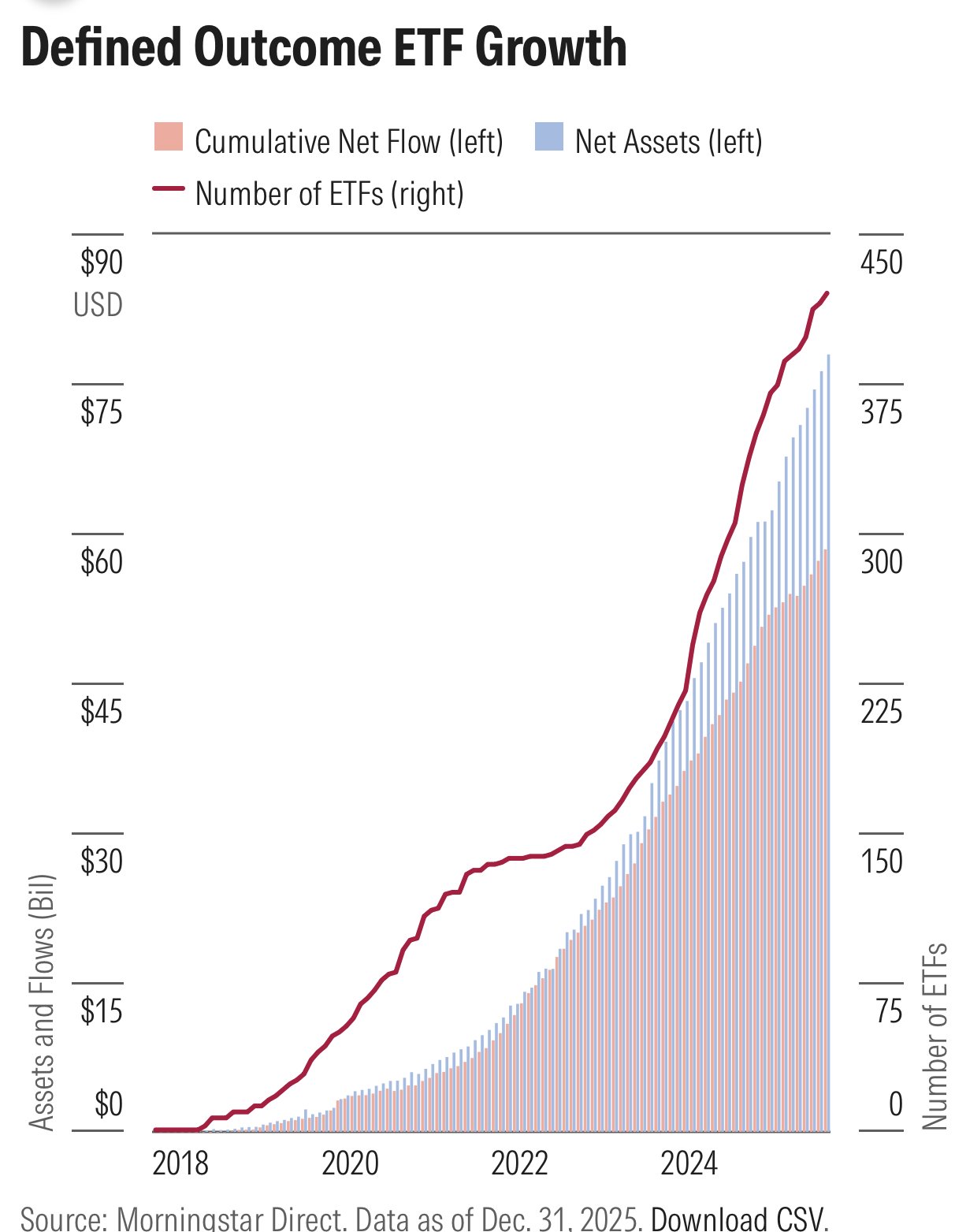
Source: Morningstar
The mechanics behind these active ETFs rely heavily on options strategies. Managers typically use combinations of put and call options—often structured as spreads—to create a buffer zone against losses. For example, a fund might protect against the first 10% of market losses, meaning an 8% market decline results in little to no investor loss. However, if the market falls more sharply—say 20%—the investor absorbs losses beyond that initial buffer.
This protection comes at a cost. To finance the downside buffer, the fund sells upside potential by capping gains, meaning that if the market rises significantly, investors participate only up to a predetermined limit.
This structure has resonated strongly with investors, particularly during periods of market volatility.
Not for Everyone
Given the surge in assets, press coverage, and the sheer number of buffer ETFs on the market, many investors have been drawn to the fund type—and it is easy to see why. However, buffer ETFs are not appropriate for every investor, and their unique structure makes them particularly well-suited for specific use cases.
According to Morningstar research, buffer ETFs have positive correlations with stocks. That correlation means a standard buffer ETF can help boost the upside of a bond-heavy allocation (20 stock/80 bond) without sacrificing downside protection. Conversely, the study found that stock-heavy allocations were largely hindered by the addition of a buffer ETF. 1
This means buffer ETFs perform best within risk-conscious portfolios.
These portfolios generally belong to two categories of investors: retirees or those nearing retirement who prioritize capital preservation over maximum growth, and investors who want equity exposure but are uncomfortable with full market volatility.
This category also includes investors with short- to medium-term investment horizons. Because buffer ETFs operate over defined periods, they can align well with specific time-based goals, such as funding a future expense.
With that in mind, buffer ETFs may be less suitable for long-term investors focused on maximizing returns. Over extended periods, the capped upside can lead to underperformance relative to traditional equity investments, particularly in strong bull markets. Growth-oriented investors may be better served by traditional diversification methods, such as bond allocations and other alternatives.
How to Use Buffer ETFs in a Portfolio
Buffer ETFs are best viewed as tools, not standalone solutions. Their effectiveness depends on how they are integrated into a broader portfolio. According to research, those portfolios should lean conservative—allowing for modest additional upside while maintaining a conservative tilt.
Buffer ETFs
These ETFs offer low-cost exposure to buffer strategies, but do not comprise a complete list of available buffer funds. Sorted by YTD total returns ranging from 5.7% to 8.9%, they carry expenses from 0.50% to 1.05% and assets from $60M to $1.3B. These ETFs pay minimal dividends.
| Ticker | Name | AUM | YTD Total Ret (%) | Yield (%) | Exp Ratio | Security Type | Actively Managed? |
|---|---|---|---|---|---|---|---|
| BUFM | AB Moderate Buffer ETF | $212M | 8.9% | 0% | 0.69% | ETF | Yes |
| BUFP | PGIM Laddered S&P 500 Buffer 12 ETF | $60M | 8.8% | 0% | 0.5% | ETF | Yes |
| PJAN | Innovator U.S. Equity Power Buffer ETF - January | $1.3B | 7.2% | 0% | 0.79% | ETF | Yes |
| BUFD | FT Vest Laddered Deep Buffer ETF | $1.3B | 7.1% | 0% | 1.05% | ETF | Yes |
| MAXJ | iShares Large Cap Max Buffer Jun ETF | $170M | 6.9% | 0.6% | 0.53% | ETF | Yes |
| IVVB | iShares Large Cap Deep Buffer ETF | $269M | 5.7% | 0.8% | 0.53% | ETF | Yes |
Buffer ETFs represent one of the most innovative developments in modern portfolio construction. By combining options strategies with the accessibility of ETFs, they give investors a way to shape risk and return outcomes more precisely than traditional approaches allow.
In today’s uncertain market environment, that flexibility is increasingly valuable. For the right investor—particularly conservative investors seeking to reduce volatility while staying invested—buffer ETFs can be a powerful portfolio addition.
However, they are not a universal solution. Their capped upside, complexity, and reliance on timing mean they must be used thoughtfully and strategically.
Buffer ETFs are best understood not as replacements for traditional investments, but as targeted tools designed to help investors navigate uncertainty with greater confidence and control.
Bottom Line
Buffer ETFs have emerged as a compelling solution for investors navigating today’s uncertain markets, offering a structured way to participate in equity upside while limiting downside risk—though they aren’t right for everyone.
1 Morningstar (March 2026). Buffer ETFs Are Not for Everyone. Here’s How to Use Them in Your Portfolio
