

Investors are facing a growing challenge. The modern equity market is increasingly defined by concentration. A small group of mega-cap technology and AI-driven companies now commands an outsized share of market capitalization, index weightings, and investor attention. These firms—often seen as engines of innovation and growth—have delivered strong returns, but their dominance has created a new challenge: the market is no longer as broad as it appears.
Traditional passive strategies, particularly those tracking capitalization-weighted indices, naturally allocate more capital to the largest companies. As a result, investors may find themselves heavily exposed to the same handful of stocks, sectors, and themes.
In this environment, active ETFs are emerging as a powerful solution, offering investors the ability to move beyond index constraints, uncover new sources of return, and gain exposure to a broader and more dynamic equity opportunity set.
The Concentration Problem: When the Market Isn't the Market
If there has been one major theme of the past year or two, it is the ascendancy of tech and artificial intelligence (AI). The promise of AI, combined with investors seeking to repeat trends from previous low-growth environments, has lifted the technology sector to concentration levels not seen in decades. Today, tech stocks hold their highest weighting in major indexes in 50 years.
The Magnificent Seven — Apple, Microsoft, Alphabet, Amazon, Meta Platforms, NVIDIA, and Tesla —have dominated market indexes and overall market returns since the pandemic.
The rise of mega-cap stocks has driven unprecedented concentration in major indices, with a small number of companies now representing a significant portion of total market value. According to Fidelity, the Mag Seven constitutes over 30% of the S&P 500’s total market cap and, through March of this year, has driven over 40% of the S&P 500’s total return.
Recent market dynamics reinforce these concerns. Even as broader economic conditions evolve, performance has often been narrowly concentrated, leaving many sectors and stocks underrepresented in passive portfolios.
Capturing Opportunity Beyond Mega-Caps
The dominance of mega-cap technology and AI stocks has pushed many top-performing sectors out of investors’ minds. European banks, for example, delivered a 12-month return of 92.7%—a result few investors would have predicted. 1
State Street has noted these opportunities outside tech by examining the pairwise correlation between stocks. The data shows a meaningful downward trend, indicating that investors are no longer trading on specific themes, ideas, or sectors. The chart below from SSGA highlights their findings.
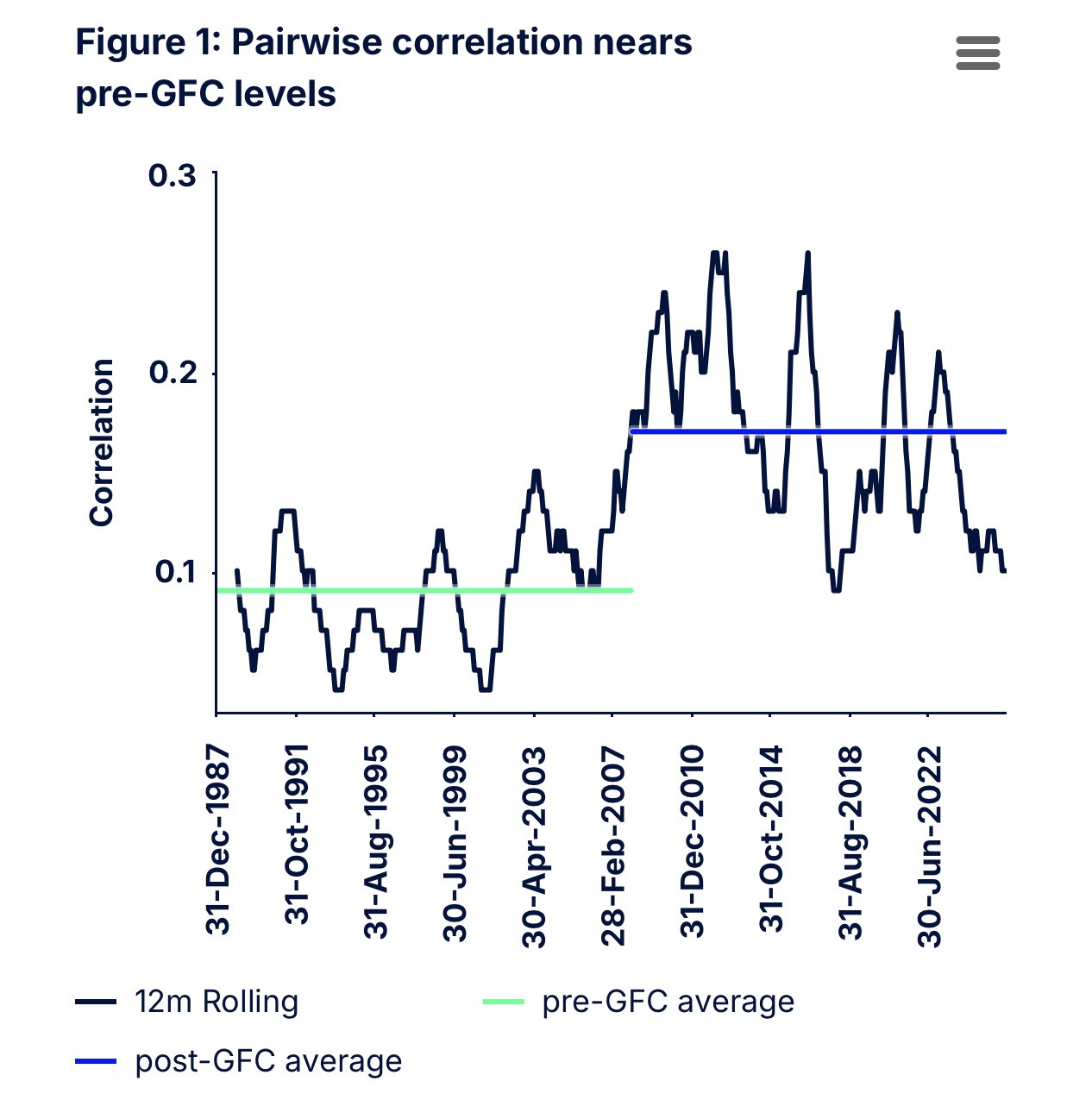
Source: State Street Global
According to State Street, this level of disparity and dispersion between sectors and stocks puts passive investments at a significant disadvantage. Passive strategies, by design, mirror index composition, which in a concentrated market means owning more of what has already performed well, causing investors to miss the broader equity market by focusing on only a few names.
A Time for Active ETFs
The current market environment is characterized by heightened dispersion, meaning the performance gap between individual stocks has widened. This creates a favorable backdrop for active management, as skilled managers can differentiate between companies poised for growth and those facing structural challenges.
Rather than being constrained by index weightings, active managers can build portfolios around high-conviction ideas, emphasizing companies with improving fundamentals while avoiding those with unjustified valuations.
Active managers have the flexibility to rotate across sectors, positioning portfolios to benefit from changing economic conditions. Infrastructure spending and reshoring trends can support industrial and materials companies, while rising consumer demand may bolster select consumer discretionary firms—allowing investors to capture opportunities that passive strategies may overlook.
Active ETFs have enhanced this further by combining lower costs, daily tradability, and tax efficiency with active insight. Active ETFs have experienced consistent inflows, reflecting growing demand for strategies that can navigate complex markets. According to State Street, active ETFs could be the preferred vehicle for overcoming the market’s current concentration issues and boosting portfolio performance.
Active Large-Cap Equity ETFs
These active ETFs were selected based on their lower concentration risk relative to the broader S&P 500 and are sorted by year-to-date total return, which ranges from 16% to 51%. They carry expenses between 0.15% and 0.59%, AUM between $760M and $21B, and current yields between 0% and 1.45%.
| Ticker | Name | AUM | YTD Total Ret (%) | Yield (%) | Exp Ratio | Security Type | Actively Managed? |
|---|---|---|---|---|---|---|---|
| FBCG | Fidelity Blue Chip Growth ETF | $764M | 50.5% | 0% | 0.59% | ETF | Yes |
| CGGR | Capital Group Growth ETF | $2.84B | 34.5% | 0.38% | 0.39% | ETF | Yes |
| CGUS | Capital Group Core Equity ETF | $1.32B | 22% | 1.24% | 0.33% | ETF | Yes |
| DFAC | Dimensional U.S. Core Equity 2 ETF | $20.45B | 16% | 1.34% | 0.17% | ETF | Yes |
| AVUS | Avantis U.S. Equity ETF | $4.53B | 16% | 1.45% | 0.15% | ETF | Yes |
Mega-cap stocks continue to dominate headlines and indices, making the need for broader exposure and differentiated strategies increasingly apparent. Active ETFs offer a compelling solution, allowing investors to move beyond the limitations of passive investing and capture a wider range of opportunities.
By combining flexibility, efficiency, and active insight, these strategies help investors access parts of the market that might otherwise remain overlooked.
In a world where the “market” no longer reflects the full opportunity set, active ETFs provide a way to see—and invest in—the bigger picture.
Bottom Line
Active ETFs offer investors a powerful way to move beyond the concentration of mega-cap and AI-driven stocks, unlocking opportunities across undervalued sectors, smaller companies, international markets, and differentiated investment factors.
1 SSGA (February 2026). Capturing opportunity as the equity landscape evolves
