

Buffer ETFs have shifted from niche solutions to mainstream portfolio tools, particularly among financial advisors managing portfolio volatility and investor expectations. Investment bank and asset manager Goldman Sachs has become one of the largest providers of these active ETFs.
Goldman Sachs’ acquisition of Innovator Capital Management represents more than a routine asset-management transaction.
By purchasing Innovator, Goldman makes a direct, sizable commitment to the defined-outcome or “buffer” ETF market, one of the fastest-growing segments in the active ETF space. In acquiring Innovator, Goldman buys not just ETF assets but category leadership, deep product expertise, and a scalable platform that positions the firm as a dominant player in buffer ETFs.
What Buffer ETFs Are and Why They’ve Gained Traction
Buffer ETFs deliver a defined return profile over a specific period, typically one year. Using options on equity indexes, these funds provide investors upside participation up to a cap while protecting against a predetermined portion of market losses. If losses exceed the buffer, investors face exposure beyond that threshold, with returns depending on when they buy or sell shares within the outcome period.
Buffer ETFs appeal through their clarity. They offer explicit trade-offs—limited upside for defined downside protection—rather than abstract volatility or diversification. This structure resonates with investors seeking equity exposure without the emotional toll of drawdowns.
This allows investors to stay invested, which Goldman Sachs says offers the best outcome. Goldman’s analysis shows that the worst day in a drawdown is often followed by just two to eight days of the best day in the subsequent recovery. Investors who time the market, flee to cash, and try to re-enter often miss those days, resulting in a wide range of return outcomes. This Goldman chart highlights the difference.
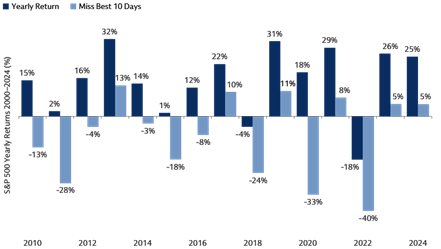
Source: Goldman Sachs
Using a buffer ETF in place of some fixed income exposure keeps investors locked into equity markets. They can achieve higher long-term returns while reducing longevity risks in portfolios. Goldman calls this a game-changer for investors facing growing risks to their nest eggs.
Buying Innovator Is a Transformational Move
Despite buffer ETFs’ potential and growing adoption, a few niche players dominate the sector. Innovator Capital Management is one of them.
Innovator pioneered buffer ETFs, launching the first products in 2018. The firm has built the largest and most comprehensive suite of defined-outcome ETFs, spanning multiple buffers, caps, outcome periods, and underlying equity indexes. Its platform now includes over 150 ETFs and roughly $30 billion in assets.
Despite its global reputation and institutional presence, Goldman has played a modest role in the ETF marketplace. The firm has launched ETFs over the years, particularly in factor-based and active strategies, but it is not seen as a defining force in ETF innovation. Its ETF lineup complements its broader asset-management business rather than defining its identity. That includes its buffer or defined-outcome ETFs, which hold around $36 million in assets.
This explains Goldman’s $2 billion purchase of Innovator.
For Goldman, acquiring Innovator instantly strengthens its position in one of the fastest-growing active ETF spaces. The defined-outcome ETF market has grown rapidly to roughly $50 billion in assets, expanding nearly tenfold since 2020. Instead of years developing options-based expertise, product depth, and advisor education, Goldman gains all that capability in one deal.
The deal aligns with Goldman’s goal of expanding stable, fee-based revenue through asset and wealth management. Buffer ETFs suit this objective well, as advisors often use them as building blocks in portfolios, model strategies, and managed accounts, fostering recurring demand and client engagement. Adding Innovator’s products bolsters Goldman’s ability to offer differentiated solutions over commoditized exposure.
The acquisition also vaults Goldman among the largest active ETF players and boosts its total ETF assets under management by a third.
What This Means for Goldman and the Industry
For Goldman, acquiring Innovator marks a turning point in its ETF strategy. It elevates the firm from market participant to category leader in a fast-growing segment. The deal illustrates a pragmatic willingness to buy innovation rather than incubate it slowly in a competitive landscape.
For the industry, the transaction validates buffer ETFs as a permanent fixture in modern investing. When a firm of Goldman’s stature commits billions to a category, it signals confidence in its longevity and relevance, likely accelerating competition, product development, and advisor adoption in defined-outcome ETFs.
Buffer ETFs
These ETFs offer low-cost exposure to buffer strategies but do not comprise a complete list of available buffer funds. Sorted by YTD returns ranging from 5.7% to 8.9%, they have expenses from 0.50% to 1.05% and assets from $60M to $1.3B. These ETFs pay minimal dividends.
| Ticker | Name | AUM | YTD Ret (%) | Yield (%) | Exp Ratio | Security Type | Actively Managed? |
|---|---|---|---|---|---|---|---|
| BUFM | AB Moderate Buffer ETF | $212M | 8.9% | 0% | 0.69% | ETF | Yes |
| BUFP | PGIM Laddered S&P 500 Buffer 12 ETF | $60M | 8.8% | 0% | 0.5% | ETF | Yes |
| PJAN | Innovator U.S. Equity Power Buffer ETF - January | $1.3B | 7.2% | 0% | 0.79% | ETF | Yes |
| BUFD | FT Vest Laddered Deep Buffer ETF | $1.3B | 7.1% | 0% | 1.05% | ETF | Yes |
| MAXJ | iShares Large Cap Max Buffer Jun ETF | $170M | 6.9% | 0.6% | 0.53% | ETF | Yes |
| IVVB | iShares Large Cap Deep Buffer ETF | $269M | 5.7% | 0.8% | 0.53% | ETF | Yes |
Goldman Sachs’ purchase of Innovator Capital Management bets on the future of buffer ETFs. Acquiring the category’s pioneer and largest platform elevates Goldman’s position in the ETF ecosystem and aligns it with a fast-growing, advisor-driven market segment.
Bottom Line
As investors increasingly seek strategies balancing growth with risk control, buffer ETFs stand poised to play an expanding role in portfolio construction. This acquisition positions Goldman not only to participate in that growth but also to shape the next chapter of outcome-oriented investing.
