

Income investors have faced a persistent challenge in recent years: how to generate meaningful yield without taking on excessive interest-rate risk or moving too far down the credit-quality spectrum. While traditional fixed-income sectors like government bonds or investment-grade corporate debt provide stability, their yields often fall short of what many investors need. At the same time, higher-risk credit markets can introduce volatility and default risk.
Against this backdrop, investors have increasingly turned to active exchange-traded funds (ETFs) to access new sources of income. One of the newest areas gaining attention is collateralized loan obligations (CLOs), a structured credit market historically dominated by institutional investors.
Recognizing this demand, Fidelity Investments recently expanded its active ETF lineup with two new funds designed to provide direct access to the CLO market. These launches reflect a broader trend: active ETFs are increasingly bringing institutional asset classes to everyday investors while offering a potential path to higher yields.
Fidelity's Entry Into the CLO ETF Market
In response to the hunt for yield and risk reduction, Fidelity introduced two actively managed ETFs focused on collateralized loan obligations. The Fidelity AAA CLO ETF (FAAA) and the Fidelity CLO ETF (FCLO) invest directly in the asset class, representing Fidelity’s entry into a rapidly growing ETF segment as investors search for diversified sources of yield.
The two ETFs provide different types of exposure within the CLO market.
FAAA focuses primarily on the highest-quality portion of the CLO capital structure, investing at least 80% of its assets in AAA-rated CLO securities, which have first claim on cash flows generated by the underlying loan pools.
FCLO targets lower portions of the CLO structure, typically investing in BBB- through B-rated CLO tranches, which offer higher income potential but carry somewhat greater credit risk.
Both ETFs are actively managed and listed on the Nasdaq exchange. Management fees will be waived for the first 12 months, after which gross expense ratios of 0.20% for FAAA and 0.45% for FCLO will apply.
With its deep experience in credit markets and loan analysis, Fidelity aims to compete directly in this growing space.
A Great Income Tool
To understand the appeal of Fidelity’s new ETFs, it helps to understand the underlying asset class and why institutional investors have been drawn to CLOs.
CLOs are essentially pools of loans—typically 150 to 250—packaged into a single security. Most CLOs consist of senior secured loans made to corporate or private equity borrowers, though other debt, including fixed-rate securities, can also be included. CLOs allow banks and lenders to move loans off their balance sheets and into investors’ hands.
These loan packages are organized into “tranches,” each carrying a different level of credit risk, rated from AAA down to BB, with an equity tranche at the very bottom. Cash flows from the underlying loans are distributed to CLO investors according to a waterfall method.
Senior tranches (AAA, AA) are paid first, followed by each successive level down the ladder. As underlying loans are repaid, the CLO manager distributes those funds in order of tranche seniority, with any remaining proceeds returning to equity holders at the bottom.
This structure allows bonds with higher credit ratings to shield investors from defaults while still offering higher yields. Those yields also tend to be floating-rate, meaning interest payments adjust as short-term rates change, which can reduce sensitivity to interest rate movements compared with fixed-rate bonds.
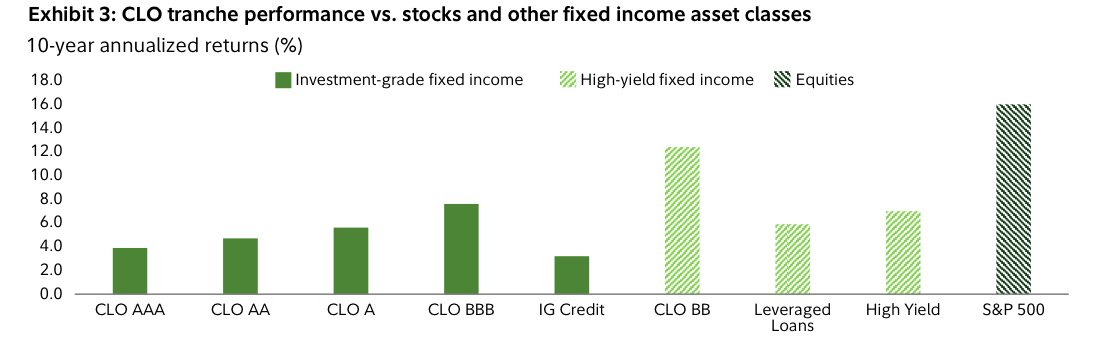
These features have allowed CLOs to outperform other investment-grade fixed-income assets. This chart from Fidelity highlights their returns.
Source: Fidelity
As a result, CLOs have become an increasingly important segment of the global credit market, finding their way into a variety of institutional portfolios.
The Role of Active ETFs in CLO Investing
While the CLO market offers compelling characteristics, it is also complex. Evaluating CLO deals requires detailed analysis of loan pools, credit quality, and structural protections.
This is where active management can add value.
Active ETF managers can analyze individual CLO structures, assess credit quality, and select securities that offer the best balance between income and risk, while adjusting portfolio exposures as market conditions change.
Active ETFs also deliver two major advantages for portfolios: liquidity and lower costs.
Unlike traditional private credit vehicles, ETFs trade throughout the day on public exchanges, allowing investors to enter or exit positions easily, and they typically carry lower expense ratios than hedge funds or private credit partnerships.
With this in mind, active CLO ETFs—along with Fidelity’s new offerings—are worth a look for investors seeking a new source of high yields:
CLO ETFs
These ETFs were selected for their ability to provide exposure to the CLO market and are sorted by one-year total return, which ranges from 6.9% to 10.2%. Expense ratios range from 0.19% to 0.50%, assets under management span $240 million to $16 billion, and current yields fall between 5.2% and 8.1%.
| Ticker | Name | AUM | 1-year Total Ret (%) | Yield (%) | Exp Ratio | Security Type | Actively Managed? |
|---|---|---|---|---|---|---|---|
| JBBB | Janus Henderson B-BBB CLO ETF | $1.35B | 10.2% | 8.1% | 0.50% | ETF | Yes |
| CLOI | VanEck CLO ETF | $749M | 8.1% | 6.3% | 0.40% | ETF | Yes |
| JAAA | Janus Henderson AAA CLO ETF | $15.6B | 7.3% | 6% | 0.22% | ETF | Yes |
| PAAA | PGIM AAA CLO ETF | $1.39B | 7.3% | 5.2% | 0.19% | ETF | Yes |
| CLOA | iShares AAA CLO Active ETF | $244M | 6.9% | 5.7% | 0.20% | ETF | Yes |
Fidelity’s launch of the FAAA and FCLO ETFs underscores the growing role of active ETFs in delivering sophisticated credit strategies to a broader audience, expanding access to the CLO market—once the domain of institutional investors—for income-focused portfolios.
CLOs offer appealing characteristics, including higher yields, floating-rate income, and structural credit protections. Combined with the flexibility and transparency of the ETF structure, they form a powerful vehicle for accessing private credit markets.
Bottom Line
For investors seeking new sources of yield in an uncertain interest-rate environment, Fidelity’s CLO ETFs are another example of how active ETFs are reshaping the fixed-income landscape.
