

New York State and, more specifically, New York City sit at the center of the municipal bond universe. Few issuers rival their scale, frequency, or importance. For decades, the city has been one of the largest and most active borrowers in the tax-exempt market, issuing billions annually to fund infrastructure, schools, transportation, and essential services. As a result, many investors—whether directly through individual bonds or indirectly through mutual funds and ETFs—already hold exposure to New York City’s debt.
That ubiquity makes the city’s credit quality more than a local story—it is a national one. When New York City’s fiscal outlook shifts, it ripples across portfolios, and recently those shifts have drawn increasing attention.
The question for investors is whether New York’s current budget woes are a cause for concern or an opportunity for fixed-income investors.
A Giant in the Municipal Market
In the $4 trillion municipal bond market, few issuers truly stand out, and New York and New York City are among them. The city’s prominence is no accident: its size alone demands constant capital investment, from maintaining aging infrastructure to funding new development projects, resulting in approximately $46 billion in outstanding muni bonds.
This scale produces a steady pipeline of issuance that investors have come to rely on for both income and perceived stability.
The city’s bonds—particularly its general obligation (GO) and Transitional Finance Authority (TFA) debt—are widely held due to their historically strong credit profile, currently rated AA.
That top rating, combined with large issuance volume and other positive factors, means NYC debt appears across a wide variety of mutual funds, ETFs, and separately managed accounts.
Spending Pressures and Budget Strains
Scale is both a strength and a challenge. The same size that supports robust revenues also demands equally large expenditures, and it is on the spending side where concerns are beginning to emerge.
At the heart of the current credit conversation is New York City’s evolving fiscal outlook and the plans of current Mayor Zohran Mamdani.
The city’s preliminary fiscal 2027 budget includes a projected deficit of approximately $5.4 billion—a notable ongoing imbalance. 1
Looking further ahead, the city faces projected spending gaps in the range of $6 to $7 billion annually. While these figures are not unprecedented, they underscore a structural challenge: expenditures are growing faster than recurring revenues. This chart from New York Life Investments highlights that trend.
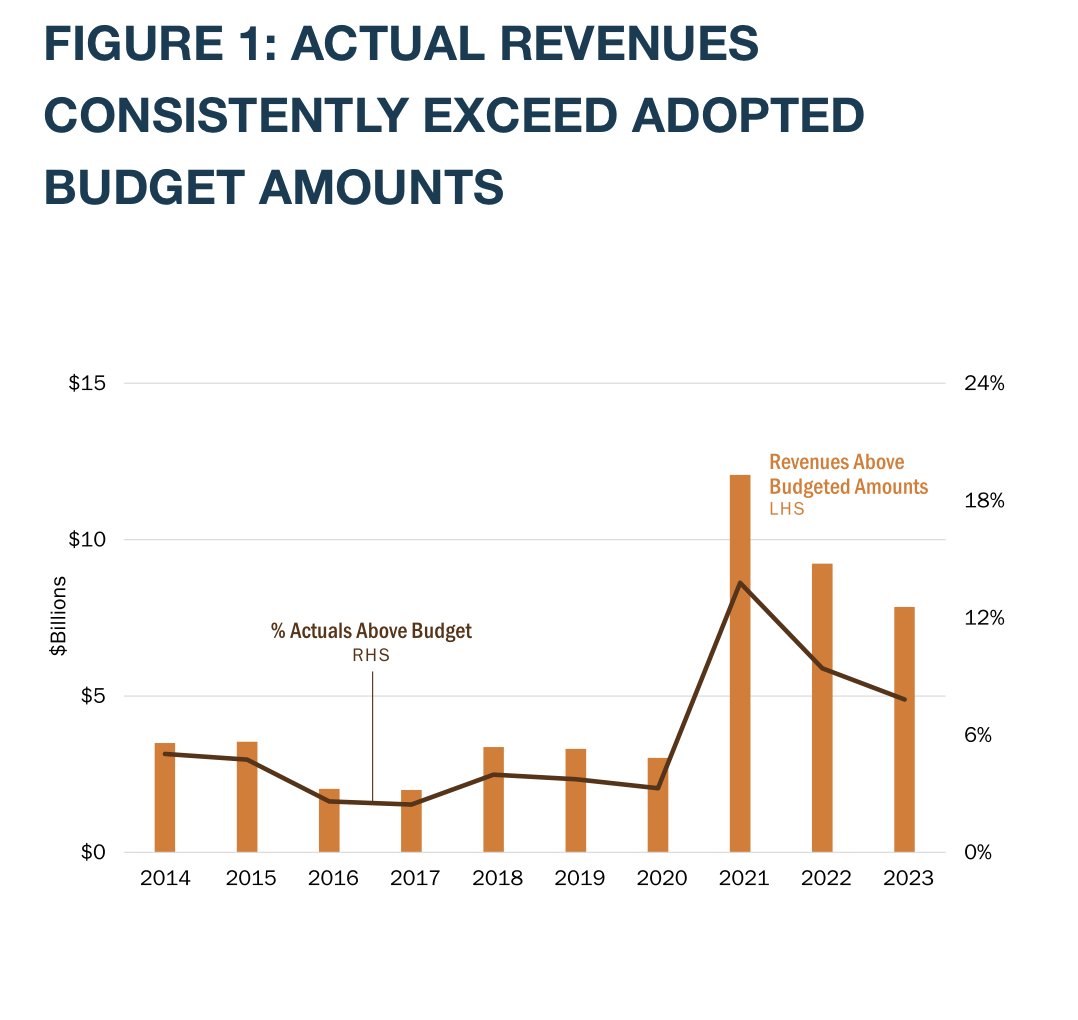
Source: New York Life
To bridge these gaps, policymakers are weighing a mix of options, including higher taxes on corporations and high-income earners, as well as possible increases in property taxes. These measures are politically sensitive and often require state-level approval, adding complexity to the budgeting process.
At the same time, the city has considered drawing on reserves—specifically its Rainy Day Fund and other financial cushions—to maintain budget balance.
Rising budget gaps and other revenue pressures have prompted multiple ratings agencies to shift their outlook on New York City’s credit to negative. For investors, this is concerning, and given comparisons to cities like Detroit or Stockton, California, along with the sheer size of NYC’s muni bond issuance, some panic has set in.
Rating Pressure vs. Fundamental Strength
Despite these concerns, it is important to distinguish between headline risk and underlying fundamentals.
While ratings agencies have adopted a more cautious stance, market pricing tells a somewhat different story. Credit spreads on New York City bonds have remained relatively stable, with 10-year spreads hovering around 34 basis points—close to historical averages and far from levels seen during periods of acute stress, such as the 2020 pandemic.
Several factors are at play.
One is the city’s institutional framework. New York City operates under strict fiscal controls, including a requirement to balance its budget annually and maintain a rolling four-year financial plan, and oversight from both city and state entities has historically constrained fiscal excesses.
Additionally, the city continues to benefit from strong revenue performance. Personal income tax collections have risen approximately 10%, while corporate tax revenues have increased by about 5%. Employment levels remain above pre-pandemic highs, and population trends have stabilized.
Meanwhile, NYC’s current budget shortfall projections are roughly half what they were a year ago, even as a deficit persists. As for the city’s rainy day fund, tapping it under aggressive scenarios would still leave more than $6 billion in reserves—above historic averages.
These factors reinforce the idea that, while fiscal pressures are real, the underlying economic base remains resilient. Investors should not view the current situation in binary terms, as New York City is neither on the brink of crisis nor immune to risk. Instead, it occupies a middle ground where solid fundamentals coexist with emerging fiscal pressures.
And that could make the bonds a buy.
New York Muni Bonds
These ETFs were selected for their low-cost exposure to New York muni debt. Sorted by YTD total return, they range from -0.4% to 0.9%, with expense ratios from 0.09% to 0.65%, assets from $33M to $1.3B, and current yields between 3% and 3.6%.
| Ticker | Name | AUM | YTD Total Ret (%) | Yield (%) | Exp Ratio | Security Type | Actively Managed? |
|---|---|---|---|---|---|---|---|
| GMNY | Goldman Sachs Dynamic New York Municipal Income ETF | $33.53M | 0.9% | 3.6% | 0.35% | ETF | Yes |
| FMNY | First Trust New York Municipal High Income ETF | $34.38M | 0.64% | 3.63% | 0.65% | ETF | Yes |
| PZT | Invesco New York AMT-Free Municipal Bond ETF | $128.11M | 0.54% | 3.52% | 0.28% | ETF | No |
| NYM | AB New York Intermediate Municipal ETF | $1.29B | 0.53% | 2.97% | 0.27% | ETF | Yes |
| NYF | iShares New York Muni Bond ETF | $1.22B | 0.2% | 3.06% | 0.09% | ETF | No |
| MUNY | Vanguard New York Tax-Exempt Bond ETF | $342.94M | -0.4% | 3.1% | 0.09% | ETF | No |
New York City’s municipal bonds remain a cornerstone of the market, backed by a powerful economic engine and strong institutional safeguards. However, growing budget gaps, reserve usage, and policy uncertainty have introduced new layers of risk that investors cannot ignore. While fundamentals remain intact, the path forward will depend heavily on fiscal discipline and political decision-making, making New York City a closely watched credit as the municipal market evolves.
Bottom Line
New York City remains a fundamentally strong municipal issuer, but rising budget pressures and growing reliance on reserves are risks investors should watch more closely.
1 New York Life (March 2026). New York City Credit Update: Noise vs. Signal
