

In an era defined by market uncertainty, sharp sector rotations, elevated valuations, and widening dispersion in returns, investors are often at a loss. Portfolio decisions that seem right one day may be regretted the next. However, as volatility and uncertainty persist, one pillar of investing seems to be working.
Value investing has reemerged as a compelling portfolio construction strategy.
While growth stocks led much of the past decade, shifting economic conditions and persistent volatility have reshaped the investment landscape. These conditions have created an opportunity for disciplined, valuation-focused strategies to outperform. Active value investing, particularly through ETFs, has gained new relevance, and the time for active value investing has never been better.
Today’s Volatile Environment
The smooth sailing of the markets has given way to rising volatility and uncertainty. Thanks to factors such as stubborn inflation, geopolitical uncertainty, fiscal woes, and dwindling economic data, investors have become more reactionary. Stocks and bonds have become more volatile, with the VIX now at highs not seen in years.
Part of the problem stems from the market’s overall high valuations amid the uncertainty.
Over recent years, a significant portion of market returns has been concentrated within a narrow set of large-cap growth stocks. The so-called Magnificent Seven—which includes names like Apple (AAPL), Nvidia (NVDA), and Meta Platforms (META) — has driven the bus. Growth stocks now trade at stretched valuation multiples relative to historical norms. Elevated valuations reduce future expected returns and make these companies more sensitive to earnings disappointment, regulatory risk, and shifts in investor sentiment.
It’s a significant issue for investors. Even those using index funds aren’t immune to the persistent and stretched valuations, now that growth stocks dominate many passive benchmarks.
Enter Value Investing
However, investors may not need to fret. There is a proven approach to navigate the volatility: value investing.
By definition, value investors seek “values,” that is, stocks trading at discounts to intrinsic value. This can be as simple as stocks trading for lower P/Es than the market or their sectors, or it can use a combination of metrics. The benefit is that value stocks can present a more attractive risk-reward dynamic in a volatile and uncertain environment because their lower multiples imply a greater margin of safety and more room for multiple expansion if fundamentals improve or if broader market leadership rotates.
This also reduces downside risk. Higher margins of safety and lower valuations provide more wiggle room when things go bad. After all, if investors buy a stock that is “cheap,” an earnings miss doesn’t do as much damage to the share price as one that is already trading at overvalued levels. By focusing on companies with depressed valuations relative to earnings, cash flow, or asset value, value strategies inherently embed protection against downside risk.
This is the recipe to help you make it through today’s uncertainty.
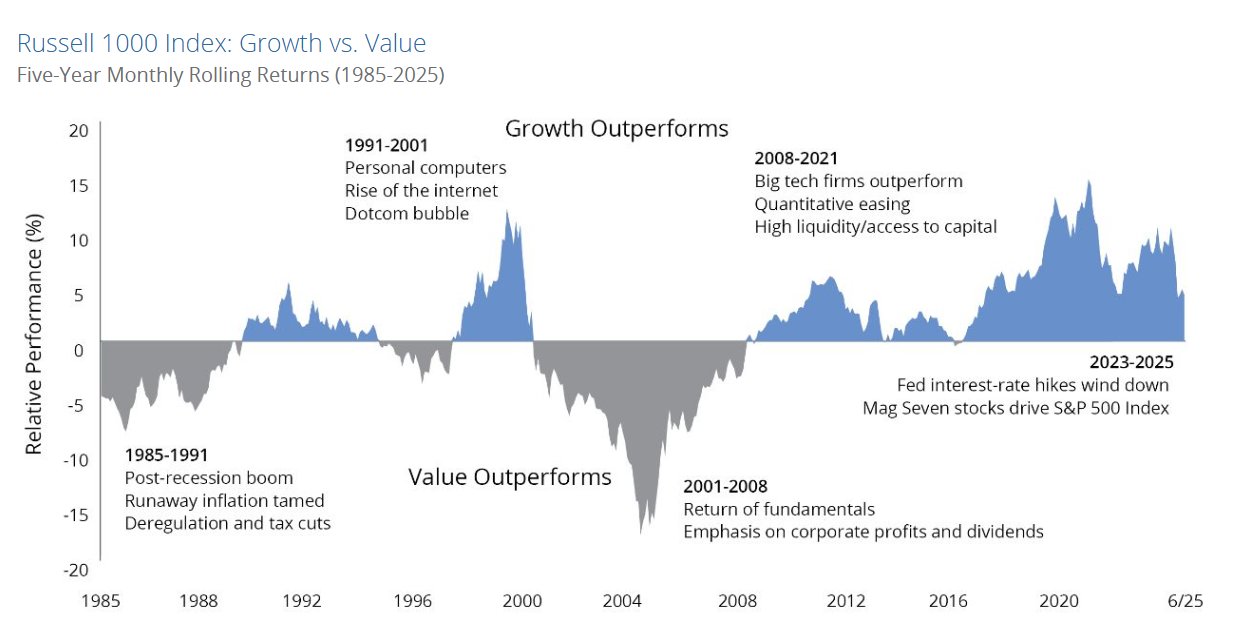
There’s historical precedence for this. Analysts at Hartford Funds looked at the cyclical trends of value versus growth stocks and found that value clearly outperforms during periods of strife and high volatility. This chart from the asset manager highlights these periods. As you can see, value has won out during many of the significant recessions and downturns of the last 30 or so years. 1
Source: Hartford Funds
Active Value and ETFs
Therefore, value investing could be an excellent way to combat the overvaluations and higher volatility of the current market environment. By seeking values, investors can get a better margin of safety, dividend potential, and other tools to navigate the market’s current volatility.
However, indexing may not be the best way to achieve these goals. There are some things to consider when going active.
Active managers have unique abilities that indexing can’t match. This includes being able to rebalance quickly without waiting for predetermined index changes. This agility is essential in markets where fundamentals can shift rapidly and where value opportunities can emerge in unexpected corners of the market. Moreover, active managers can avoid the pitfalls of pure index-based value strategies, which may lean heavily on backward-looking metrics or overconcentrate in specific industries simply because they appear statistically cheap. They can also combine their own secret recipes of metrics to derive true values among sectors and stocks.
And it looks like it works.
According to Morningstar data, more than half of active value managers have beaten the Russell 1000 Value Index over the last five years. At the same time, these active value managers have significantly added alpha, averaging 4 basis points’ worth of excess annual returns during that time. Being active in value pays serious benefits.
While value investing has long been associated with traditional mutual funds or individual stock selection, the growth of active ETFs has opened the door to new opportunities. Active ETFs combine the advantages of active management—flexibility, conviction, and the ability to exploit inefficiencies—with the structural benefits of the ETF wrapper. This includes intraday liquidity, lower expenses than many mutual funds, transparency of holdings, and tax efficiency. For value managers, the ETF structure could be a godsend, allowing additional tax-efficient returns to their shareholders.
The best part is that investors now have numerous choices within the active ETF market to play value stocks and take advantage of. Investors can use these funds in a core-and-satellite approach, shifting away from high-growth allocations and overvaluations.
Active Value ETFs
These ETFs were selected based on their exposure to value strategies using active management. They are sorted by their year-to-date (YTD) total return, which ranges from 6% to 24%. They have assets under management between $269 million and $18.6 billion and have expenses of 0.15% to 0.44%. They are currently yielding between 1% and 1.9%.
| Ticker | Name | AUM | YTD Total Ret (%) | Yield (%) | Exp Ratio | Security Type | Actively Managed? |
|---|---|---|---|---|---|---|---|
| CGDV | Capital Group Dividend Value ETF | $14.2B | 24.3% | 1.3% | 0.33% | ETF | Yes |
| FLV | American Century Focused Large Cap Value ETF | $269M | 14.7% | 1.2% | 0.42% | ETF | Yes |
| DFUV | Dimensional U.S. Marketwide Value ETF | $12.3B | 13.1% | 1.6% | 0.21% | ETF | Yes |
| DFLV | Dimensional U.S. Large Cap Value ETF | $3.6B | 13.1% | 1.7% | 0.22% | ETF | Yes |
| JAVA | JPMorgan Active Value ETF | $4.2B | 12.9% | 1.4% | 0.44% | ETF | Yes |
| AVLV | Avantis U.S. Large-Cap Value ETF | $8.3B | 12.7% | 1% | 0.15% | ETF | Yes |
| DFAT | Dimensional U.S. Targeted Value ETF | $11.6B | 7.5% | 1.9% | 0.28% | ETF | Yes |
| AVUV | Avantis U.S. Small-Cap Value ETF | $18.6B | 6.1% | 1.8% | 0.25% | ETF | Yes |
Value investing has reemerged as a powerful strategy amid today’s volatile market conditions, stretched valuations, and shifting economic trends. With higher margins of safety, more dependable dividend profiles, and greater resilience during periods of uncertainty, value strategies offer compelling advantages. The rise of active ETFs has made value investing more accessible, efficient, and customizable than ever.
Bottom Line
Rising market volatility has created some interesting conditions for investors to navigate. To that end, it may be time for active value investing. With their higher margins of safety, these stocks have been able to navigate changes in market movements with ease over rivals. ETFs make it easy to add active value to a portfolio.
1 Hartford Funds (November 2025). The Cyclical Nature of Growth vs. Value Investing
