

If there is one issue investors can’t seem to shake, it is inflation, which has reasserted itself as a defining challenge for investors and policymakers. After decades of relative stability, the global economy has entered a period characterized by heightened price pressures, structural shifts in labor markets, supply chain realignment, and persistent geopolitical strains.
The steady price rise does not appear to be going away, as inflation has become stubborn.
However, investors have new solutions to combat the issue. Active investing, supported by the rapidly expanding universe of active exchange-traded funds (ETFs), offers investors a dynamic and flexible way to fight inflation, preserve purchasing power, and capitalize on opportunities that emerge in higher-inflation environments. Adding a sleeve of inflation-fighting tools makes sense.
Staying Stubborn
A combination of pent-up demand, consumer spending, stimulus, and supply chain woes created one of the worst inflationary environments in decades, hitting a peak of 9.1% in June of 2022.
The Federal Reserve dropped inflation from record highs, but it cannot get it any lower and move closer to its 2% target. This chart from NerdWallet, using U.S. Bureau of Labor Statistics data, illustrates how far inflation has fallen and how it has stayed steady. For the 12 months ending in September, the U.S. inflation rate hit 3.0%. The report for October was canceled due to the government shutdown.
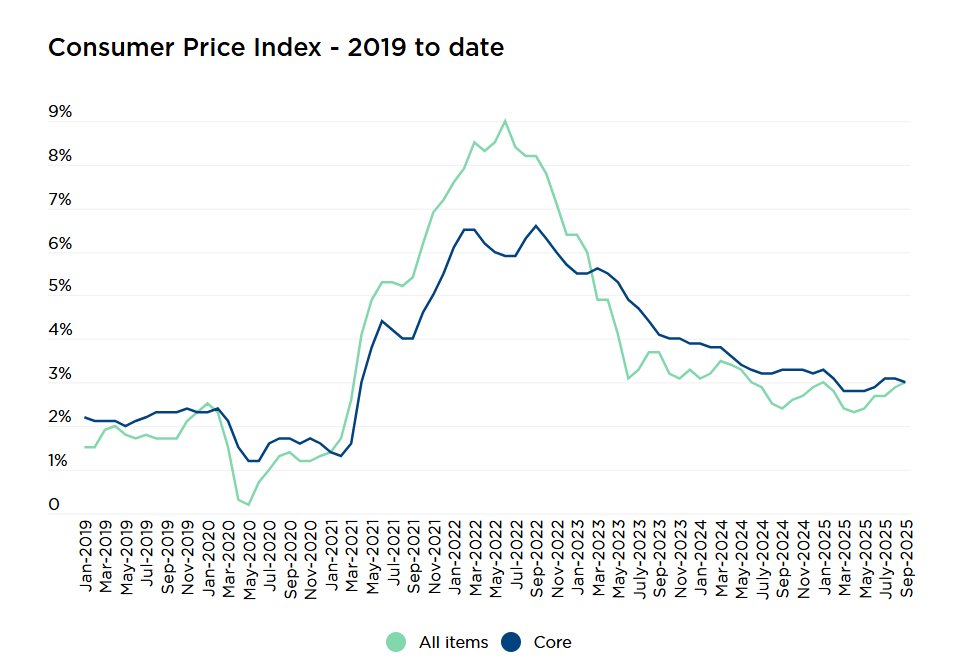
Source: NerdWallet
Today, inflation is driven by a combination of cyclical and structural forces that are proving harder to deal with than the central bank and investors had planned.
While supply chain disruptions and energy shocks were key contributors in the early phases of inflation’s rise, the data have persisted beyond those temporary effects. Tight labor markets, rising wage expectations, demographic changes, and long-term capital underinvestment in key sectors have created a backdrop where inflation remains above central bank comfort levels.
At the same time, the United States is operating with tariff measures at historically elevated levels. Moreover, these new measures introduced in 2025 are expected to remain in place for the foreseeable future. Fiscal stimulus, such as stimulus measures and tax cuts through the One Big Beautiful Bill, is expected to add pressure. There is hefty artificial intelligence (A.I.) spending that far exceeds normal corporate CAPEX build-outs and is creating an arms race and extra demand.
Therefore, inflation has not been able to crack the 3% mark, and some analysts now believe that it will begin to creep higher. For example, analysts at T. Rowe Price now predict that these macroeconomic reasons will cause inflation to rise as high as 4% in 2026. 1
Active Inflation Fighting
Traditional stock and bond allocations face headwinds in such an environment. Growth stocks tend to suffer as rising rates compress valuation multiples, and long-duration bonds lose value when inflation expectations rise. Broad passive allocations may not adjust quickly to these pressures, leaving investors exposed to sectors and styles that underperform in inflationary regimes. With steady inflation now part of the picture, investors need to rethink allocations to fight the rising hand of prices.
This backdrop has shifted attention toward strategies capable of adapting in real time, making active management an increasingly valuable tool.
Active investing offers an advantage in inflationary environments by enabling managers to dynamically tilt portfolios toward assets and sectors that historically perform well during periods of rising prices. Unlike passive strategies, which are bound to index weights, active managers can overweight inflation beneficiaries, adjust duration exposure, hedge currency risks, and take advantage of market dislocations. This includes the ability to target inflation-sensitive sectors with strong pricing power that tend to outperform when input costs rise.
Outside stocks, active management can also help in other asset classes. For example, within the fixed-income space, active bond managers can shorten duration to reduce rate sensitivity, rotate between inflation-protected and nominal securities, such as TIPS, and identify credit opportunities that benefit from higher nominal GDP growth.
Active management also plays a strong leadership role within “real assets”, such as commodities and real estate. Commodities, which have historically been one of the strongest hedges against inflation, benefit greatly from active approaches, as managers can overweight commodities experiencing tightening supply-demand balances and underweight those with weakening fundamentals. Real assets, such as natural resources, real estate, infrastructure, and farmland, provide inflation protection, where active strategies can add additional alpha. For instance, infrastructure assets, such as toll roads, pipelines, or energy transport, often have built-in inflation escalators in their contracts, making them natural beneficiaries of rising prices.
By adapting across sectors, asset classes, and time horizons, active strategies create a more responsive defense against inflation than traditional passive portfolios.
Taking An Active Approach To Inflation Fighting
With inflation still running high and expectations for higher inflation on the horizon, it is paramount that investors seek solutions to fight the force and steady their future purchasing power. To that end, building an inflation-focused sleeve within a traditional allocation model makes sense.
Investors can do that on their own, purchasing an active commodities ETF, a TIPS fund, etc. However, a better bet could be one of the new active ETFs designed to cover a wide range of real assets and inflation-fighting securities. With one ticker access, investors can get the best active management to stabilize returns, preserve purchasing power, and reduce the vulnerability of traditional equity-bond allocations, without having to do the legwork themselves. By selecting one of these funds, investors can focus on their total allocation strategies rather than adding a level of additional complication.
Inflation Focused Active ETFs
These ETFs were selected based on their ability to provide low-cost and active exposure to the inflation-fighting asset classes and strategies. They are sorted by their YTD total return, which ranges from 3.2% to 13.4%. They have expense ratios between 0.12% and 0.92% and assets under management of $5M to $1.26B. They are yielding between 1.5% and 4.7%.
| Ticker | Name | AUM | YTD Total Ret (%) | Yield (%) | Exp Ratio | Security Type | Actively Managed? |
|---|---|---|---|---|---|---|---|
| RAAX | VanEck Inflation Allocation ETF | $132M | 13.4% | 1.7% | 0.95% | ETF | Yes |
| RLY | SPDR SSGA Multi-Asset Real Return ETF | $503M | 11.5% | 3.4% | 0.50% | ETF | Yes |
| INFL | Horizon Kinetics Inflation Beneficiaries ETF | $1.26B | 11.3% | 1.76% | 0.85% | ETF | Yes |
| FCPI | Fidelity Stocks for Inflation ETF | $226M | 10.6% | 1.5% | 0.16% | ETF | Yes |
| CMDT | PIMCO Commodity Strategy Active Exchange-Traded Fund | $373M | 9% | 3.2% | 0.92% | ETF | Yes |
| DFIP | Dimensional Inflation-Protected Securities ETF | $924M | 6.3% | 4.7% | 0.12% | ETF | Yes |
| JCPI | JPMorgan Inflation Managed Bond ETF | $716M | 6.2% | 3.9% | 0.40% | ETF | Yes |
| AVIE | Avantis Inflation Focused Equity ETF | $5M | 3.4% | 2% | 0.25% | ETF | Yes |
| CPII | American Beacon Ionic Inflation Protection ETF | $10M | 3.2% | 3% | 0.75% | ETF | Yes |
Overall, rising and persistent inflation has challenged conventional portfolio construction, but it has also created a powerful opportunity for active management and active ETFs to shine. Inflation alters the relationships between asset classes. Active managers have the flexibility to rotate among inflation-benefiting assets and avoid inflation-exposed vulnerabilities, and active ETFs allow investors to capture this flexibility while maintaining the transparency and cost efficiency of the ETF structure.
Bottom Line
Inflation is here to stay and may get worse before it gets better. Therefore, inflation-fighting is a top priority for portfolios. Going active and using active ETFs is an excellent way to add a dedicated inflation-fighting sleeve without the hassle and protect portfolio purchasing power.
1 T. Rowe Price (December 2025). 2026 Global Market Outlook: Minds, machines, and market shifts
