

For much of the past two decades, passive investing dominated the conversation. Low-cost index funds and ETFs reshaped portfolios, offering broad market exposure with simplicity and efficiency. However, markets have evolved. Concentration in mega-cap stocks, rising volatility, shifting interest rate regimes, and more complex global dynamics have made it harder for investors to rely solely on traditional passive strategies.
Investors are increasingly seeking flexible, outcome-oriented portfolio solutions, and that search is driving a powerful shift toward active ETFs. By combining the structural advantages of ETFs—liquidity, transparency, and tax efficiency—with the flexibility of active management, momentum in this fund type continues to build.
What was once a niche category has become one of the fastest-growing segments in asset management, reshaping how portfolios are constructed across both equities and fixed-income.
The Growth of Active ETFs: From Niche to Mainstream
The rise of active ETFs has been remarkable. Structural and regulatory changes from the SEC have ignited a firestorm of activity, quickly transforming active ETFs from an esoteric fund form into a portfolio staple.
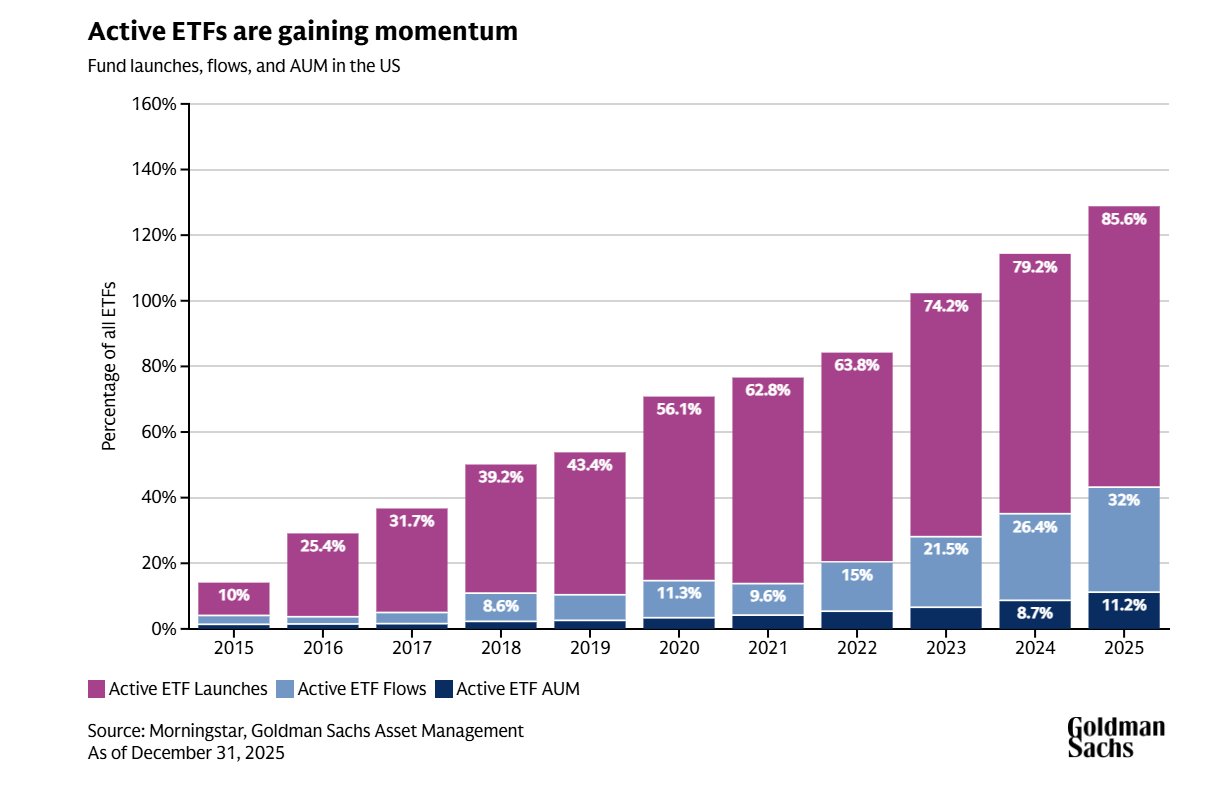
According to the latest data from Goldman Sachs, global active ETFs held nearly $1.8 trillion in assets by the end of 2025, reflecting an organic growth rate of 50% per year since their creation just before the Great Recession. This growth reflects a fundamental shift in investor preferences. In 2025 alone, active ETFs gathered approximately $475 billion in inflows, accounting for about one-third of all ETF flows despite representing a much smaller share of total ETF assets. There have even been periods where active ETFs outpaced passive ETFs in monthly inflows—a notable development given the massive size advantage of passive funds. 1
Asset gathering has not been limited to a few funds. The product landscape has expanded rapidly, with nearly 1,000 active ETFs launched in 2025—far exceeding passive ETF launches and signaling where asset managers are focusing their innovation efforts.
While passive ETFs still dominate in total assets, active ETFs are gaining market share at a much faster pace, with some estimates showing their assets growing nearly three times faster than those of passive ETFs.
This chart from Goldman highlights the rapid rise of active ETFs.
Source: Goldman Sachs
This momentum carries a clear message from investors: they want more than market exposure—they want solutions.
The Where and The Why Of Active ETFs
Goldman Sachs offers some answers as to why active ETFs are gathering market share, assets, and investor attention. In short, active ETFs can deliver increasingly sophisticated strategies in an accessible format.
In equity markets, active ETFs allow investors to move beyond index constraints. Rather than concentrating heavily in the largest companies, these strategies can seek opportunities in underrepresented areas, such as small- and mid-cap stocks, international markets, or specific factors like quality, value, or momentum—flexibility that is particularly valuable when a handful of mega-cap stocks dominate index performance.
The most notable growth, however, has been in fixed-income, where active management has long been considered essential.
Unlike equities, where information is widely available and markets are highly efficient, fixed-income markets are more fragmented and less transparent. This creates opportunities for active managers to add value through security selection, sector allocation, and risk management—capabilities that active ETFs now deliver in a more efficient and liquid structure.
Goldman notes that in 2025, active ETFs captured a record 38% of all fixed-income ETF inflows, underscoring strong investor demand for actively managed bond strategies.
Investors are turning to active fixed-income ETFs for several reasons. First, these strategies can navigate complex environments—such as changing interest rate regimes or credit cycles—more effectively than passive approaches. Second, they access a broader opportunity set, including sectors underrepresented in traditional indices. Third, they can actively manage risks, such as duration and credit exposure, in ways passive funds cannot.
Beyond fixed-income, active ETFs are expanding into alternatives, income strategies, and outcome-oriented solutions. These products are designed not merely to track markets, but to achieve specific goals, such as generating income, reducing volatility, or providing downside protection.
This evolution—from simple beta exposure to targeted outcomes—is what sets active ETFs apart, and investors have embraced this potential enthusiastically.
Investors are no longer satisfied with simply matching market returns. They want strategies aligned with their specific goals—whether income generation, capital preservation, or enhanced returns. Rising volatility, higher interest rates, and increased dispersion across sectors and securities are creating opportunities for active managers to differentiate between winners and losers.
Active ETFs are uniquely positioned to meet these needs.
From Growth to Dominance
Looking ahead, the trajectory and future growth of active ETFs appear very strong.
Goldman forecasts that active ETFs will continue to gain market share, potentially doubling their share of total ETF assets over the next decade, driven by continued innovation, expanding product offerings, and increasing adoption by both institutional and retail investors.
Goldman suggests that a major trend is the convergence of active and passive strategies. Rather than viewing them as competing approaches, investors are increasingly combining them in core-satellite portfolios, where passive ETFs provide broad market exposure and active ETFs target specific opportunities.
Another important development is the expansion of active ETFs into new asset classes and strategies. From private markets–inspired approaches to more advanced income and risk management strategies, the range of available products is growing rapidly. Advances in data analytics, quantitative modeling, and portfolio construction are also enabling more sophisticated active strategies to be delivered efficiently within the ETF structure.
At the same time, regulatory changes have made it easier for asset managers to launch active ETFs, further accelerating innovation and competition.
Perhaps most importantly, investor behavior is evolving. As markets grow more complex, demand for active decision-making within efficient structures is likely to increase, driving continued launches, asset gathering, and adoption.
Popular Active ETFs
These active ETFs, sorted by one-year total returns ranging from 4.7% to 20.6%, carry expense ratios from 0.17% to 0.36%, assets under management from $12.8 billion to $43 billion, and yields from 0.9% to 9.6%.
| Ticker | Name | AUM | 1Y Total Ret (%) | Yield (%) | Exp Ratio | Security Type | Actively Managed? |
|---|---|---|---|---|---|---|---|
| AVUV | Avantis U.S. Small-Cap Value ETF | $22.2B | 20.6% | 1.3% | 0.25% | ETF | Yes |
| DFUV | Dimensional U.S. Marketwide Value ETF | $13.5B | 20.5% | 1.3% | 0.21% | ETF | Yes |
| DFAT | Dimensional U.S. Targeted Value ETF | $12.8B | 19.1% | 1.5% | 0.28% | ETF | Yes |
| DFAC | Dimensional U.S. Core Equity 2 ETF | $41.6B | 17.3% | 0.9% | 0.17% | ETF | Yes |
| JEPQ | JPMorgan Nasdaq Equity Premium Income ETF | $32B | 13.5% | 9.6% | 0.35% | ETF | Yes |
| JEPI | JPMorgan Equity Premium Income ETF | $43.2B | 9.3% | 7.0% | 0.35% | ETF | Yes |
| FBND | Fidelity Total Bond ETF | $24B | 7.0% | 3.8% | 0.36% | ETF | Yes |
| JPST | JPMorgan Ultra Short Income ETF | $36.4B | 4.9% | 4.1% | 0.18% | ETF | Yes |
| MINT | PIMCO Enhanced Short Maturity Active ETF | $14.8B | 4.7% | 4.1% | 0.36% | ETF | Yes |
The rise of active ETFs represents a significant shift in how investors approach portfolio construction, and what began as a niche innovation has quickly become a central part of the investment landscape.
By combining the flexibility of active management with the efficiency of ETFs, these strategies offer a compelling solution for today’s investors—one that goes beyond simply tracking the market to actively navigating it.
As growth continues and the product set expands, active ETFs are not just gaining favor—they are redefining what modern portfolios look like.
Bottom Line
Active ETFs are rapidly becoming a core building block in modern portfolios as investors seek more flexible, outcome-driven solutions in an increasingly complex market. As innovation accelerates—particularly in fixed-income and more sophisticated strategies—and demand for customization grows, active ETFs are well positioned to gain share and play an even larger role in shaping the future of investing.
1 Goldman Sachs (March 2026). Why Active ETFs Are Gaining Momentum as Investors Seek New Solutions
