

Active exchange-traded funds (ETFs) have emerged as one of the asset-management industry’s most dynamic segments. After years of steady growth, active ETF assets expanded rapidly, driven by investor demand for flexibility, diversification, and outperformance potential in uncertain markets.
Although the category has seen surges in new launches and innovation, investors consistently allocate assets to older active ETFs rather than the newest entrants.
New data illustrates that two- to three-year-old ETFs had significantly higher median assets under management than newer offerings, underscoring preference for established strategies. This trend highlights the rapid evolution of the active ETF space and investors’ considerations of experience, track records, and liquidity in actively managed products.
A Brief History of Active ETF Growth
Active ETFs remain relative newcomers compared with traditional passive ETFs, which grew from index funds’ early success in the 1970s and 1980s. The first active ETF launched in the mid-2000s, but regulatory changes in the late 2010s—sometimes called the “ETF rule”—truly opened the space and eased asset managers’ launches of active strategies in ETF wrappers.
Since then, active ETFs proliferated across asset classes and strategies. By the third quarter of 2025, active ETF assets reached approximately $1.35 trillion, up 38% year-to-date versus passive ETFs’ modest 6% growth over the same period. 1
This rapid expansion reflects investor interest and manager confidence in the format’s ability to deliver performance and tax efficiencies while combining daily liquidity with portfolio agility.
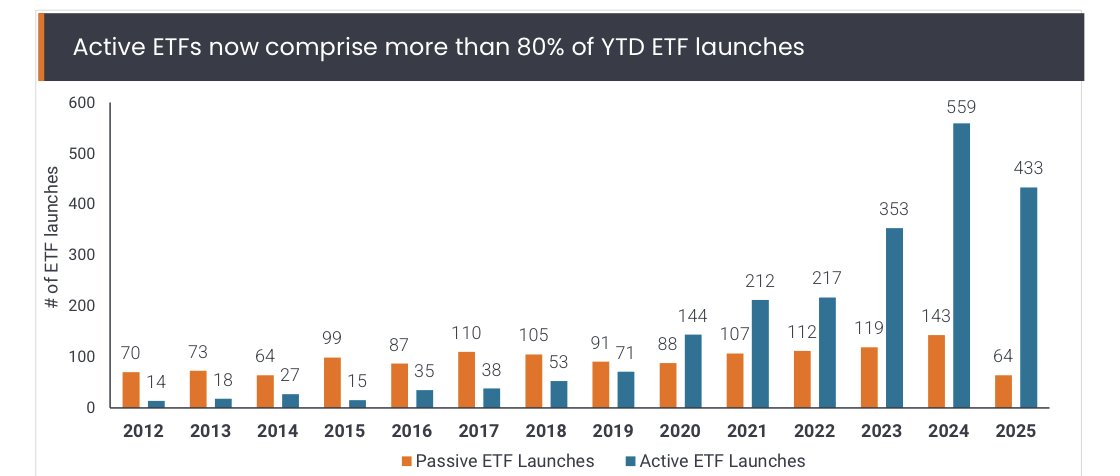
Active strategies accounted for most new ETF launches. More than 80% of year-to-date ETF launches through third-quarter-end 2025 were actively managed, contrasting earlier cycles dominated by passive index products.
This Janus Henderson chart illustrates the active ETF revolution’s rapid growth.
Source: Janus Henderson
Investors Gravitate Toward Older Active ETFs
Despite this growth, the distribution of assets within the active ETF universe remains highly uneven—a key point that recent surveys and flow data clearly reveal. That data comes from a new quarterly survey by asset manager Janus.
Janus Henderson’s new ETF Pulse report illustrates a curious yet telling pattern: older active ETFs attract significantly more assets than newer ones. The report illustrates median assets under management of about $40 million for one- to two-year-old active ETFs and roughly $120 million for those two to three years old, a threefold difference.
This divergence suggests investors discriminate about where they place capital. Younger active ETFs often struggle to gain traction despite robust launches. Analysts point to longer track records, clearer process histories, and more established liquidity profiles as main reasons, since investors prefer vehicles with evaluable performance histories.
Investors—especially institutional and advisory clients—place a premium on historical performance spanning diverse market conditions. Older ETFs provide data for trend analysis, risk assessment, and performance benchmarking, while newer funds lack this breadth and prove harder to evaluate and integrate into models.
ETFs with larger assets under management also feature tighter bid/ask spreads, deeper secondary-market liquidity, and more efficient price discovery. When an ETF has existed longer and gathered assets, trading becomes more efficient, attracting further inflows in a virtuous cycle—as seen on the passive side. Newer or smaller funds feel less liquid, particularly for larger institutional allocations.
Older ETFs typically come from well-known asset managers with established distribution channels, research capabilities, and client relationships that build investor confidence. Newer active ETFs—especially from emerging issuers—appear as untested propositions. BlackRock or J.P. Morgan seem safer bet for potential $1 billion investments.
This Preference Should Inform Investor Decisions
Understanding why investors favor older active ETFs offers key lessons for portfolio construction, especially when evaluating vehicles that blend active management with ETF flexibility.
Older funds benefit from track records, but that does not mean investors should dismiss newer ETFs outright. Product design innovation, new themes, or tactical strategies warrant consideration if they align with investor objectives. The preference for older ETFs highlights due diligence on manager pedigree, process robustness, and risk controls.
The tendency for older ETFs to attract more assets reflects the broader market’s valuation of liquidity in both secondary trading and portfolio implementation. Investors should assess not only how actively an ETF trades but also how easily it integrates into a portfolio without execution cost drag. Older ETFs often excel here because their market presence builds liquidity over time.
Popular Active ETFs
These active ETFs are sorted by 1-year total returns, ranging from 5% to 17.4%. Expense ratios range from 0.17% to 0.36%, assets under management from $11 billion to $42 billion, and current yields from 0.8% to 11.2%.
| Ticker | Name | AUM | 1Y Total Ret (%) | Yield (%) | Exp Ratio | Security Type | Actively Managed? |
|---|---|---|---|---|---|---|---|
| JEPQ | JPMorgan Nasdaq Equity Premium Income ETF | $32B | 17.4% | 11.2% | 0.35% | ETF | Yes |
| DFAC | Dimensional U.S. Core Equity 2 ETF | $40B | 17.2% | 0.8% | 0.17% | ETF | Yes |
| DFUV | Dimensional U.S. Marketwide Value ETF | $12.6B | 17.1% | 1.5% | 0.21% | ETF | Yes |
| DFAT | Dimensional U.S. Targeted Value ETF | $11.8B | 10.4% | 1.6% | 0.28% | ETF | Yes |
| JEPI | JPMorgan Equity Premium Income ETF | $41.5B | 9.5% | 7.7% | 0.35% | ETF | Yes |
| AVUV | Avantis U.S. Small-Cap Value ETF | $19.4B | 9.2% | 1.4% | 0.25% | ETF | Yes |
| FBND | Fidelity Total Bond ETF | $22.9B | 7.8% | 4.4% | 0.36% | ETF | Yes |
| JPST | JPMorgan Ultra Short Income ETF | $35.3B | 5.4% | 4.2% | 0.18% | ETF | Yes |
| MINT | PIMCO Enhanced Short Maturity Active ETF | $14.5B | 5.1% | 4.4% | 0.36% | ETF | Yes |
The rapid growth of active ETFs has transformed investor access to professional management combined with ETF flexibility. Yet the data clearly illustrates investors prefer older, more established active ETFs, allocating more assets to vehicles that have proven performance history, liquidity, and process credibility over time.
This preference makes sense, given the value of track records in evaluating active strategies and the practical benefits of scale and liquidity. At the same time, newer active ETFs—especially those from strong managers with innovative exposure—still play an important role in diversified portfolios.
Bottom Line
As the active ETF market continues to expand and innovate, investor behavior illustrates a clear preference for experience over novelty. Older active ETFs have earned assets by demonstrating performance through multiple market environments, building liquidity, and establishing confidence in their investment processes. Data and fund flows support this idea.
1 Janus (December 2025). ETF Pulse Q3 2025
