

Exchange-traded funds have transformed the investment landscape over the past two decades. What began as a simple tool for tracking major market indexes has evolved into a vast ecosystem of strategies spanning equities, fixed-income, commodities, and even sophisticated institutional approaches. One of the most significant developments in recent years has been the rapid growth of active ETFs, which allow portfolio managers to apply discretionary investment strategies within the ETF structure.
This evolution is opening the door to something once reserved primarily for institutional investors and ultra-high-net-worth individuals: alternative investments.
Through active ETFs, strategies previously accessible only through hedge funds, private partnerships, or complex institutional mandates are now available to a much broader audience. The combination of active management and the ETF structure has created a powerful vehicle for delivering alternative strategies in a transparent, liquid, and cost-efficient format.
Understanding Alternatives
When constructing a portfolio, the central question is how all assets move during various market scenarios. Modern Portfolio Theory shows that by focusing on a variety of asset classes, investors can build a portfolio that generates steady returns regardless of economic, market, or geopolitical conditions. This is the essence of diversification—why portfolios hold both stocks and bonds.
Correlation measures how we identify what zigs when something zags, capturing the strength of the relationship between the returns of two investments.
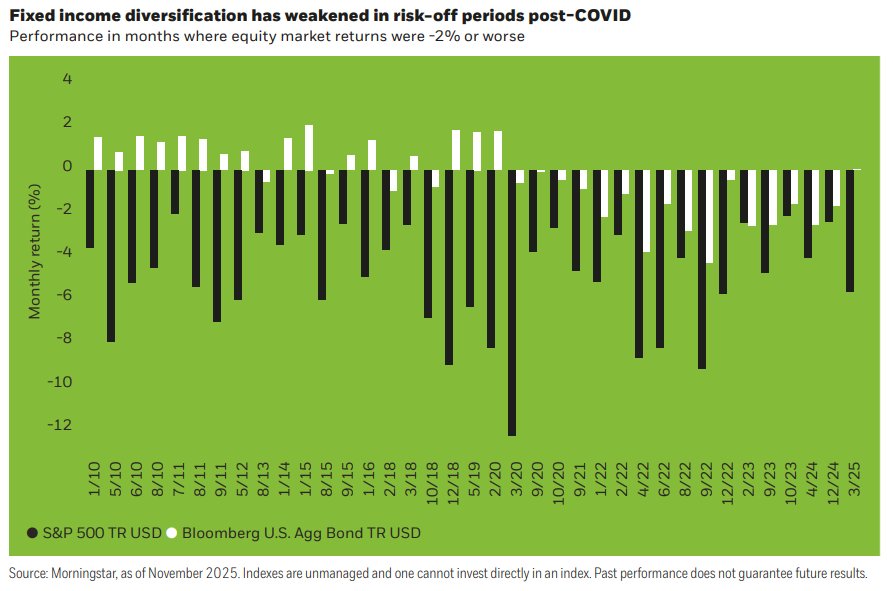
The problem is that correlations between asset classes have continued to converge over the years, making a simple stock-and-bond portfolio insufficient. According to the asset manager, since 2020, returns for the Bloomberg Agg Bond Index have been negative in 16 of the 18 months when equities declined by 2% or more. 1
This chart from BlackRock highlights how similarly stocks and bonds now behave during downturns.
Source: BlackRock
This is where alternatives come in.
Alternative investments encompass a wide range of strategies designed to provide returns less dependent on traditional stock and bond markets. Historically, alternatives have included hedge funds, private equity, commodities, real estate, and trading strategies designed to generate returns regardless of market direction.
Many alternative strategies focus on diversification and risk management, seeking returns through mechanisms that differ from simply rising and falling with the broader market. Some strategies aim to profit from market inefficiencies, while others use derivatives, arbitrage, or relative-value trades. A long/short equity strategy, for example, buys stocks expected to outperform while shorting those expected to decline, and market-neutral strategies remove overall market exposure entirely, focusing on security selection.
These approaches can offer valuable diversification benefits because their performance drivers differ from those of traditional stocks and bonds.
Active ETFs Are an Ideal Vehicle for Alternatives
Despite their diversification benefits, alternative strategies have been difficult for everyday investors to access. Many hedge funds, separately managed accounts (SMAs), and interval funds require large minimum investments, restrict access to accredited investors, limit liquidity, and charge high management and performance fees.
Active ETFs are beginning to change that dynamic. The ETF structure offers several advantages that make it well-suited for delivering alternative strategies to a broad audience efficiently.
Perhaps the biggest advantage of using active ETFs for alternatives is cost. Alternatives remain one of the most expensive asset classes in terms of fees and fund expenses. The average multi-strategy mutual fund carries an expense ratio of 1.66%, while the average alternatives fund hovers around 1.48%—high hurdles to overcome. Other vehicles, such as hedge funds, add sales fees and higher operational costs on top of that.
Active ETFs help reduce costs for investors in the alts space, with average expense ratios around 0.75%—a much easier hurdle for a manager to clear when delivering returns. Minimum investments are equally accessible, as many brokerage firms allow investors to put in as little as $1.
Liquidity is another key consideration. Many traditional alternative funds lock up investor capital for months or even years, whereas ETFs trade on exchanges throughout the day, allowing investors to enter or exit whenever markets are open. This secondary-market liquidity lets managers keep the fund’s capital invested in longer-term assets to deliver on their mandates.
An ETF’s creation/redemption mechanism and secondary-market liquidity also benefit investors on the tax front. Alternative funds tend to have high turnover—some exceeding 200%—but structuring the fund as an ETF allows managers to minimize capital gains distributions. Many active ETFs also eliminate the K-1 statement common among alternative funds.
The Current Environment Favors Alternatives and Active ETFs
Now could be an opportune time to consider active ETFs within the alternative space, as the current investment environment is particularly well-suited for alternative strategies.
Markets today are characterized by heightened volatility, geopolitical uncertainty, and shifting economic conditions. Inflation has remained stubborn in parts of the global economy, while interest rates have moved dramatically after years of historically low levels. Equity markets have grown increasingly concentrated in a small number of large technology companies, and fixed-income markets have been challenged by interest rate uncertainty.
These conditions highlight the potential value of alternative strategies. By pursuing returns less tied to the direction of stocks or bonds, alternatives can help diversify portfolios and potentially reduce overall volatility.
Given this, alternatives make sense as a portfolio sleeve. Analysts and advisors suggest allocating 5% to 20% of a portfolio to alternative strategies, depending on an investor’s risk tolerance, objectives, and need for growth.
Alternatives ETFs
These funds are selected for their ability to tap into liquid alternatives across a variety of strategies, sorted by YTD total return, which ranges from -3.2% to 7.7%. Expense ratios range from 0.35% to 1.38%, AUM ranges from $150M to $40B, and current yields range from 0% to 14.1%.
| Ticker | Name | AUM | YTD Total Ret (%) | Yield (%) | Exp Ratio | Security Type | Actively Managed? |
|---|---|---|---|---|---|---|---|
| RLY | SPDR SSgA Multi-Asset Real Return ETF | $486M | 7.7% | 0% | 0.50% | ETF | No |
| QAI | IQ Hedge Multi-Strategy Tracker ETF | $695M | 2.2% | 2.3% | 1.13% | ETF | No |
| JEPI | JPMorgan Equity Premium Income ETF | $40.2B | 2% | 11.5% | 0.35% | ETF | Yes |
| WTMF | WisdomTree Managed Futures Strategy Fund | $185M | 1.6% | 0% | 0.65% | ETF | Yes |
| FTLS | First Trust Long/Short Equity ETF | $1.95B | -0.1% | 1% | 1.38% | ETF | Yes |
| JEPQ | JPMorgan Nasdaq Equity Premium Income ETF | $23.4B | -0.3% | 14.1% | 0.35% | ETF | Yes |
| DBMF | iMGP DBi Managed Futures Strategy ETF | $1.38B | -2.5% | 2.9% | 0.85% | ETF | Yes |
| FMF | First Trust Managed Futures Strategy Fund | $157M | -3.2% | 2.1% | 1.01% | ETF | Yes |
The growth of active ETFs is reshaping how investors access complex investment strategies. By bringing alternatives into the ETF structure, asset managers are democratizing strategies once available only to institutions and wealthy investors.
This shift carries significant implications for portfolio construction, as investors now have access to a broader toolkit of strategies designed to navigate complex and volatile markets.
As economic uncertainty, geopolitical risks, and market concentration continue to influence global markets, the ability to diversify beyond traditional stocks and bonds is becoming increasingly important. Active ETFs are making that diversification more accessible than ever.
Bottom Line
Active ETFs are opening the door to alternative investment strategies once largely inaccessible to everyday investors. By combining professional portfolio management with the structural advantages of ETFs, these funds offer a practical way to incorporate alternatives into modern portfolios.
1 BlackRock (January 2026). Where alpha meets access: unlocking alternatives in active ETFs
