

The ETF industry has undergone a remarkable transformation over the past decade. Once viewed primarily as vehicles for low-cost passive index investing, ETFs have evolved into one of the most dynamic corners of active asset management. The numbers tell the story, with active ETFs attracting hundreds of billions of dollars in net new assets from financial advisors, institutions, and individual investors alike. Active ETFs are no longer a niche category but a core portfolio tool.
One of the biggest beneficiaries of the active ETF evolution has been fixed income.
Active bond ETFs have become one of the fastest-growing segments of the ETF marketplace as investors seek solutions that can navigate today’s increasingly complex bond market. Many investors are concluding that simply owning “the market” may no longer be enough, and active bond ETFs have finally hit their stride.
Fund Flows Show Investors Are Embracing Active Bond ETFs
The growth of active fixed-income ETFs has been extraordinary, with both fund flows and new product launches accelerating as investors continue to turn toward active management in fixed income. A new J.P. Morgan report illustrates just how strongly investors have been embracing active bond ETFs.
According to J.P. Morgan, investors poured more than $163 billion into fixed-income strategies through May, with about $62 billion flowing into active bond ETFs alone. If this pace holds, it will shatter last year’s record by a wide margin. 1
J.P. Morgan also notes that over the trailing 12 months, more than 110 new active fixed-income ETFs were launched, accounting for roughly 70% of all fixed-income fund launches.
This torrid growth has led J.P. Morgan to raise its forecast for the global fixed-income ETF market to levels that would have seemed unimaginable before. By 2030, the bank predicts the market will reach $7 trillion, up from $3.6 trillion today, with active fixed-income ETFs comprising roughly $2 trillion of that total, up from about $650 billion currently. The U.S. market will capture a significant portion of those flows.
Why the Attraction to Active Fixed-Income ETFs?
While passive bond ETFs continue to attract assets, active strategies have captured a disproportionately large share of new money entering the category. The question is: why all the interest in active fixed-income ETFs?
The trend toward active reflects more than simple investor curiosity.
Historically, many investors accepted passive investing as the default approach for its low cost and broad diversification. Today’s bond market, however, presents challenges that passive strategies may not be equipped to solve, including persistent structural problems with many broad bond benchmarks.
The Bloomberg U.S. Aggregate Bond Index—commonly called “the Agg”—has long served as the standard benchmark for core bond investing and remains useful for many portfolios. It also carries structural shortcomings, including heavy exposure to U.S. Treasuries and agency mortgage-backed securities while allocating relatively little capital to areas of the fixed-income market that may offer superior risk-adjusted returns. Sectors, such as securitized credit, bank loans, emerging market debt, preferred securities, private credit, high-yield corporates, and certain international bonds, receive little or no representation.
This chart from J.P. Morgan highlights that roughly 49% of the $60 trillion U.S. bond market is excluded from the Agg.
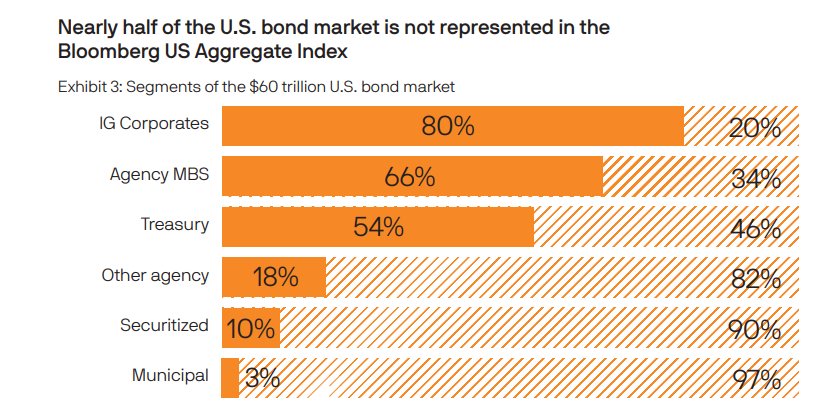
Source: J.P. Morgan
Investors tracking the Agg may therefore hold a portfolio heavily concentrated in interest-rate risk while missing large segments of today’s fixed-income opportunity set. Rather than simply chasing benchmark exposure, investors increasingly want portfolio managers who can actively adjust duration, rotate among sectors, manage credit risk, identify attractive securities, and respond quickly to changing economic conditions.
Individual security selection also appears to matter more in the bond market than in equities. Even bonds issued by the same entity can trade differently depending on maturity, coupon, liquidity, or covenant structure. Active managers can selectively purchase securities they believe offer superior risk compensation while avoiding those with weaker fundamentals.
This research-driven approach may improve long-term risk-adjusted returns, and data supports that view: a majority of active fixed-income managers have outperformed passive bond benchmarks, with the average active core plus manager delivering 0.7% in excess annual returns over the passive AGG during the last decade—meaningful compounding for slow-and-steady bonds.
The ETF structure itself also adds to the appeal of active fixed-income investing.
ETFs carry lower costs and fewer fee hurdles for managers. Because bond investing is a game of inches, reducing costs allows managers to return more of their yields and gains to investors. The creation-redemption mechanism of ETFs provides tax savings, while intraday trading flexibility adds a layer of liquidity to portfolios and helps overcome the illiquidity common to many bond varieties.
Taken together, these features are driving the continued growth and adoption of active bond ETFs across a wide range of investors and portfolio outcomes.
Time To Consider Active Bond ETFs
The growth in active bond ETFs is easy to see and understand. Active managers may be better positioned to achieve goals by adjusting portfolios as market conditions evolve, rather than simply accepting benchmark construction. Active fixed income serves as a better choice for many portfolios.
It is easy to see why the outlook for active bond ETFs remains rosy.
Asset managers are likely to continue to launch strategies covering virtually every segment of the bond market, including core bonds, municipal securities, securitized credit, preferreds, bank loans, ultra-short duration, multisector portfolios, and income-focused strategies, and more advisors will build portfolios using these ETFs.
Active Bond ETFs
These ETFs offer low-cost exposure to active bond management across various sectors. Sorted by YTD return, ranging from negative 2.8% to 9.1%, they carry expenses of 0.10%-0.56%, assets of $51M-$23B, and yields of 3.5-6.8%.
| Ticker | Name | AUM | YTD Total Ret (%) | Yield (%) | Exp Ratio | Security Type | Actively Managed? |
|---|---|---|---|---|---|---|---|
| BOND | PIMCO Active Bond ETF | $6.6B | 9.1% | 5.0% | 0.56% | ETF | Yes |
| JCPB | JPMorgan Core Plus Bond ETF | $8.8B | 8.7% | 5.30% | 0.40% | ETF | Yes |
| OBND | SPDR Loomis Sayles Opportunistic Bond ETF | $51M | 8.10% | 6.8% | 0.55% | ETF | Yes |
| FBND | Fidelity Total Bond ETF | $22B | 7.9% | 4.9% | 0.36% | ETF | Yes |
| VCRB | Vanguard Core Bond ETF | $3B | 7.85% | 4.20% | 0.10% | ETF | Yes |
| TOTL | SPDR DoubleLine Total Return Tactical ETF | $4B | 7.84% | 5.1% | 0.55% | ETF | Yes |
| DBND | DoubleLine Opportunistic Bond ETF | $600M | 7.6% | 5% | 0.45% | ETF | Yes |
| BINC | BlackRock Flexible Income ETF | $14B | 7.59% | 5.5% | 0.52% | ETF | Yes |
| VPLS | Vanguard Core Plus Bond ETF | $138M | 3.3% | 4.6% | 0.2% | ETF | Yes |
| MINT | PIMCO Enhanced Short Maturity Active ETF | $9.7B | 2.2% | 5.1% | 0.35% | ETF | Yes |
| AVIG | Avantis Core fixed-income ETF | $1B | 2.2% | 5% | 0.15% | ETF | Yes |
| JPST | JPMorgan Ultra Short Income ETF | $22.8B | 1.9% | 5.4% | 0.18% | ETF | Yes |
| IMNU | iShares Intermediate Muni Income Active ETF | $919M | 1.7% | 3.6% | 0.41% | ETF | Yes |
| HMOP | Hartford Municipal Opportunities ETF | $576M | 1.7% | 3.5% | 0.29% | ETF | Yes |
| CGMU | Capital Group Municipal Income ETF | $3.36B | 1.6% | 3.9% | 0.27% | ETF | Yes |
| DFCF | Dimensional Core fixed-income ETF | $3.35B | -1.3% | 5.0% | 0.19% | ETF | Yes |
| FBND | Fidelity Total Bond ETF | $5.1B | -1.5% | 4.9% | 0.36% | ETF | Yes |
| FIXD | First Trust TCW Opportunistic fixed-income ETF | $4.4B | -2.8% | 4.4% | 0.65% | ETF | Yes |
The rapid growth of active fixed-income ETFs reflects more than shifting investor preferences—it reflects changing market realities. Today’s bond market is larger, more complex, and more dynamic than ever. Traditional passive benchmarks like the Bloomberg Aggregate Bond Index remain useful starting points, but they may no longer be the most effective way to capture the full range of fixed-income opportunities.
This is where active managers and active bond ETFs offer something passive indexes cannot: the flexibility to outperform.
Bottom Line
Active bond ETFs have become one of the fastest-growing segments of the ETF industry. For those looking to build more resilient income portfolios, the future of fixed income may not simply lie in ETFs—it may lie in active ETFs.
1 J.P. Morgan (May 2026). From Evolution to Revolution: The Power of Active Fixed Income ETFs
