

For years, investors faced what often seemed like a simple choice: own a low-cost passive ETF that tracked an index or pay significantly higher fees for an actively managed mutual fund in hopes of outperforming the market. Active ETFs have begun to change that equation. By combining professional portfolio management with the efficiency of the ETF structure, these funds have narrowed the cost gap between active and passive investing while offering investors greater tax efficiency, intraday liquidity, and transparency than many traditional mutual funds.
Yet while active ETFs have become increasingly competitive on price, investors should avoid assuming they are all inexpensive.
As more firms enter the market and launch specialized strategies, the average cost of active ETFs has quietly begun to climb. That makes understanding fees—and the value investors receive for those fees—just as important today as it has always been.
The Active ETF Revolution Begins To Boom
Few areas of the investment industry have experienced as much growth over the past several years as actively managed ETFs. Once viewed as a niche corner of the ETF market, active ETFs have become one of the fastest-growing investment vehicles available to both advisors and individual investors. Since the ETF Rule was adopted in 2019, nearly 3,000 active ETFs have launched, and assets have surged from roughly $140 billion to more than $1.6 trillion, as investors increasingly embrace the combination of professional management and the ETF structure.
The appeal is easy to understand. Investors still want the opportunity to outperform the market, but they also value the advantages ETFs offer, including tax efficiency, daily transparency, intraday liquidity, and generally lower costs than comparable mutual funds.
Active ETFs have delivered on one of their biggest promises. According to Morningstar, active ETFs have generally outperformed their mutual fund counterparts, and that success has helped fuel enormous investor demand.
Active Doesn't Automatically Mean Low Cost
There is an important caveat many investors may be overlooking: a fund structured as an ETF is not automatically cheap. Compared to actively managed mutual funds, that statement is generally true, as active ETFs still carry meaningfully lower expense ratios than their mutual fund equivalents. Morningstar found that active ETF fees averaged roughly 37 basis points lower than comparable mutual funds, which explains much of the performance advantage ETFs have demonstrated in recent years.
However, comparing active ETFs to mutual funds is not the right benchmark. Investors should instead compare ETFs—both active and passive—against one another.
The ETF industry built its reputation on extremely low costs, and investors grew accustomed to paying just a few basis points for broad market exposure through passive index funds. Active ETFs are cheaper than other active vehicles, but average fees within the active ETF universe have gradually moved higher.
According to data from JPMorgan Asset Management, the equal-weighted average fee for newly launched ETFs has increased by 11% over the past decade as more active products have entered the marketplace. Ironically, mutual fund expenses have dropped by 22% over the same period.
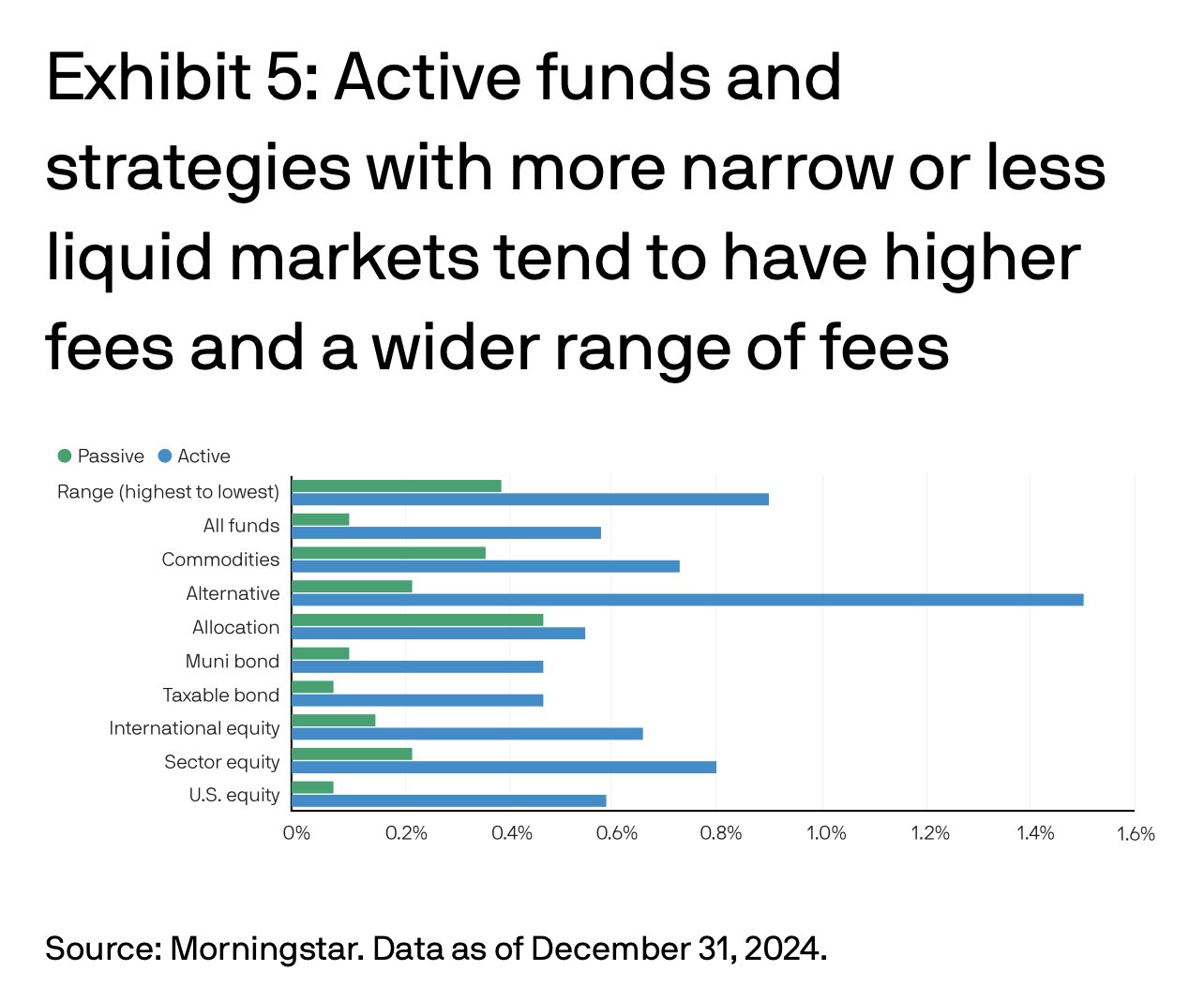
The fee increases reflect the types of products being launched. Simple active stock or bond picking has given way to more complex strategies, and options, buffers, commodities, and CLOs now populate the active ETF space—all of which cost considerably more to operate.
This chart from JPMorgan highlights the fees paid across various active ETF sectors.
Source: J.P. Morgan
Even within active ETFs, fees matter.
Managers have not suddenly become better stock pickers or options traders, but the ETF structure gives them a lower hurdle to clear. Lower expenses allow investors to keep more of the portfolio’s gross return, making it easier for an active manager to outperform after fees.
Morningstar’s recent research reinforces this point. The firm concluded that much of active ETFs’ advantage over mutual funds stems directly from their lower fee structures rather than dramatically superior investment decisions. When researchers compared gross returns before expenses, the ETF advantage largely disappeared, confirming that investors benefited primarily because ETFs allowed them to keep more of what managers earned.
Building a Better Active ETF Portfolio
The ETF wrapper may be innovative, but it cannot compensate for poor portfolio construction, excessive fees, or speculative investment themes. For investors incorporating active ETFs into their portfolios, selecting the lowest-fee fund should not be the only objective—but it remains an important consideration.
Morningstar notes that many of the strongest-performing active ETFs have come from established asset managers that brought proven investment processes into the ETF wrapper after 2020. Firms such as JPMorgan, Dimensional Fund Advisors, and Capital Group leveraged their deep research capabilities while offering investors lower-cost ETF versions of active strategies.
Fees should always be weighed against the value a manager provides. Paying modestly higher expenses for a highly differentiated strategy may be justified if it fills an important portfolio role, but paying premium fees for a strategy that closely resembles a benchmark is far more difficult to justify.
Broad market index funds can continue serving as a portfolio’s core, while carefully selected active ETFs can provide exposure to areas where active management may add greater value—such as fixed-income, international markets, small-cap stocks, or specialized income strategies.
Popular Active ETFs
These active ETFs, sorted by one-year total returns ranging from 4.7% to 20.6%, carry expense ratios from 0.17% to 0.36%, assets under management from $12.8 billion to $43 billion, and yields from 0.9% to 9.6%.
| Ticker | Name | AUM | 1Y Total Ret (%) | Yield (%) | Exp Ratio | Security Type | Actively Managed? |
|---|---|---|---|---|---|---|---|
| AVUV | Avantis U.S. Small-Cap Value ETF | $22.2B | 20.6% | 1.3% | 0.25% | ETF | Yes |
| DFUV | Dimensional U.S. Marketwide Value ETF | $13.5B | 20.5% | 1.3% | 0.21% | ETF | Yes |
| DFAT | Dimensional U.S. Targeted Value ETF | $12.8B | 19.1% | 1.5% | 0.28% | ETF | Yes |
| DFAC | Dimensional U.S. Core Equity 2 ETF | $41.6B | 17.3% | 0.9% | 0.17% | ETF | Yes |
| JEPQ | JPMorgan Nasdaq Equity Premium Income ETF | $32B | 13.5% | 9.6% | 0.35% | ETF | Yes |
| JEPI | JPMorgan Equity Premium Income ETF | $43.2B | 9.3% | 7.0% | 0.35% | ETF | Yes |
| FBND | Fidelity Total Bond ETF | $24B | 7.0% | 3.8% | 0.36% | ETF | Yes |
| JPST | JPMorgan Ultra Short Income ETF | $36.4B | 4.9% | 4.1% | 0.18% | ETF | Yes |
| MINT | PIMCO Enhanced Short Maturity Active ETF | $14.8B | 4.7% | 4.1% | 0.36% | ETF | Yes |
Active ETFs have fundamentally changed the investment landscape by combining professional portfolio management with the efficiency, transparency, and tax advantages of the ETF structure. Their rapid growth reflects a straightforward reality: investors want access to active management without the high fees traditionally associated with mutual funds.
Investors should not assume every active ETF is inexpensive simply because it is an ETF. As the market has matured, average fees have drifted higher, and the gap between the lowest- and highest-cost active ETFs has widened. The principle that has guided investors for decades still applies—lower fees improve the odds of long-term success.
Bottom Line
Active ETFs have made it easier than ever for investors to access professional portfolio management at lower costs than traditional mutual funds, but the category’s rapid growth doesn’t mean every fund is a bargain.
