For decades, building a core bond portfolio was relatively straightforward. Investors seeking stability, income, and diversification typically gravitated toward broad investment-grade bond funds benchmarked against the Bloomberg U.S. Aggregate Bond Index, commonly known as “the Agg.” The logic was simple: own a diversified basket of Treasuries, agency mortgage-backed securities, and investment-grade corporate bonds and let fixed-income do what it was designed to do. That approach worked well for many years.
However, the bond market has changed dramatically over the past decade, and particularly since the inflation shock of 2022.
Institutional investors, advisors, and portfolio managers are increasingly rethinking what “core” fixed-income should look like. One asset class benefiting from this reassessment is securitized credit, which has steadily evolved from a niche or satellite allocation into a much larger and more important segment of the fixed-income universe.
The Agg Has Not Always Delivered What Investors Expected
The Bloomberg U.S. Aggregate Bond Index was designed during a very different interest-rate environment. Over time, its composition has become heavily influenced by debt issuance rather than investment attractiveness, meaning the more debt a sector issues, the larger its representation within the index.
This creates some unintended consequences.
Treasuries and agency mortgage-backed securities dominate the benchmark, while other potentially attractive sectors remain underrepresented. The index’s duration profile also expanded significantly during years of ultra-low interest rates as governments and corporations issued longer-term debt.
The result became painfully clear when inflation surged, and interest rates rose sharply.
Rather than providing stability, many core bond portfolios experienced substantial losses as duration risk overwhelmed the benefits of diversification. Investors who viewed core bonds as a source of safety suddenly found themselves facing equity-like drawdowns.
This experience forced many market participants to reconsider whether traditional benchmarks still represent the optimal approach to fixed-income investing.
Securitized Credit Gains Attention
Wall Street loves to reinvent the wheel, and the process of securitization does just that.
Securitized credit refers to bonds backed by pools of underlying assets rather than a corporation’s or government’s balance sheet. Instead of lending money directly to a corporation or government, investors purchase bonds backed by cash flows from assets, such as residential mortgages, auto loans, credit card receivables, equipment leases, or commercial real estate loans.
Those cash flows are then distributed to bondholders according to predefined structures.
The sector includes a wide variety of securities: residential mortgage-backed securities (RMBS), commercial mortgage-backed securities (CMBS), asset-backed securities (ABS), collateralized loan obligations (CLOs), and other structured finance products.
Securitized credit encompasses a broad range of risk profiles, from highly rated investment-grade securities to more opportunistic segments offering higher yields, creating opportunities for active managers to target specific risk and return objectives.
For some investors, however, the term “securitized credit” still evokes memories of the Global Financial Crisis.
While that reaction is understandable, today’s securitized market looks dramatically different than it did in 2008. Regulatory reforms, improved underwriting standards, greater transparency, stronger capital requirements, and enhanced risk management have all contributed to a more resilient market structure.
The securitized universe has also expanded significantly.
New issuance continues across a wide range of sectors, creating a deeper and more liquid marketplace than many investors realize. The asset class has matured from a niche specialty sector into a core component of institutional fixed-income portfolios.
Attractive Returns With Lower Volatility
One reason securitized credit has attracted growing attention is its historical ability to generate attractive risk-adjusted returns.
Many securitized sectors have delivered yields that compare favorably with corporate bonds while exhibiting lower volatility. This chart from Voya highlights securitized credit’s high yields relative to its volatility.
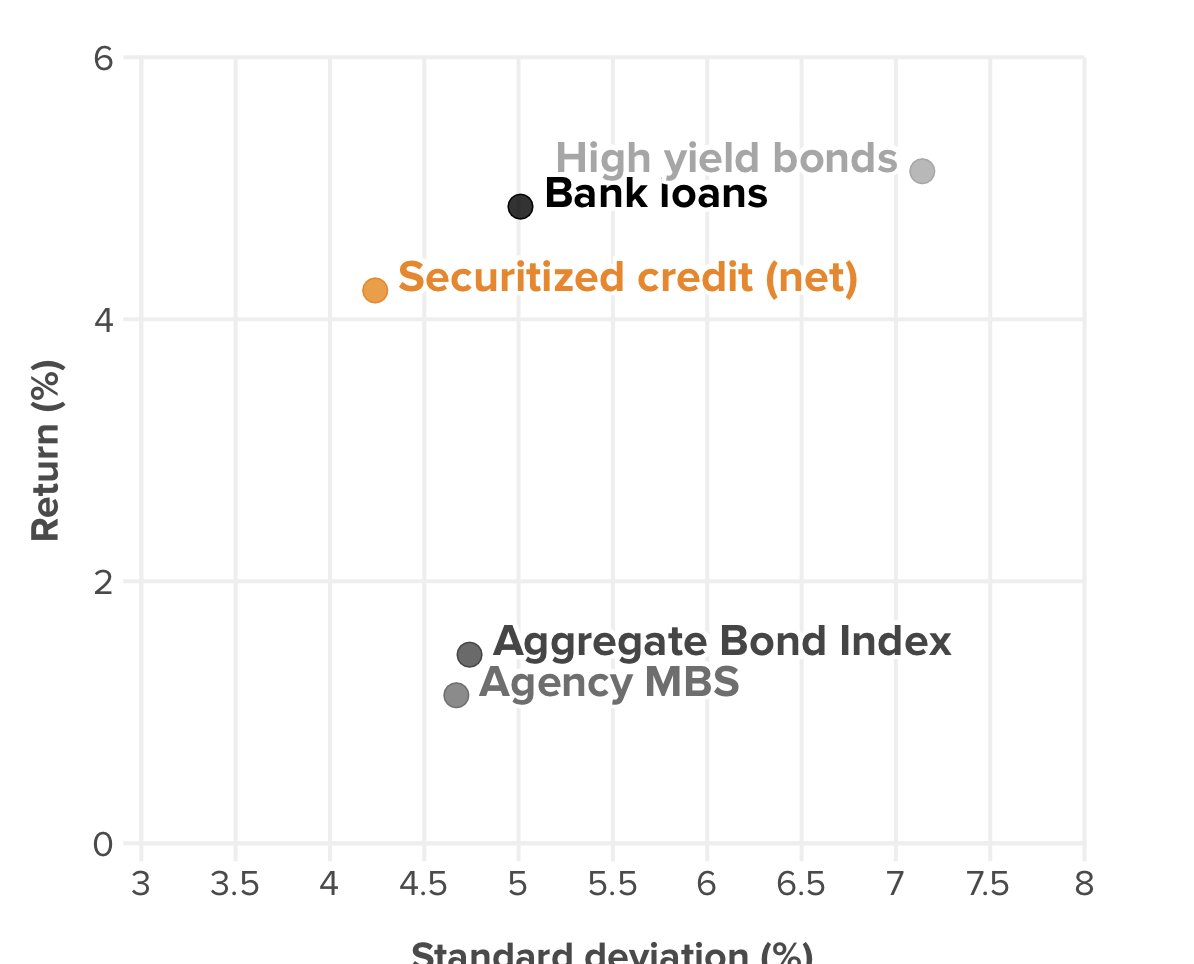
Source: Voya
Several factors contribute to this yield/volatility advantage.
First, securitized bonds often benefit from structural protections that corporate bonds lack, including credit enhancement features, subordination structures, excess collateral, and other mechanisms designed to protect investors from losses.
Second, the underlying collateral pools are often diversified across thousands of individual borrowers or assets.
For example, an asset-backed security backed by auto loans may derive cash flows from tens of thousands of individual borrowers rather than relying on the financial health of a single corporation.
This diversification can reduce idiosyncratic risk.
Additionally, many securitized sectors tend to carry shorter durations than traditional core bond benchmarks.
The combination of attractive yields, structural protections, and lower interest-rate sensitivity has helped many securitized sectors deliver compelling risk-adjusted returns over time.
Included In Core
The increasing visibility of securitized credit within benchmark indexes and investment products has led many investors to view securitized credit in a new light.
Historically, accessing securitized credit required specialized expertise, institutional resources, and dedicated managers. Index providers have gradually expanded coverage of securitized sectors, making them easier to track, analyze, and benchmark. According to Voya, $103 billion in securitized credit funds have been “unlocked” as category changes and indexing have taken hold.
Investors no longer need to view securitized credit as an obscure or difficult-to-access corner of the market, as it has become a mainstream asset class.
And that could place it at the core.
Core bond allocations are expected to accomplish several objectives simultaneously: providing income, diversification, risk management, and capital preservation. Securitized credit can contribute to each of these goals.
ABS ETFs
These ETFs provide exposure to the ABS market and are sorted by 1-year total return, ranging from 2.5% to 7.7%. They carry expense ratios between 0.04% and 0.53%, assets under management between $400M and $39B, and current yields between 3.7% and 6.2%.
| Ticker | Name | AUM | 1Y Total Ret (%) | Yield (%) | Exp Ratio | Security Type | Actively Managed? |
|---|---|---|---|---|---|---|---|
| JMBS | Janus Henderson Mortgage-Backed Securities ETF | $6.9B | 7.7% | 5.1% | 0.26% | ETF | Yes |
| SPMB | SPDR Portfolio Mortgage-Backed Bond ETF | $6.6B | 7.3% | 3.73% | 0.04% | ETF | No |
| VMBS | Vanguard Mortgage-Backed Securities ETF | $39B | 7% | 5.2% | 0.04% | ETF | No |
| GNMA | iShares GNMA Bond ETF | $402M | 6.5% | 4.3% | 0.11% | ETF | No |
| JSI | Janus Henderson Securitized Income ETF | $1.3B | 6.1% | 4.9% | 0.53% | ETF | Yes |
| CLOA | iShares AAA CLO Active ETF | $1.38B | 5% | 5.5% | 0.20% | ETF | Yes |
| JAAA | Janus Henderson AAA CLO ETF | $24B | 5% | 4.3% | 0.22% | ETF | Yes |
| PAAA | PGIM AAA CLO ETF | $6.2B | 4.9% | 5.3% | 0.19% | ETF | Yes |
| CLOI | VanEck CLO ETF | $1.3B | 4.9% | 5.4% | 0.36% | ETF | Yes |
| JBBB | Janus Henderson B-BBB CLO ETF | $1.2B | 3.9% | 6.2% | 0.50% | ETF | Yes |
| MBB | iShares MBS ETF | $37.6B | 2.5% | 4.2% | 0.05% | ETF | No |
The bond market has evolved, and investors may need to evolve with it.
Traditional core bond allocations built around the Agg have faced significant challenges in recent years, exposing weaknesses many investors previously overlooked. Rising interest-rate volatility, changing market structures, and evolving risk sources have prompted a broader reassessment of fixed-income portfolio construction.
Securitized credit offers a compelling alternative.
With attractive yields, lower duration, diversified collateral pools, structural protections, and increasingly accessible investment vehicles, the asset class delivers many of the characteristics investors seek from core fixed-income holdings.
Bottom Line
The definition of a core bond holding is evolving, and securitized credit is increasingly earning a place at the center of fixed-income portfolios rather than the sidelines.

