When it comes to fixed-income investments, U.S. Treasury bonds are supposed to be the gold standard, offering steady coupons, good yields, and overall low volatility. With that in mind, the recent surge in long-term Treasury yields has created a difficult environment for bond investors, increasing volatility and growing investor concerns.
However, investors may want to focus on optimism rather than pessimism.
The jump in Treasury yields could be seen as an opportunity largely absent for nearly two decades: the ability to lock in substantial income from U.S. government bonds for as long as 30 years, making Treasury bonds a compelling buy right now.
The Surge in Long-Term Treasury Yields
Treasury bonds aren’t supposed to move much, which is why the bond market’s selloff has been so dramatic. Back in August, the 30-year Treasury yield reached 5.3%, its highest level since 2007. By September 25, that yield had climbed above 5.5%, reaching levels last seen in 2004, while the benchmark 10-year yield crossed 5.2%, reflecting a broad repricing of longer-term government debt.
Several forces are driving that move. Inflation remains a concern, particularly as higher energy prices threaten to keep price pressures elevated, and expectations for additional Federal Reserve rate increases have contributed to rising yields. Meanwhile, investors are demanding greater compensation for the uncertainty of lending money to the government for decades.
The resulting volatility has been painful for existing bondholders. Because bond prices move inversely to yields, a sharp increase in rates can produce substantial losses, especially for securities with long maturities.
A Supply Problem, Not Necessarily a Solvency Problem
However, the situation looks different for investors buying today. Higher yields mean new buyers can secure significantly more income than was available throughout much of the previous two decades, and the question is whether those yields adequately compensate investors for the risks ahead.
The answer may be yes.
One straightforward explanation for rising Treasury yields is that the government is borrowing enormous amounts of money and investors are demanding higher yields to absorb the supply.
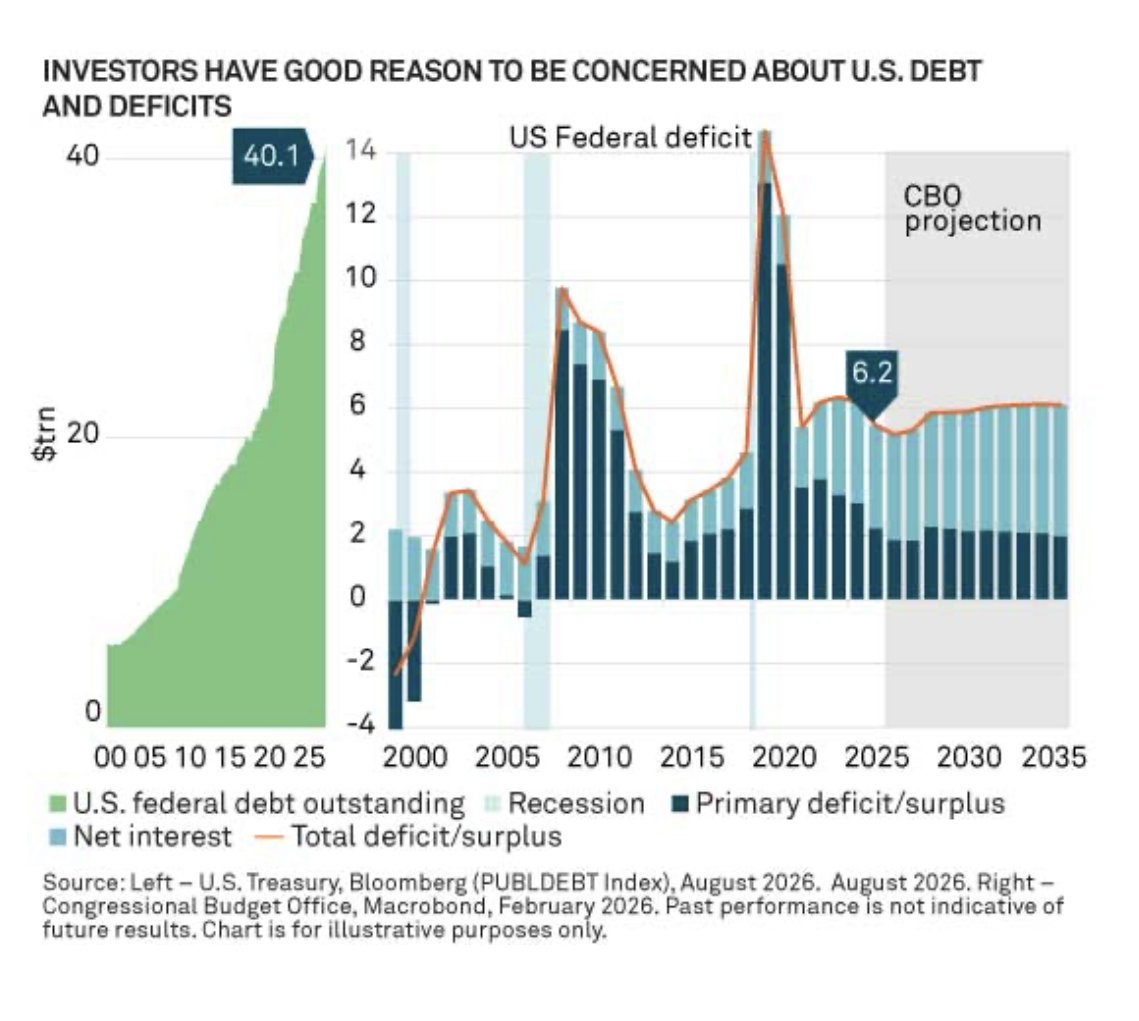
According to BNY Investments, federal debt reached $40 trillion in August 2026, and the Congressional Budget Office expects annual budget deficits to remain around 6% of GDP for the foreseeable future, implying substantial additional Treasury issuance even without an economic downturn.
This chart from BNY Investments highlights the current deficit environment.
Source: BNY
At the same time, some traditional sources of demand have become more price-sensitive.
The Federal Reserve is no longer expanding its balance sheet, leaving private investors to absorb more government borrowing. Rising yields in Japan and Europe also give international investors alternatives to U.S. Treasuries.
Corporate bonds are creating additional competition. BNY notes that issuance of dollar-denominated corporate debt with maturities of 30 years or longer is on pace to exceed comparable Treasury issuance for the first time since the pandemic, with much of that borrowing tied to artificial intelligence (AI) infrastructure, including large offerings from major technology companies.
For investors committing capital for 30 years, highly rated corporate bonds may offer additional yield over government securities.
The key point is that none of this necessarily means the United States is approaching default, as higher borrowing costs are not the same as an inability to repay debt.
BNY argues that recent market behavior is more consistent with supply-and-demand pressures than an imminent solvency crisis. In a September analysis, the firm pointed to narrowing credit-default-swap spreads through August, functioning Treasury auctions, and a lack of clear evidence of foreign-investor flight. 1
For long-term investors, the distinction matters. If yields are rising primarily because buyers require more compensation for absorbing supply and inflation uncertainty, those higher yields may represent an attractive entry point rather than a warning to avoid government bonds, giving investors a real opportunity to lock in strong yields and build long-term income streams.
Locking In Historically High Yields for Decades
The most obvious attraction of today’s Treasury market is income.
Consider an investor purchasing $100,000 face value of a newly issued 30-year Treasury bond with a 5.5% coupon at par. That investment would generate approximately $5,500 in annual interest, paid semiannually, with the principal scheduled for repayment at maturity.
Over 30 years, those coupon payments would total $165,000, excluding reinvestment. The investor would also receive the original $100,000 principal at maturity, assuming the government meets its obligations. Given that potential, revisiting long bonds for a portfolio may make sense.
You can buy individual Treasuries and hold them to maturity, purchasing them directly from the government or through any brokerage.
You can also use one of the many ETFs targeting long bonds. While the effect won’t necessarily be the same and these funds carry higher volatility, they offer many investors an easy way to capture high yields.
Long Bond ETFs
These funds were selected based on their exposure to longer-dated bonds. They cover a wide range of bond types and are sorted by one-year total returns, which range from 0.4% to 7.8%. Assets under management range from $7M to $49B, expenses from 0.03% to 0.15%, and current yields from 3.8% to 5.8%.
| Ticker | Name | AUM | YTD Total Ret (%) | Yield (%) | Exp Ratio | Security Type | Actively Managed? |
|---|---|---|---|---|---|---|---|
| UTEN | U.S. Treasury 10 Year Note ETF | $224M | 7.8% | 3.8% | 0.15% | ETF | Yes |
| VGLT | Vanguard Long-Term Treasury ETF | $14.3B | 5.8% | 4.3% | 0.03% | ETF | Yes |
| SPTL | State Street SPDR Portfolio Long Term Treasury ETF | $11.9B | 5.8% | 4% | 0.03% | ETF | Yes |
| BBLB | JPMorgan BetaBuilders U.S. Treasury Bond 20+ Year ETF | $7.4M | 5.5% | 5.1% | 0.04% | ETF | Yes |
| TLT | iShares 20+ Year Treasury Bond ETF | $48.8B | 5.2% | 4.4% | 0.15% | ETF | No |
| EDV | Vanguard Extended Duration ETF | $5B | 2.5% | 4.8% | 0.05% | ETF | No |
| ZROZ | PIMCO 25+ Year Zero Coupon U.S. Treasury Index ETF | $1.72B | 1.4% | 4.5% | 0.15% | ETF | Yes |
| GOVZ | iShares 25+ Year Treasury STRIPS Bond ETF | $300M | 0.4% | 4.7% | 0.15% | ETF | No |
At yields above 5%, long-term government bonds offer meaningful income on their own. A future decline in yields would create an additional opportunity for capital appreciation, though it is not the only potential source of return.
For investors with sufficiently long horizons, the ability to lock in elevated nominal income for decades may be attractive even if bond prices remain volatile in the meantime.
Bottom Line
The Treasury market’s recent selloff has reminded investors that government bonds are not immune to losses, but it has also created an opportunity largely unavailable throughout the previous decade: earning substantial long-term income without accepting corporate credit risk.
1 BNY Investments (September 2026). Higher Treasury Yields May Present Opportunities

