Over the past decade, few areas of finance have generated as much excitement as private credit. Once considered a niche institutional asset class dominated by pension funds and insurance companies, private credit has rapidly entered the mainstream. Wealth managers, financial advisors, family offices, and even individual investors are increasingly allocating capital to private lending strategies in search of higher yields and attractive risk-adjusted returns.
However, as private credit assets have ballooned into a multi-trillion-dollar industry, some of the advantages that originally fueled its growth have begun to narrow.
Against that backdrop, traditional high-yield corporate bonds are looking increasingly attractive. With starting yields above 7%, improving credit quality, daily liquidity through ETFs, and historically lower default rates than many areas of private credit, public high-yield markets may offer investors a compelling alternative that deserves renewed attention.
Private Credit Is Not a Cure-All
Private credit remains an important asset class with several attractive characteristics. Direct lending can provide stable income, floating-rate exposure, and access to companies that do not issue public debt. Experienced managers may also benefit from stronger lender protections, customized loan structures, and close relationships with borrowers.
However, the rapid growth of the industry has introduced new challenges.
Perhaps the biggest misconception surrounding private credit is that it consistently delivers superior returns simply because it is private.
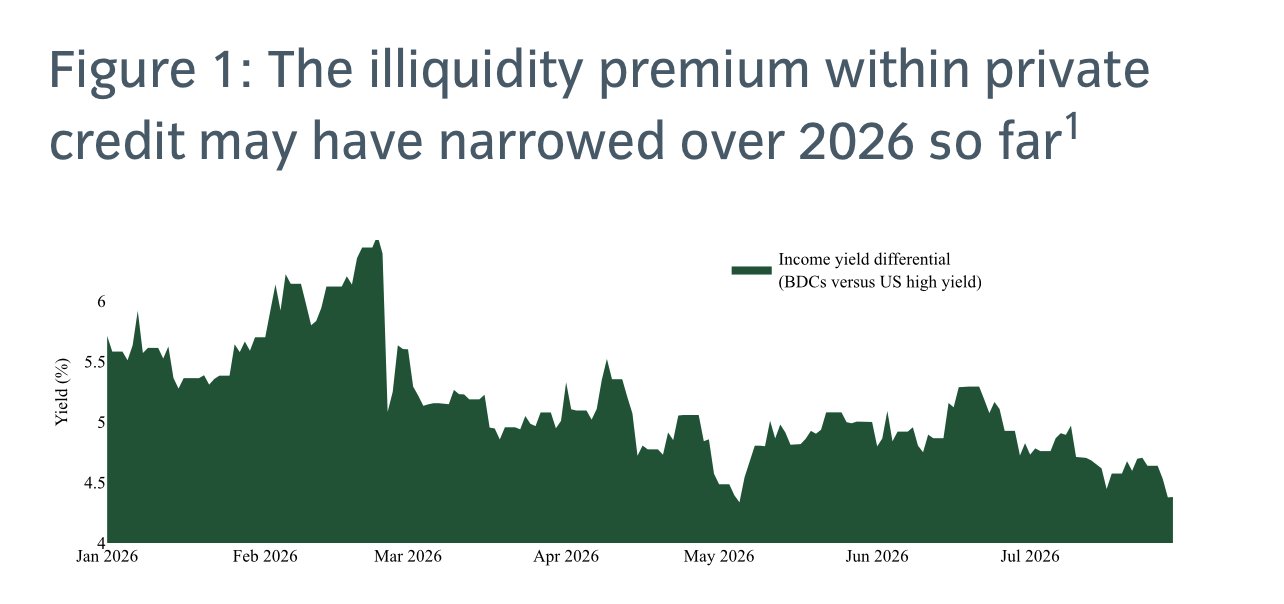
In reality, much of the historical outperformance came from an illiquidity premium. Investors accepted restrictions on accessing their capital and, in return, earned higher yields than those available in public markets. That premium has narrowed considerably.
According to research from Insight Investment, yields on public high-yield bonds have risen significantly as interest rates moved higher, while private credit spreads have compressed due to intense investor demand. As a result, the compensation investors receive for sacrificing liquidity has become much smaller than it was just a few years ago.
This chart from Insight highlights how the yield and illiquidity premium
Source: Insight Investment/BNY Mellon
In other words, investors may now be giving up daily liquidity without receiving the additional return that originally justified the tradeoff.
At the same time, investors must contend with other issues emerging in the private credit space, including rising defaults and stressed loans. Private credit portfolios generally consist of loans to smaller, less-established businesses than those found in the broadly syndicated public bond market, and many borrowers are private equity-backed companies carrying significant leverage.
These businesses often perform well during economic expansions, but in slower environments, elevated leverage can create meaningful refinancing risks. Insight Investment notes that default activity within portions of the private credit market has increased as higher borrowing costs place additional pressure on borrowers.
This becomes a significant problem given the defining characteristic of private credit: illiquidity. Most private credit funds require investors to commit capital for extended periods, often restricting withdrawals through quarterly redemption windows or other limitations. These structures generally work well in normal market environments, where stable investor capital allows managers to focus on long-term lending opportunities.
Problems arise when investors unexpectedly need access to cash.
This is precisely what is happening: too much capital has flowed into the sector, compressing yields, while investors face a lack of liquidity at exactly the wrong time.
Traditional High Yield Bonds Look Increasingly Attractive
There is, however, an alternative to private credit.
Often called “junk bonds,” high-yield securities have historically been viewed as one of the riskier segments of fixed-income because they are issued by companies rated below investment-grade.
Today’s market tells a somewhat different story.
According to Insight Investment, the Bloomberg U.S. Corporate High Yield Index currently offers a yield of approximately 7.34%, providing one of the most attractive starting income opportunities in years — roughly on par with the average private credit fund.
Equally important, the credit quality of today’s public high-yield market has improved substantially.
The proportion of BB-rated bonds—the highest tier of the high-yield universe—has steadily increased over the past decade. Many issuers entered the current economic cycle after refinancing debt during periods of exceptionally low interest rates, leaving balance sheets stronger than in previous credit cycles.
That improvement has contributed to relatively modest default expectations despite ongoing economic uncertainty.
Public high-yield bonds have become structurally less risky over time as issuer quality has improved and more highly leveraged borrowers increasingly access private lending markets. Investors are getting better bonds in junk than in private credit funds.
ETFs Add Another Competitive Advantage
The growth of bond ETFs has further strengthened the case for public high-yield investing.
Historically, purchasing individual high-yield bonds required significant research, large minimum investments, and access to institutional bond markets.
ETFs have removed many of those barriers.
Today, investors can gain exposure to hundreds or thousands of diversified high-yield bonds through a single ETF. The two-layer ETF structure also provides additional liquidity beyond what public high-yield securities alone offer.
Adding junk bonds in place of private credit makes sense: they offer higher yields, less risk, and greater liquidity.
Passive Junk Bond ETFs
These funds provide junk bond exposure and yields, sorted by one-year total return ranging from 6.7% to 6.9%. Expense ratios range from 0.05% to 0.49%, AUM from $3.9 billion to $24 billion, and current yields from 5.7% to 7.3%.
| Ticker | Name | AUM | 1-year Total Ret (%) | Yield | Exp Ratio | Security Type | Actively Managed? |
|---|---|---|---|---|---|---|---|
| USHY | iShares Broad USD High Yield Corporate Bond ETF | $23.8B | 6.9% | 6.9% | 0.08% | ETF | No |
| HYG | iShares iBoxx $ High Yield Corporate Bond ETF | $17.4B | 6.8% | 5.7% | 0.49% | ETF | No |
| JNK | SPDR Bloomberg High Yield Bond ETF | $7.9B | 6.8% | 6.5% | 0.40% | ETF | No |
| HYLB | Xtrackers USD High Yld Corporate Bd ETF | $3.93B | 6.8% | 6.6% | 0.05% | ETF | No |
| SPHY | SPDR Portfolio High Yield Bond ETF | $8.7B | 6.7% | 7.3% | 0.05% | ETF | No |
Active Junk Bond ETFs
These actively managed funds provide high-yield bond exposure, sorted by one-year total return from 1.3% to 4.7%. Expense ratios range from 0.22% to 1.02%, AUM from $50M to $5.63B, and current yields from 5.7% to 8.6%.
| Ticker | Name | AUM | 1-year Total Ret (%) | Yield (%) | Exp Ratio | Security Type | Actively Managed? |
|---|---|---|---|---|---|---|---|
| FLHY | Franklin High Yield Corporate ETF | $268M | 4.7% | 5.7% | 0.40% | ETF | Yes |
| YLD | Principal Active High Yield ETF | $160M | 4.7% | 7.2% | 0.39% | ETF | Yes |
| HYBL | SPDR Blackstone High Income ETF | $136M | 4.4% | 8.2% | 0.70% | ETF | Yes |
| THYF | T. Rowe Price U.S. High Yield ETF | $50M | 4.1% | 7.5% | 0.56% | ETF | Yes |
| SRLN | SPDR Blackstone Senior Loan ETF | $5.63B | 3.8% | 8.6% | 0.70% | ETF | Yes |
| FTSL | First Trust Senior Loan Fund | $2.27B | 3.8% | 7.5% | 0.87% | ETF | Yes |
| BKHY | BNY Mellon High Yield Beta ETF | $292M | 3.4% | 6.9% | 0.22% | ETF | Yes |
| PHYL | PGIM Active High Yield Bond ETF | $124M | 3.4% | 8.2% | 0.39% | ETF | Yes |
| HYFI | AB High Yield ETF | $123M | 3.4% | 6.7% | 0.40% | ETF | Yes |
| HYLS | First Trust Tactical High Yield ETF | $1.43B | 1.3% | 6.4% | 1.02% | ETF | Yes |
Private credit has earned its place in modern portfolios, but today’s market environment suggests investors should revisit whether its advantages remain as compelling as they once were. As the illiquidity premium narrows, defaults gradually rise, and redemption restrictions grow more meaningful, traditional high-yield bonds are emerging as a surprisingly attractive alternative.
Bottom Line
Rather than assuming higher returns require locking capital away for years, today’s bond market suggests investors may be able to achieve similar income objectives while maintaining far greater control over their portfolios.

