High-yield bonds have long offered investors an opportunity to generate attractive income by accepting additional credit risk. Unlike investment-grade debt, these securities are issued by companies with weaker financial profiles, greater leverage, or more uncertain earnings prospects.
Not all high-yield bonds carry the same risks, and the differences between credit ratings can create significant investment opportunities. CCC-rated bonds occupy one of the lowest rungs of the credit-quality ladder, and the companies that issue them typically face financial challenges that make them more vulnerable to economic downturns, refinancing difficulties, and potential defaults.
The latest sell-off in CCC-rated debt has created an unusual situation. For investors willing to embrace selective credit exposure, it could represent an opportunity to capture substantial additional income without necessarily investing in the market’s most troubled companies.
An Outlier in High-Yield Credit
Investors tend to view high-yield, or junk, bonds as a monolithic category in which all securities function the same way, leading most to gain exposure through passive vehicles. In reality, the sector contains considerable nuance.
Right now, those nuances are playing out across the various rungs of the junk bond ladder.
The high-yield market is generally divided into three major credit categories: BB, B, and CCC. BB-rated bonds represent the highest-quality segment of speculative-grade debt, often issued by established companies with manageable financial challenges, while B-rated securities carry greater credit risk but may still offer relatively stable cash flows and sustainable debt obligations.
CCC represents one of the lowest tiers, and these firms often face significant financial hurdles and repayment risks, trading at substantial discounts to par value. Historically, investors have demanded considerably higher yields to compensate for those risks compared with higher-rated BB or B bonds.
The difference in yields versus safe Treasuries is called the spread, and right now something unusual is happening. After a recent sell-off, CCC bond spreads have widened dramatically while spreads on higher-rated bonds have held steady.
According to BNY’s Insight Investment, CCC credit spreads widened by approximately 237 basis points during the first eight months of 2026. By comparison, spreads on BB-rated bonds narrowed by 11 basis points, while B-rated spreads tightened by four basis points. 1
Consequently, the broader U.S. high-yield market experienced only a modest three-basis-point increase in spreads.
This chart from Insight showcases the jump in spreads.
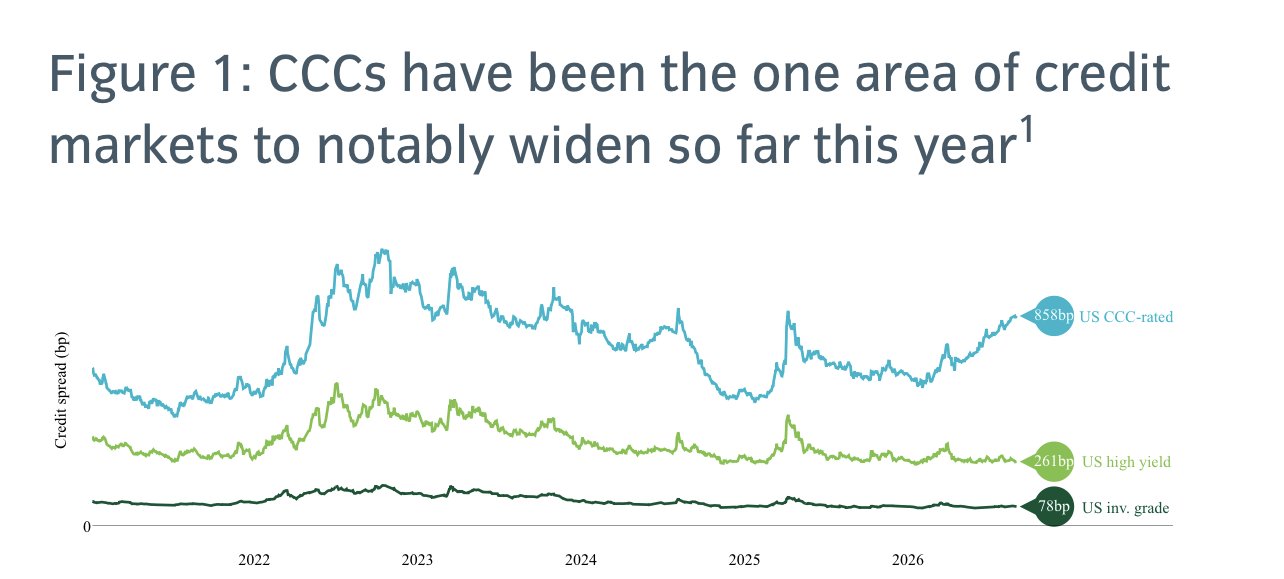
Source: BNY/Insight Investment
Looking at the differences between high-yield credit bands, CCC spreads were approximately 3.25 times those of the broader high-yield market, approaching their widest relative valuations in more than two decades.
The divergence suggests that investors have grown increasingly concerned about the weakest borrowers while remaining relatively comfortable with the financial health of higher-rated speculative-grade companies.
Not Every CCC Bond Is Distressed
Investors tend to treat the various credit bands within high-yield as uniform, but a closer look inside the CCC universe reveals a different picture. Rather than reflecting widespread deterioration in corporate credit, the sell-off has been concentrated in industries experiencing structural challenges.
Telecommunications, cable providers, traditional media businesses, and certain healthcare companies have faced significant pressure as competition, technological disruption, and elevated borrowing costs threaten their financial models, and these industries account for a disproportionately large share of the CCC universe.
Their spreads have surged accordingly. Cable and satellite CCC spreads climbed above 3,500 basis points in October, while wireline telecommunications spreads approached 1,600 basis points. The weakness of these troubled borrowers has distorted the overall valuation picture for CCC-rated debt.
Removing the roughly 20% of CCC bonds trading at 60 cents on the dollar—a common benchmark for distressed debt—produces a very different picture. The remaining performing CCC universe traded at spreads that appeared relatively normal, and even somewhat tight, compared with historical averages.
A Few Bad Apples Have Spoiled the Entire Barrel
The remaining higher-quality CCC bonds may actually outperform higher-rated bonds. Insight Investment divided the CCC universe into five groups based on fundamental credit characteristics, including financial strength and other measures of issuer quality. Excluding the weakest 20%, the asset manager found that stronger CCC groups historically generated higher excess returns than BB- and B-rated securities—though with greater volatility—while also offering an additional 340 basis points of yield.
This creates an interesting opportunity.
Rather than avoiding CCC bonds entirely, investors could focus on companies with adequate liquidity, manageable debt maturities, and businesses capable of generating sustainable cash flow. The market’s broad dismissal of the sector has created an attractive entry point for these bonds.
Accessing CCC Bonds Through ETFs
Given the disparity within the CCC universe, investors willing to take on some risk could be rewarded. The key is to think surgically about these bonds and identify the top performers.
Broad passive strategies, such as the iShares iBoxx $ High Yield Corporate Bond ETF (HYG), iShares Broad USD High Yield Corporate Bond ETF (USHY), and SPDR Bloomberg High Yield Bond ETF (JNK) offer diversified exposure across BB-, B-, and CCC-rated securities, but they also include ample “trash.”
You could purchase individual CCC-rated bonds, but active management through ETFs may be an easier route. Top managers can identify the strongest CCC bonds and deliver them in an accessible package.
Active High Yield Bond ETFs
These actively managed funds provide high-yield bond exposure, sorted by one-year total return ranging from 1.3% to 4.7%. Expense ratios range from 0.22% to 1.02%, AUM from $50M to $5.63B, and current yields from 5.7% to 8.6%.
| Ticker | Name | AUM | 1-year Total Ret (%) | Yield (%) | Exp Ratio | Security Type | Actively Managed? |
|---|---|---|---|---|---|---|---|
| FLHY | Franklin High Yield Corporate ETF | $268M | 4.7% | 5.7% | 0.40% | ETF | Yes |
| YLD | Principal Active High Yield ETF | $160M | 4.7% | 7.2% | 0.39% | ETF | Yes |
| HYBL | SPDR Blackstone High Income ETF | $136M | 4.4% | 8.2% | 0.70% | ETF | Yes |
| THYF | T. Rowe Price U.S. High Yield ETF | $50M | 4.1% | 7.5% | 0.56% | ETF | Yes |
| SRLN | SPDR Blackstone Senior Loan ETF | $5.63B | 3.8% | 8.6% | 0.70% | ETF | Yes |
| FTSL | First Trust Senior Loan Fund | $2.27B | 3.8% | 7.5% | 0.87% | ETF | Yes |
| BKHY | BNY Mellon High Yield Beta ETF | $292M | 3.4% | 6.9% | 0.22% | ETF | Yes |
| PHYL | PGIM Active High Yield Bond ETF | $124M | 3.4% | 8.2% | 0.39% | ETF | Yes |
| HYFI | AB High Yield ETF | $123M | 3.4% | 6.7% | 0.40% | ETF | Yes |
| HYLS | First Trust Tactical High Yield ETF | $1.43B | 1.3% | 6.4% | 1.02% | ETF | Yes |
The recent sell-off in CCC-rated bonds has created one of the most compelling valuation divergences within the high-yield market. With credit spreads approaching historically elevated levels, investors have an opportunity to capture substantial additional income and potential capital appreciation.
However, weakness has been concentrated among a relatively small group of distressed issuers, making careful credit selection essential.
By focusing on performing CCC bonds with stable fundamentals and manageable refinancing risks, investors may be able to capitalize on attractive spreads without assuming the full risks of the most troubled borrowers. Active and systematic high-yield ETFs offer a practical way to pursue these opportunities while maintaining broader portfolio diversification.
Bottom Line
The recent sell-off in CCC-rated bonds has created a potentially compelling opportunity for investors seeking higher yields and attractive valuations within the high-yield market.
1 Insight Investment(October 2026). Systematic Insights: High yield: CCCs friend or foe?High-yield CCCs: Friend or foe?

