For bond investors, the last several years have produced a remarkable transformation. After spending much of the post-financial-crisis era searching for income in a world of rock-bottom interest rates, investors can finally earn meaningful yields across large portions of the fixed income market. Treasuries, corporate bonds, municipal debt, securitized credit and emerging market bonds all offer substantially more income than they did during the ultra-low-rate years.
But there is a catch. The same economic forces that created these attractive yields have also made fixed income considerably harder to navigate. Forces such as inflation, dwindling credit spreads, and uncertain monetary policy have made fixed income investors’ jobs a bit harder lately.
Simply buying “bonds” may not be enough anymore.
Today’s fixed income environment may require a combination of tactical offense and resilient defense. Investors need to pursue the attractive income opportunities now available without forgetting that credit, duration and liquidity risks can quickly become problematic if economic conditions deteriorate.
Plenty of Yield, But Plenty of Risk Too
Call it the great yield reset.
Thanks to the Federal Reserve’s actions to combat inflation, higher interest rates have pushed starting yields back toward historically normal levels. Today, investors no longer necessarily need a major decline in interest rates to generate an attractive return. Coupon income can once again do much of the heavy lifting. A variety of fixed income sectors are now paying meaningful yields north of 4%. That matters because starting yield has traditionally been an important driver of longer-term bond returns. We can already see that in action with bond market returns.
Since the yield reset and rate hikes used to combat inflation, bond returns have been decent. The benchmark Bloomberg Aggregate Bond Index’s (Agg) annualized total return is around 4%. That return basically reflects the now higher yield on the Agg. The same could be said for much of the fixed income universe.
But those higher yields and overall euphoria around bonds don’t exactly make for a rosy picture. Risks have continued to rise in the bond market across a wide range of factors.
For example, while the initial surge in inflation following the pandemic has subsided, getting inflation sustainably back toward central-bank targets has proven difficult. Structural forces including deglobalization, tariffs, reshoring, higher wages, energy-market disruptions and enormous infrastructure investment could keep price pressures elevated.
This has murkied the waters on monetary policy. Market participants have been forced to constantly reassess whether central banks will cut rates, hold steady, or potentially tighten again if inflation reaccelerates. Each change in expectations can produce substantial moves in yields and duration-sensitive securities. Today, we’ve continued to see this play out as the latest CPI figures have risen.
Economic woes have also started to creep into the picture, with consumer spending dipping, job growth slowing, and overall measures of economic activity taking a pause. This comes at a time when government borrowing has increased.
The issue is, investors may not be adequately assessing all these risks in their bond holdings. Sure, yields are great and high, but spreads are telling a different story. This chart from investment manager Schroders looks at current option-adjusted spreads (OAS) for a multitude of fixed income asset classes.
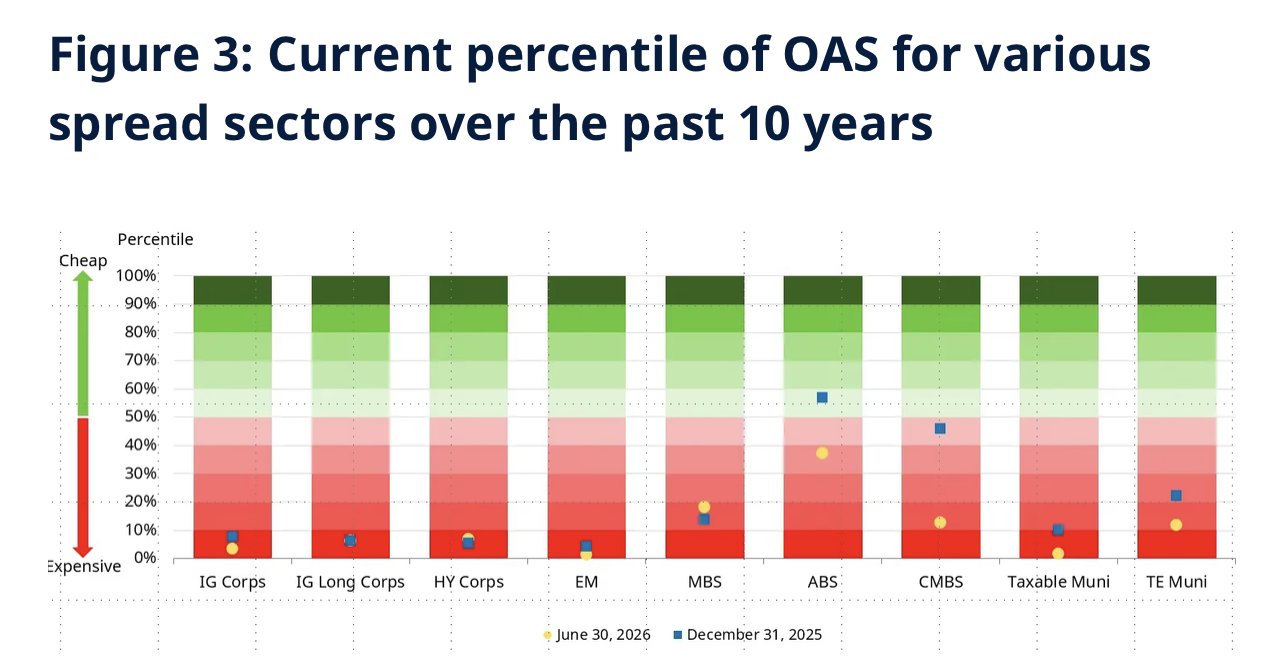
Source: Schroders
As you can see, many bond asset classes fall within the expensive range when looking at 10-year averages. Investors are getting more yield overall, but not enough yield to compensate for more risks.
Fixed Income Requires More Tactical Selection
This doesn’t mean that it’s time to throw away bonds. A traditional core bond allocation can still play an important role. However, the current environment argues against treating the bond market as a monolithic asset class.
Investors may want to be far more deliberate about where they take duration and credit risk. The objective is to capture attractive income without becoming excessively exposed to the risks that could dominate the next stage of the economic cycle.
For example, Schroeder highlights municipal bonds as a potential winner as well as securitized credit, emerging market bonds and corporate credits.
The key is that the complexity of these markets can create pricing inefficiencies. Different securities can possess dramatically different cash-flow characteristics, collateral quality and sensitivity to interest rates. Corporate bonds also remain compelling, particularly higher-quality investment-grade debt, as many firms generally entered the current cycle with healthier balance sheets than in many previous downturns. But tight spreads require more research. Emerging markets add a wide variety of currency and other diversifying metrics. The same can be said for mortgage-backed securities, asset-backed securities and commercial mortgage securities, among other assets.
All in all, these are opportunities for active managers capable of analyzing individual issuers rather than simply purchasing the entire market. For investors, the various issues, potential pitfalls and growing risks mean being tactful with their bond holdings is more important than ever.
Multi-Sector Bond Funds Could Be the Sweet Spot
All of these opportunities create a practical problem for individual investors.
Knowing that municipal bonds, corporate credit, securitized debt and emerging markets may offer attractive opportunities is one thing. Determining which sector is most attractive at any particular moment is considerably harder.
Which is why Schroeder’s suggests being tactical and using an active manager via a multi-sector income strategy.
Rather than remaining tied to one segment of the bond market, multi-sector managers can move capital toward areas offering the best combination of yield, valuation and credit quality. If corporate spreads become unattractive, a manager can increase securitized exposure. If emerging markets become compelling, the portfolio can move overseas. If economic risks increase, managers can emphasize Treasuries and higher-quality securities.
The growth of actively managed ETFs has made these strategies much easier for individual investors to access. Multi-sector bond ETFs can combine professional credit research, duration management and tactical asset allocation with the liquidity, transparency and relatively low costs of the ETF structure.
Investors effectively outsource some of the most difficult decisions in today’s fixed income market to professional managers.
Multisector Active Bond ETFs
These ETFs provide low-cost exposure to active bond management in unconstrained, dynamic, and go-anywhere sectors. Sorted by YTD return—from 7.6% to 9.1%—they have expenses between 0.10% and 0.56%, assets between $51M and $22B, and current yields between 4.2% and 6.8%.
| Ticker | Name | AUM | YTD Total Ret (%) | Yield (%) | Exp Ratio | Security Type | Actively Managed? |
|---|---|---|---|---|---|---|---|
| BOND | PIMCO Active Bond ETF | $6.6B | 9.1% | 5.0% | 0.56% | ETF | Yes |
| JCPB | JPMorgan Core Plus Bond ETF | $8.8B | 8.7% | 5.30% | 0.40% | ETF | Yes |
| OBND | SPDR Loomis Sayles Opportunistic Bond ETF | $51M | 8.10% | 6.8% | 0.55% | ETF | Yes |
| FBND | Fidelity Total Bond ETF | $22B | 7.9% | 4.9% | 0.36% | ETF | Yes |
| VCRB | Vanguard Core Bond ETF | $3B | 7.85% | 4.20% | 0.10% | ETF | Yes |
| TOTL | SPDR DoubleLine Total Return Tactical ETF | $4B | 7.84% | 5.1% | 0.55% | ETF | Yes |
| DBND | DoubleLine Opportunistic Bond ETF | $600M | 7.6% | 5% | 0.45% | ETF | Yes |
| BINC | BlackRock Flexible Income ETF | $14B | 7.59% | 5.5% | 0.52% | ETF | Yes |
The great yield reset has made this one of the most attractive fixed income environments investors have seen in years, but attractive yields shouldn’t be confused with an easy market.
Persistent inflation, uncertain monetary policy, enormous government borrowing needs, tight credit spreads and growing concerns within private markets create meaningful risks beneath the surface.
Investors therefore need to be more selective about where they take credit and duration exposure, emphasizing areas such as high-quality corporate debt, municipal bonds, securitized credit and emerging market debt when valuations justify the risk. Multi-sector bond funds and actively managed ETFs may be particularly well suited to this environment
Bottom Line
The great yield reset has restored fixed income as a meaningful source of income and total return, but today’s bond market requires investors to be far more selective about where they take risk.
1 Schroders (July 2026). Fixed income markets now demand a mix of tactical offense and resilient defense

