A CEF’s investment objective is explicitly stated in the fund’s prospectus and shareholder reports. Fund sponsors, like BlackRock, generally provide portfolio holdings and characteristics on a monthly basis via their public website and/or in fund factsheets. Before investing in a CEF, investors should consider and understand the risks associated with investing in CEFs, which are available in the fund’s prospectus and shareholder reports. Many CEFs utilize leverage to increase their exposure to a particular asset class in order to potentially enhance distributions or generate higher returns. The use of leverage may result in an increase in the volatility of the value of the fund’s assets, which is referred to as the net asset value (“NAV”). Careful consideration of the risks and benefits associated with CEFs can unveil potential value-add opportunities for your portfolio.
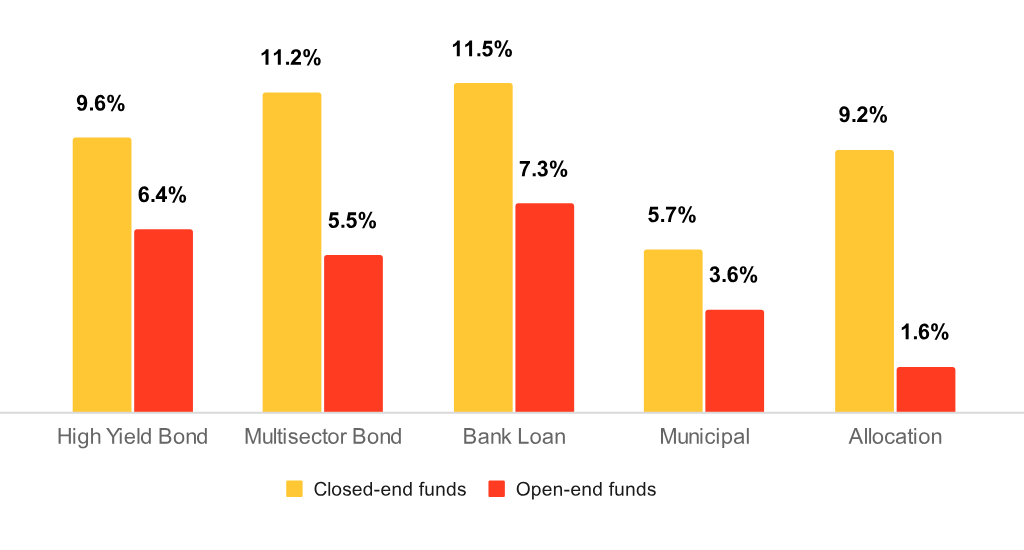
Source: Morningstar as of 9/30/ 2025. Past performance is not a guarantee of future results. For closed-end funds, distribution rate is reflected by annualized NAV distribution rate as of 9/30/2025. For open-end funds, distribution rate is represented by 12 Month NAV Yield as of 9/30/2025. Morningstar categories reflect the peer group median. Allocation represented by Tactical Allocation, Municipal represented by Muni National Long, and other categories represented by Morningstar categories of the same name. It is important to evaluate material differences between CEFs and open-end mutual funds with regards to structure, pricing, distribution mechanics, etc. (1) Closed end fund distributions may be derived from various sources of a fund’s return, including interest, dividends, capital gains or other non-income sources such as return of capital — the composition will vary for each fund depending on its underlying holdings and portfolio turnover.
Rather than simply calculating a CEF’s price return (i.e. the change in share price over a certain period of time), the total return calculation takes into account both the change in share price, as well as any distributions received by the investor over the investment period. Since CEFs distribute the majority of their income and realized capital gains, a simple price return calculation overlooks a significant factor for CEF returns.1 When a CEF pays a distribution, the amount of the distribution is deducted from the fund’s NAV and, in an efficient market, the share price is reduced by a similar amount. Importantly, cash flow from CEF distributions should be viewed as a component of the investment’s total value. Accordingly, when calculating a CEF’s total return over a given period, the amount of the distributions paid by the fund should be added back to the share price to arrive at the total return. As seen in Exhibit 2, excluding distributions significantly understates a CEF’s performance.
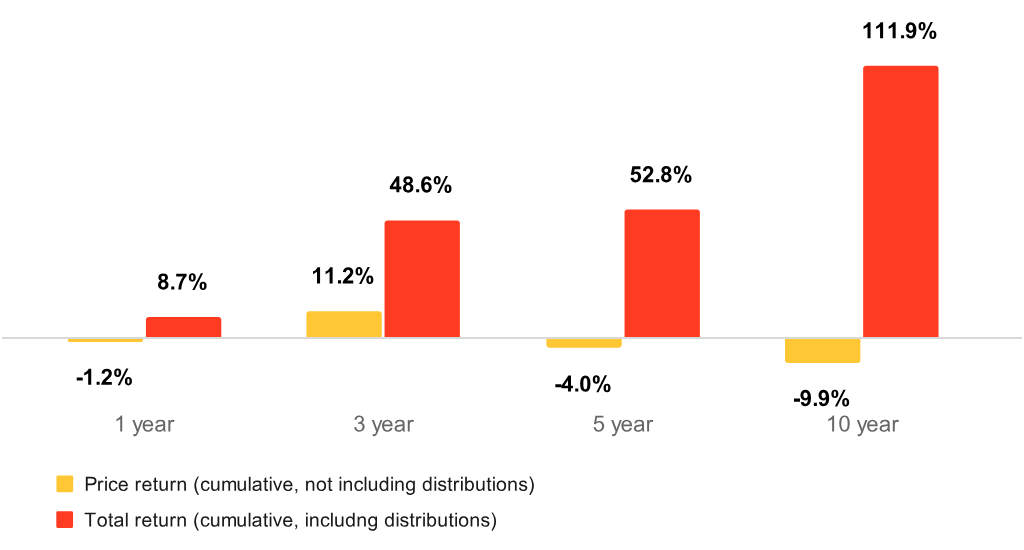
Source: Morningstar as of 9/30/2025. CEFs are represented by the average of all funds in the Morningstar closed-end fund universe. In general, CEF distributions may be sourced from net investment income, realized gains and return of capital. For specific information about a fund’s distribution sources, visit the fund sponsor’s website. Past performance is not a guarantee of future results. Morningstar category returns are shown for illustration purposes only and are not meant to represent the past or future performance of any fund.
In the current low interest rate environment as of September 2025, many investors may be seeking a stable source of income. BlackRock believes that CEFs may be an attractive opportunity for these investors given their potentially higher distribution rates than comparable investments. As illustrated in Exhibit 1, certain CEFs may offer distribution rates that are two to three times greater than the distribution rates of mutual funds in similar categories. Importantly, investors may want to evaluate the stability of a fund’s distribution, in addition to the level of the distribution, as a distribution reduction could negatively impact a fund’s share price. Moreover, distribution stability is important in maintaining a steady rate of cash flow into your portfolio. Many fund sponsors, like BlackRock, post earnings data for their taxable fixed income and municipal income CEFs on a monthly basis. To determine if a CEF is able to support its distribution, simply compare the level of earnings versus the distribution amount. If earnings exceed the distribution amount, then the fund earned its distribution for that period.
Some investors may view a discount as a potential value opportunity; however, discounts can persist or widen, and there is no assurance that purchasing at a discount will result in a favorable outcome. Over time, CEFs tend to establish a particular premium/discount trading range. As a potential investor, it is important to understand a fund’s short-term (i.e. 1-year) and longer-term (i.e. 3- and 5-year) historical trading patterns, specifically focusing on a fund’s average discount and the magnitude of fluctuations around that average (i.e. high and low discount over each time period). BlackRock believes that CEFs generally exhibit mean reversion to their historical premium/discount averages over time, though this is not guaranteed. Additionally, investors may want to consider the potential impact market sentiment and/or certain catalysts such as distribution increases or reductions may have in creating deviations from historical trading ranges.
CEFs tend to have lower trading volumes than other exchange-traded securities, such as single stocks and exchange-traded funds. Larger CEFs generally trade more efficiently due to their larger asset base and higher daily trading volume. Less liquid securities tend to have wider bid/ask spreads, which may result in higher transaction costs, particularly when using market orders. Investors may want to consider using limit orders when buying or selling CEFs.
(1) Closed-end fund distributions may be derived from various sources of a fund’s return , including interest, dividends, capital gains and other non-income sources such as return of capital — the composition and tax treatment will vary for each fund depending on its underlying holdings and portfolio turnover. A return of capital may occur, for example, when some or all of the shareholder’s investment is paid back to the shareholder. A return of capital distribution does not necessarily reflect the Fund’s investment performance and should not be confused with ‘yield’ or ‘income’. When distributions exceed total return performance, the difference will reduce the Fund’s net asset value per share.
BlackRock’s purpose is to help more and more people experience financial well-being. As a fiduciary to investors and a leading provider of financial technology, we help millions of people build savings that serve them throughout their lives by making investing easier and more affordable. For additional information on BlackRock, please visit www.blackrock.com/corporate
BlackRock will update performance and certain other data for closed-end funds on a monthly basis on its website in the “Closed-end Funds” section of www.blackrock.com as well as certain other material information as necessary from time to time. Investors and others are advised to check the website for updated performance information and the release of other material information about the Funds. This reference to BlackRock’s website is intended to allow investors public access to information regarding the Funds and does not, and is not intended to, incorporate BlackRock’s website in this release.
Investment return, price, yields and NAV will fluctuate with changes in market conditions. At the time of sale, your shares may have a market price that is above or below net asset value, and may be worth more or less than your original investment. There is no assurance that a fund will meet its investment objective. Closed-end fund shares are not deposits or obligations of, or guaranteed by, any bank and are not insured by the FDIC or any other agency. Investing involves risk, including possible loss of principal amount invested. This is not a prospectus intended for use in the purchase or sale of any fund’s shares. Investors should review a fund’s prospectus and other publicly available information, including shareholder reports, carefully before investing. Shares may only be purchased or sold through registered broker/dealers. No assurance can be given that a fund will achieve its investment objective.
You should consider the Fund’s investment objectives, risks, charges and expenses carefully before investing. This and other information can be found in the Fund’s prospectus or shareholder report, as applicable, which may be obtained by visiting the BlackRock Fund Prospectuses & Shareholder Reports webpage, calling 800-882-0052 or from your financial professional. Read the Fund’s prospectus or shareholder report, as applicable, carefully before investing.
There is no assurance any fund will achieve its objectives. The information contained herein is not complete and may be changed. This document is not an offer to sell a fund’s securities and is not soliciting an offer to buy a fund’s securities in any jurisdiction where the offer or sale is not permitted.
Performance results reflect past performance and are no guarantee of future results. Current performance may be lower or higher than the performance data quoted. All returns assume reinvestment of all dividends. The market value and net asset value (NAV) of a Trust’s shares will fluctuate with market conditions. Closed-end funds may trade at a premium to NAV but often trade at a discount.
This information should not be relied upon as research, investment advice, or a recommendation regarding any products, strategies, or any security in particular. This material is strictly for illustrative, educational, or informational purposes and is subject to change.
Some BlackRock CEFs may utilize leverage to seek to enhance the yield and net asset value of their common stock, through bank borrowings, issuance of short-term debt securities or shares of preferred stock, or a combination thereof. However, these objectives cannot be achieved in all interest rate environments. While leverage may result in a higher yield for the fund, the use of leverage involves risk, including the potential for higher volatility of the NAV, fluctuations of dividends and other distributions paid by the fund and the market price of the fund’s common stock, among others. Certain funds may invest assets in securities of issuers domiciled outside the United States, including issuers from emerging markets. Foreign investing involves special risks, including foreign currency risk and the possibility of substantial volatility due to adverse political, economic or other developments.
Some BlackRock CEFs make distributions of ordinary income and capital gains at calendar year end. Those distributions temporarily cause extraordinarily high yields. There is no assurance that a fund will repeat that yield in the future. Subsequent monthly distributions that do not include ordinary income or capital gains in the form of dividends will likely be lower. Fund details, holdings and characteristics are as of the date noted and subject to change.
The opinions expressed are those of BlackRock as of September 30, 2025, and are subject to change at any time due to changes in market or economic conditions. BlackRock makes no undertaking to change this document in response to such changes. These comments should not be construed as a recommendation of any individual holdings or market sectors.
© 2025 BlackRock, Inc. or its affiliates. All Rights Reserved. BLACKROCK is a trademark of BlackRock, Inc. or its affiliates. All other trademarks are those of their respective owners
Prepared by BlackRock Investments, LLC, member FINRA

