Active ETFs have become one of the fastest-growing corners of the investment industry. Offering the potential for market-beating returns in a tax-efficient, low-cost package, investors have flocked to active ETFs to build their portfolios. During the first half of 2026 alone, actively managed ETFs attracted approximately $398 billion, accounting for 39% of all U.S. ETF inflows.
However simply placing an active strategy inside an ETF doesn’t guarantee better results. Some markets are harder for active managers to beat, while others allow skilled managers to thrive.
Investment-grade corporate bonds have characteristics that create opportunities for active managers to add value through credit research, security selection, new bond issues, and duration management. Those advantages are enhanced by the liquidity, transparency, and relatively low costs of the ETF structure, making corporate bonds a fruitful starting point for investors building out their bond portfolios.
Active Management Has Delivered in the Bond Market
The premise of active management is that managers can outperform the market—whether in the short or long term and with less risk. Unfortunately, active management has historically failed to deliver on that promise across many asset classes, even before accounting for fees and transaction costs.
The case for active management in fixed-income, however, isn’t merely theoretical. Data back it up: historically, active bond managers have had considerably more success beating their benchmarks than active stock managers.
According to Morningstar data cited by Parametric, 64% of active bond managers outperformed their respective benchmarks over the five years through June 2025, compared with just 24% of active equity managers. That gap is particularly notable because active management is often discussed as though its effectiveness is consistent across asset classes, when in reality the historical record shows fixed-income has provided a far more favorable environment for active managers.
More recent Morningstar data reinforce that advantage. Over the 10 years through June 2026, active fixed-income funds posted a 45% success rate, the highest of any broad asset class in Morningstar’s Active/Passive Barometer.
That track record isn’t accidental.
The structure of the bond market gives active managers several advantages that don’t exist to the same degree in highly efficient areas of the stock market. Thousands of individual securities, uneven liquidity, shifting credit quality, and index construction based largely on debt outstanding can all create opportunities for managers willing to look beyond the benchmark.
Investment-grade Corporate Bonds Are Ripe for Active Management
The characteristics that favor active management are particularly prominent in investment-grade corporate bonds.
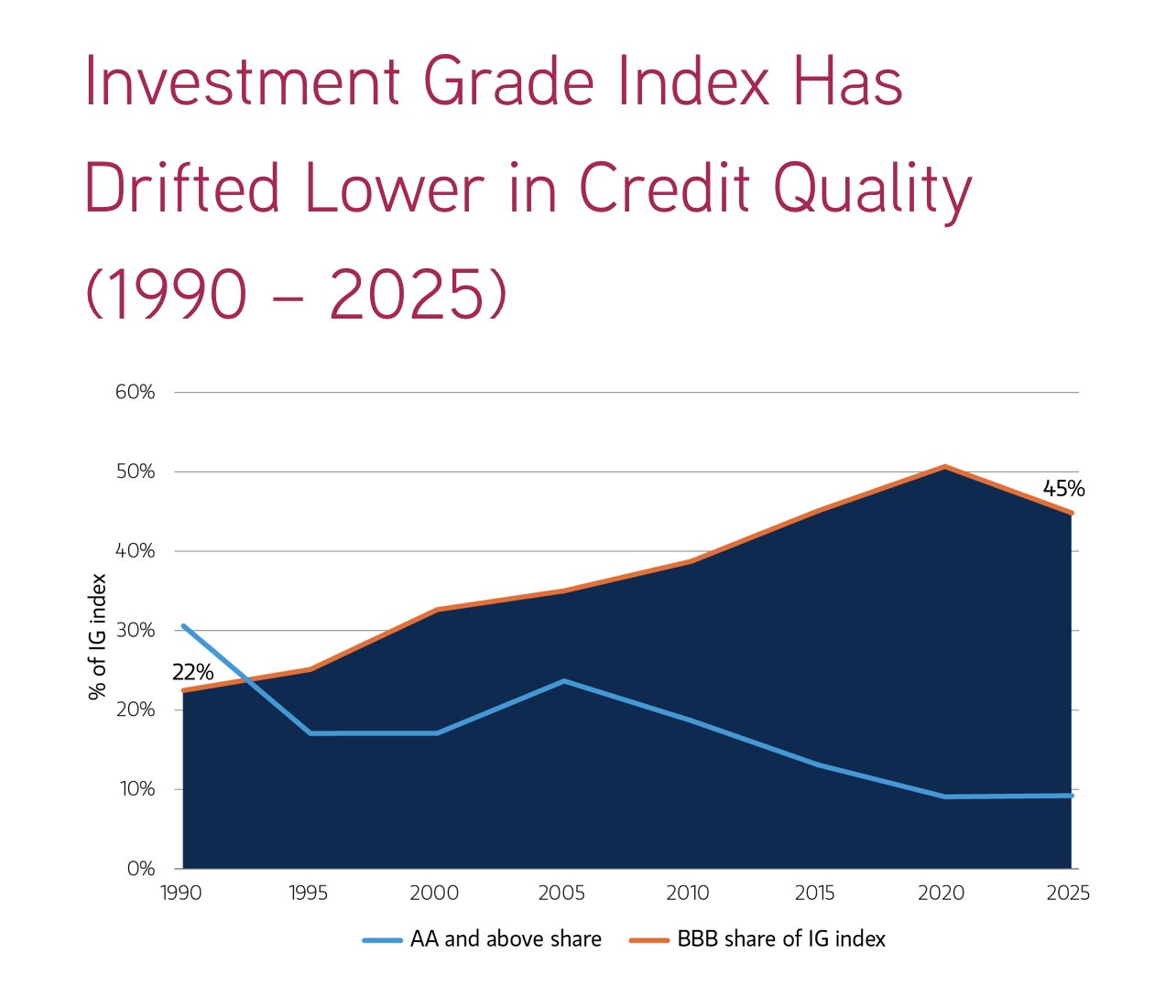
The composition of the investment-grade market has changed dramatically. According to Parametric, BBB-rated bonds represented roughly one-quarter of the ICE BofA U.S. Corporate Index in 1990 but account for nearly half today. Over the same period, bonds rated AA or better declined from roughly one-third of the index to less than 10%.
In other words, the investment-grade market has gradually migrated toward the lowest rung of investment-grade credit. This chart from Parametric highlights the shift toward lower-quality credit.
Source: Parametric
Investors buying a passive investment-grade index today are getting a meaningfully different credit-quality mix than they would have several decades ago. BBB bonds aren’t inherently bad investments, but they do add volatility and additional risk to an index.
When a BBB issuer is downgraded to high yield, for example, an ETF and its investors can become forced sellers at the worst possible time. During the 2020 downgrade cycle, approximately $88 billion of investment-grade bonds became fallen angels and entered the high-yield market, creating permanent losses for investors forced to sell within indexes.
Another advantage for active management in the investment-grade corporate bond universe is the market’s built-in inefficiencies. A single company may have one publicly traded stock but dozens—even hundreds—of outstanding bonds, each with different maturities, coupons, call provisions, seniority, and liquidity characteristics.
That complexity creates opportunities for relative-value analysis, as each bond can be evaluated on its own merits across a variety of factors.
This dynamic is compounded by the presence of many non-economic buyers. Central banks, insurance companies, and banks collectively own a significant portion of the global bond market and often make investment decisions based on regulations, liability matching, capital requirements, or monetary policy rather than total returns. That behavior can create additional pricing inefficiencies, particularly in the investment-grade market.
Finally, new bond issuance can create a tailwind for active management. Companies frequently price newly issued bonds at slightly more attractive yields than comparable bonds already trading in the secondary market, and a passive index generally lacks the flexibility to capture that advantage because a newly issued bond doesn’t immediately enter its benchmark.
Taken together, these factors explain why active management can and does consistently outperform indexes in the investment-grade corporate bond market.
Put Active Management Inside an ETF
Historically, investors who wanted professional bond management generally turned to mutual funds or separately managed accounts.
ETFs have changed the equation.
An active corporate bond ETF combines professional credit research and portfolio construction with the convenience of an exchange-traded vehicle. Investors can buy or sell shares throughout the trading day, view portfolio holdings regularly, and gain exposure to hundreds of individual securities through a single position. For many investors, investment-grade corporate bonds can serve as part of the core fixed-income allocation rather than as a speculative satellite position.
Investment-Grade Corporate Bond ETFs
These funds were selected based on their exposure to investment-grade bonds at a low cost. They carry expenses of 0.03% to 0.36% and yields from 4.4% to 5.9%, with assets under management between $393M and $31B.
| Ticker | Name | AUM | YTD Total Ret (%) | Yield (%) | Exp Ratio | Security Type | Actively Managed? |
|---|---|---|---|---|---|---|---|
| IGSB | iShares 1-5 Year investment-grade Corporate Bond ETF | $21.7B | 1.3% | 4.4% | 0.04% | ETF | No |
| IGIB | iShares 5-10 Year investment-grade Corporate Bond ETF | $15.3B | 0.8% | 4.6% | 0.04% | ETF | No |
| CORP | PIMCO investment-grade Corporate Bond Index ETF | $1.33B | 0.7% | 5.2% | 0.36% | ETF | Yes |
| KORP | American Century Diversified Corporate Bond ETF | $393M | 0.2% | 5.0% | 0.29% | ETF | Yes |
| SPBO | SPDR Portfolio Corporate Bond ETF | $1.83B | -0.1% | 5.2% | 0.03% | ETF | No |
| LQD | iShares iBoxx $ investment-grade Corporate Bond ETF | $30.4B | -0.3% | 4.7% | 0.14% | ETF | No |
| VCLT | Vanguard Long-Term Corporate Bond ETF | $15.5B | -2.2% | 5.9% | 0.03% | ETF | No |
| USIG | iShares Broad USD investment-grade Corporate Bond ETF | $ | 0% | 4.55% | 0.04% | ETF | No |
| SCHI | Schwab 5-10 Year Corporate Bond ETF | $ | 0% | 5.04% | 0.03% | ETF | No |
| FSIG | First Trust Limited Duration investment-grade Corporate ETF | $ | 0% | 4.54% | 0.55% | ETF | Yes |
In a market where indexes increasingly favor heavily indebted issuers, nearly half the benchmark sits at the lowest investment-grade rating tier, and thousands of individual bonds trade with varying liquidity and efficiency—making the flexibility of active management especially valuable.
Investment-grade corporate credit offers many of the conditions that allow skilled managers to earn their fees, and investors can take advantage of this through low-cost ETFs.
Bottom Line
Active management does not provide the same advantage in every market segment, but investment-grade corporate bonds have historically offered managers more opportunities to add value. Active corporate bond ETFs combine those advantages with the diversification, liquidity, and convenience of the ETF structure.

