Few areas of the investment industry have experienced as much momentum over the past several years as active exchange-traded funds. Once considered a niche corner of the ETF universe, active ETFs have become one of the fastest-growing segments in asset management. Nearly every major investment firm now offers actively managed ETF strategies, and new products continue to launch at a remarkable pace.
Still, investors shouldn’t assume that every active equity ETF deserves a place in a portfolio simply because it carries the word “active” in its name. While the category has expanded rapidly, success remains highly uneven.
The challenge for investors isn’t deciding whether active management has merit—it’s determining where active management has the greatest opportunity to succeed.
Not Every Active ETF Delivers Alpha
Active ETFs now account for well over $1.5 trillion in assets, with thousands of products available across equities, fixed-income, alternatives, and income strategies. While passive ETFs still dominate total industry assets, active ETFs have captured a disproportionate share of recent fund inflows as investors seek ways to navigate increasingly complex markets without sacrificing the operational benefits of the ETF structure.
The rapid growth of active ETFs has dramatically expanded investor choice, but more choices do not automatically translate into better outcomes, and many active managers continue to underperform their benchmarks over long periods.
According to AllianceBernstein (AB), only about 29% of active managers in large-cap U.S. equities managed to beat the Russell 1000 last year. Over the last two decades, only about 37% of managers have beaten the benchmark each year. 1
The question is: why the underperformance?
AB has a theory. When market leadership is extremely narrow, it becomes difficult for diversified active managers to outperform indexes heavily concentrated in a small group of outperforming stocks—and that is precisely what is happening today.
Indexes, such as the S&P 500, have become increasingly concentrated in a handful of mega-cap technology companies. These businesses have delivered exceptional earnings growth and stock performance, making it difficult for active managers with diversified portfolios to keep pace if they are underweight these names.
That concentration creates an interesting paradox: passive investors benefit while leadership remains narrow, but concentration also increases portfolio risk.
Where Active Management Has Historically Worked Best
According to AllianceBernstein, investors may achieve better results by allocating active management intentionally rather than uniformly across an entire portfolio. Rather than assuming every market segment offers equal opportunities for active managers, investors should focus on areas where security selection has historically mattered most.
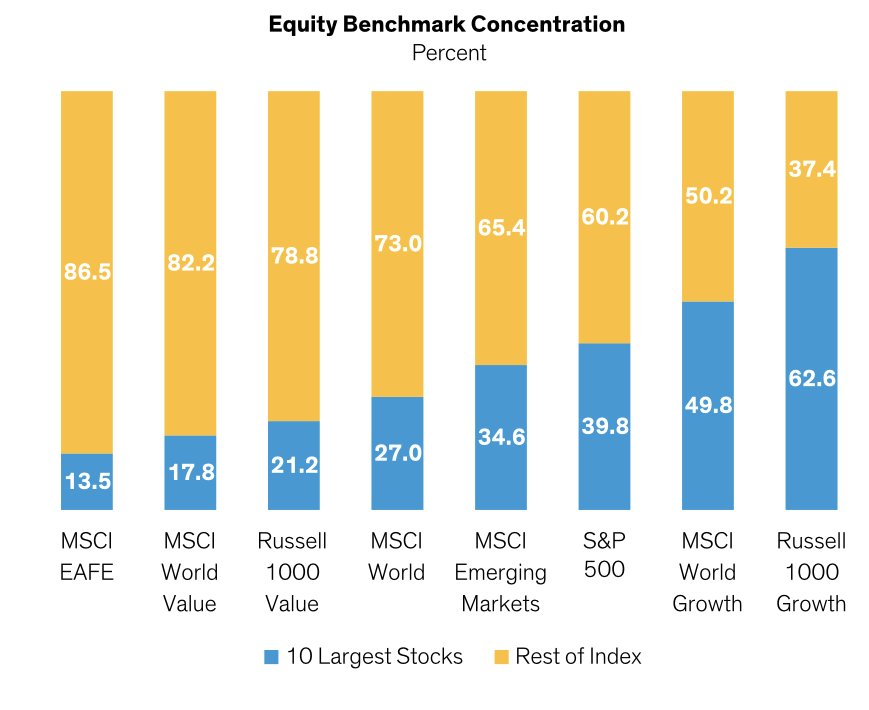
Those are areas of wide dispersion in leadership and lower concentration.
This chart from AB highlights the lower concentration of top stocks in major global indexes.
Source: AllianceBernstein
In the U.S., those areas remain value and small-cap stocks.
Smaller companies generally receive less Wall Street research coverage than large-cap firms, while value stocks often exhibit much greater dispersion in business quality than broad growth indexes.
International and emerging market investing is another such area. Companies operating outside the United States face differing regulatory environments, accounting standards, political risks, currencies, and economic cycles, and understanding these local dynamics often requires extensive regional expertise that passive indexes cannot incorporate.
AllianceBernstein argues that these less efficient market segments create greater opportunities for skilled managers to generate alpha through fundamental research and disciplined security selection. Rather than competing directly against highly efficient large-cap U.S. indexes, active management may produce stronger risk-adjusted returns where information advantages still exist.
Build Around Strengths Rather Than Replace Everything
For many investors, the idea that not all active equity ETFs deliver superior results may cause some disruption. Many investors and advisors have flocked to active ETFs as passive replacements, driven by the promise of better returns, but treating active and passive investing as mutually exclusive may be a mistake.
In reality, the two approaches often complement each other.
AB suggests that many investors should continue using broad passive ETFs as their portfolio foundation while selectively adding active equity ETFs where managers have greater opportunities to outperform—being active with their active allocations. Rather than asking whether to invest actively or passively, investors increasingly ask where each approach makes the most sense, reflecting a shift toward intentional allocation.
For example, a passive S&P 500 ETF may continue serving as a core holding, while active ETFs provide exposure to international equities, small-cap companies, value stocks, or specialized thematic opportunities.
Investors can build diversified portfolios by combining passive core holdings with carefully selected active strategies that complement—not duplicate—existing exposures.
Active Value ETFs
These ETFs were selected for their exposure to value strategies using active management. Sorted by YTD total return, they range from -5.8% to 4.5%, with assets under management between $236M and $15.5B, expense ratios of 0.15% to 0.44%, and current yields between 1.1% and 1.9%.
| Ticker | Name | AUM | YTD Total Ret (%) | Yield (%) | Exp Ratio | Security Type | Actively Managed? |
|---|---|---|---|---|---|---|---|
| CGDV | Capital Group Dividend Value ETF | $14.2B | 4.5% | 1.2% | 0.33% | ETF | Yes |
| FLV | American Century Focused Large Cap Value ETF | $236M | 2.6% | 1.9% | 0.42% | ETF | Yes |
| DFLV | Dimensional U.S. Large Cap Value ETF | $1.6B | 1% | 1.7% | 0.22% | ETF | Yes |
| DFUV | Dimensional U.S. Marketwide Value ETF | $11.6B | 0.9% | 1.6% | 0.21% | ETF | Yes |
| JAVA | JPMorgan Active Value ETF | $2.98B | 0.8% | 1.1% | 0.44% | ETF | Yes |
| AVLV | Avantis U.S. Large-Cap Value ETF | $5.8B | -0.4% | 1.6% | 0.15% | ETF | Yes |
| DFAT | Dimensional U.S. Targeted Value ETF | $10.6B | -3.4% | 1.2% | 0.28% | ETF | Yes |
| AVUV | Avantis U.S. Small-Cap Value ETF | $15.5B | -5.8% | 1.5% | 0.25% | ETF | Yes |
International Active ETFs
These funds were selected for their low-cost, actively managed exposure to international stocks. Sorted by YTD total return, they range from 3.3% to 14.3%, with expense ratios of 0.18% to 0.55%, assets under management between $160M and $8.7B, and current yields between 0.5% and 4.4%.
| Ticker | Name | AUM | YTD Total Ret (%) | Yield (%) | Exp Ratio | Security Type | Actively Managed? |
|---|---|---|---|---|---|---|---|
| JIRE | JPMorgan International Research Enhanced Equity ETF | $7B | 14.3% | 2.7% | 0.29% | ETF | Yes |
| AVDE | Avantis International Equity ETF | $5.8B | 14.3% | 2.4% | 0.23% | ETF | Yes |
| DFIC | Dimensional International Core Equity 2 ETF | $5.5B | 14% | 1.2% | 0.23% | ETF | Yes |
| AVDV | Avantis International Small-Cap Value ETF | $7.2B | 13.7% | 4.4% | 0.36% | ETF | Yes |
| DFAI | Dimensional International Core Equity Market ETF | $8.7B | 12.9% | 1.2% | 0.18% | ETF | Yes |
| DFAX | Dimensional World ex U.S. Core Equity 2 ETF | $7.4B | 11% | 1% | 0.29% | ETF | Yes |
| OSEA | Harbor International Compounders ETF | $160M | 7.5% | 0.5% | 0.55% | ETF | Yes |
| AVEM | Avantis Emerging Markets Equity ETF | $7.4B | 5.8% | 4.2% | 0.33% | ETF | Yes |
| CGXU | Capital Group International Focus Equity ETF | $3.4B | 3.3% | 0.70% | 0.54% | ETF | Yes |
Active Small-Cap ETFs
These funds were selected for their ability to serve various segments of the small-cap space through active management. Sorted by YTD total return, they range from 6% to 14%, with expenses between 0.25% and 0.86%, assets under management between $6M and $11B, and yields between 0% and 1.6%.
| Ticker | Name | AUM | YTD Total Ret (%) | Yield (%) | Exp Ratio | Security Type | Actively Managed? |
|---|---|---|---|---|---|---|---|
| FESM | Fidelity Enhanced Small Cap ETF | $1.9B | 14.1% | 0.6% | 0.29% | ETF | Yes |
| PSC | Principal U.S. Small-Cap ETF | $502M | 12.8% | 0.76% | 0.38% | ETF | Yes |
| NSCS | Nuveen Small Cap Select ETF | $6.87M | 12.4% | 0.11% | 0.86% | ETF | Yes |
| JPSV | JPMorgan Active Small Cap Value ETF | $14.8M | $9.8% | 0% | 0.74% | ETF | Yes |
| DFAS | Dimensional U.S. Small Cap ETF | $7.57B | 8.9% | 0.92% | 0.26% | ETF | Yes |
| TMSL | T. Rowe Price Small-Mid Cap ETF | $829M | 8.6% | 0.4% | 0.55% | ETF | Yes |
| AVUV | Avantis U.S. Small-Cap Value ETF | $10.9B | 7.7% | 1.6% | 0.25% | ETF | Yes |
| DFSV | Dimensional U.S. Small Cap Value ETF | $2.9B | 6% | 1.25% | 0.31% | ETF | Yes |
Active equity ETFs have fundamentally changed how investors build portfolios by making professional portfolio management more accessible, tax-efficient, and cost-competitive than ever before, yet the category’s rapid expansion means investors must be selective.
Not every active manager consistently delivers alpha, and concentrated market leadership has made outperformance particularly challenging in certain areas of the market.
Rather than abandoning passive investing altogether, investors may achieve better long-term results by deploying active management with intention—focusing on segments where security selection historically adds the greatest value, including value stocks, small-cap companies, and international equities.
Bottom Line
By combining broad passive exposure with carefully chosen active equity ETFs, investors can build more balanced portfolios better equipped to navigate an increasingly complex and evolving market environment.
1 AllianceBernstein (May 2026). Allocate with Intent: Active Equity Strategies for Changing Markets

