For decades, generating income from an investment portfolio was relatively straightforward. Investors could build a ladder of Treasury bonds, own a diversified portfolio of dividend-paying stocks, or allocate to investment-grade corporate bonds and collect a predictable stream of income. The approach was simple, familiar, and generally effective.
Today’s market environment looks very different, with a growing list of challenges facing income seekers.
Investors are increasingly exploring option-income strategies as a way to lower risk, generate high yields, and smooth out volatility. With a growing number of actively managed ETFs making these strategies more accessible than ever, the asset class has become one of the fastest-growing segments of the ETF industry.
Traditional Income Investing Has Become More Difficult
These days, bond investors are dealing with an unusual combination of pros and cons that have made today’s market difficult to navigate.
Thanks to the Fed’s rate normalization, Treasury yields are substantially higher than they were a few years ago. That’s welcome, except that bond prices remain highly sensitive to changes in interest-rate expectations. Economic data releases, inflation reports, and central bank comments can trigger significant swings across fixed-income markets. The Merrill Lynch Option Volatility Estimate (MOVE) Index—which measures volatility in U.S. Treasury futures—has remained elevated over the last five years.
Credit spreads have also compressed significantly in recent years, meaning investors are receiving less compensation for taking on additional credit risk. While yields remain respectable, much of that income comes from higher base rates rather than wider spreads, leaving investors taking on meaningful risk for relatively limited incremental reward.
Equity income and dividend stocks have encountered challenges as well. Many high-dividend sectors have struggled as higher interest rates increased competition from fixed-income alternatives. Dividend-paying stocks remain attractive over the long term, but they are still equities and can experience substantial volatility during market downturns.
The result is a market in which traditional income sources no longer provide the same balance of yield, stability, and diversification that investors once expected.
Option Income Could Be the Answer
For investors seeking stability and high yields, the answer may lie in taking a cue from sophisticated traders and focusing on options.
At its core, option income is straightforward. The strategy typically involves owning a portfolio of stocks and selling call options against those holdings—an approach known as a covered-call strategy—allowing investors to collect option premiums in exchange for giving another investor the right to purchase the underlying securities at a predetermined price.
The option premium becomes an additional source of income. Think of it as renting out a portion of the portfolio’s future upside in exchange for cash today. For example, an investor who owns a stock can sell a call option allowing someone else to purchase that stock at a higher price, receiving an upfront premium regardless of whether the option is eventually exercised.
That premium creates income.
Over time, repeatedly selling options can generate a steady stream of cash flow that supplements dividends and other portfolio income.
While covered calls are the most common option-income strategy, many modern ETFs use more sophisticated approaches, including index options, flexible strike selection, tactical option overlays, and active management techniques designed to optimize income generation.
Here’s where it gets interesting for investors. Options can help reduce volatility and losses, as the premiums collected cushion drawdowns and can turn flat returns into gains. This table from T. Rowe Price highlights how derivative income strategies helped reduce equity market drawdowns.
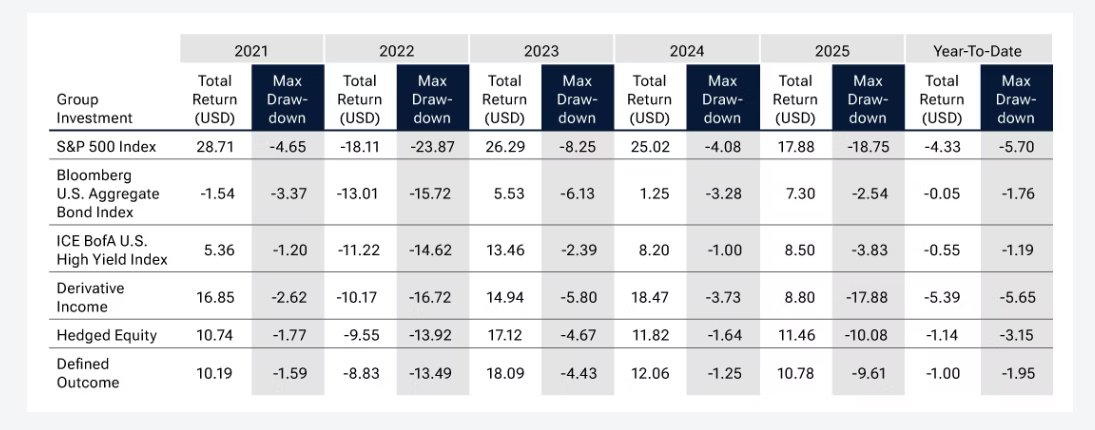
Source: T. Rowe Price
Many investors also worry that stock market returns may moderate after several years of strong gains. Option-income strategies can provide an alternative source of return even if markets move sideways or experience periods of consolidation.
Questions surrounding inflation, interest rates, government spending, global conflicts, and economic growth continue to create uncertainty. Strategies that emphasize income generation rather than relying entirely on capital appreciation may become increasingly attractive in such environments.
Option-income strategies are designed specifically with those objectives in mind.
The Rise of Option-Income ETFs
Historically, implementing option-income strategies required specialized knowledge, ongoing management, and access to options markets. That has changed dramatically, as a new generation of actively managed ETFs has made option-income investing accessible to virtually anyone.
These funds handle option selection, trade execution, portfolio management, and risk monitoring on behalf of investors, allowing them to simply purchase ETF shares rather than managing options positions individually.
The category has expanded rapidly, with covered-call ETFs, enhanced-income strategies, index-option funds, and actively managed option-overlay products now representing one of the fastest-growing areas of the ETF marketplace. According to J.P. Morgan, Morningstar’s “derivative income” category has experienced exponential growth since 2020, reaching over $150 billion in assets at the start of the year.
Active management can be particularly valuable in this space because option markets are dynamic. Skilled managers can adjust strike prices, expiration dates, and portfolio exposures in response to changing market conditions.
Popular Active Derivative-Focused ETFs
These ETFs were selected based on their exposure to options overlays and derivative mandates, and are sorted by YTD total return, which ranges from -2% to 7.3%. They carry expense ratios between 0.29% and 0.75%, assets under management between $98M and $38B, and current yields between 4.9% and 11.3%.
| Ticker | Name | AUM | YTD Total Ret (%) | Yield | Exp Ratio | Security Type | Actively Managed? |
|---|---|---|---|---|---|---|---|
| IDVO | Amplify International Enhanced Dividend Income ETF | $145M | 7.3% | 6.1% | 0.66% | ETF | Yes |
| TLTW | iShares 20+ Year Treasury Bond BuyWrite Strategy ETF | $1.09B | 6.1% | 21.6% | 0.35% | ETF | Yes |
| LQDW | iShares investment-grade Corporate Bond BuyWrite Strategy ETF | $223M | 4.9% | 21% | 0.34% | ETF | Yes |
| NUSI | Nationwide Nasdaq-100 Risk-Managed Income ETF | $328M | 3.5% | 8.6% | 0.68% | ETF | Yes |
| JEPI | JPMorgan Equity Premium Income ETF | $38B | 2.6% | 6.8% | 0.35% | ETF | Yes |
| KNG | FT Cboe Vest S&P 500 Dividend Aristocrats Target Income ETF | $3.65B | 2.3% | 8.6% | 0.75% | ETF | No |
| HYGW | iShares High Yield Corporate Bond BuyWrite Strategy ETF | $220M | 2.1% | 15.2% | 0.69% | ETF | Yes |
| DIVO | Amplify CWP Enhanced Dividend Income ETF | $3.89B | 1.8% | 4.9% | 0.56% | ETF | Yes |
| PBP | Invesco S&P 500 BuyWrite ETF | $98.7M | -1% | 10.9% | 0.29% | ETF | Yes |
| JEPQ | JPMorgan Nasdaq Equity Premium Income ETF | $19.6B | -1.5% | 10.7% | 0.35% | ETF | Yes |
| QYLD | Global X NASDAQ 100 Covered Call ETF | $8.38B | -2% | 11.3% | 0.61% | ETF | No |
Income investing has grown more complicated than in previous decades. Bonds remain volatile, dividend stocks face their own challenges, and economic uncertainty creates difficult tradeoffs for investors seeking dependable cash flow.
Option-income strategies offer a different approach.
By converting a portion of future upside into current income through the sale of options, investors can potentially generate higher cash flow while reducing portfolio volatility. Although the strategy requires sacrificing some upside participation, many income-focused investors view that tradeoff as worthwhile.
The rapid growth of actively managed option-income ETFs has made these strategies more accessible than ever. As investors continue searching for ways to generate reliable income in an uncertain market, option-income investing may increasingly move from a niche strategy to a mainstream portfolio solution.
Bottom Line
Option-income strategies offer investors a compelling middle ground between traditional bonds and equities by transforming market volatility into a potential source of cash flow. In an environment where bond prices remain sensitive to interest rates, dividend stocks face valuation and economic risks, and market uncertainty remains elevated, option-income strategies can help generate attractive distributions while potentially reducing portfolio volatility.

