For decades, building an equity portfolio was relatively straightforward. Investors established a diversified core using broad market index funds and then layered on actively managed funds in an attempt to outperform the market. The strategy became known as the “core-and-satellite” approach, and for years it represented one of the most common methods of portfolio construction.
Today’s investment landscape, however, is demanding more from equity allocations. Market volatility has increased, geopolitical uncertainty remains elevated, and valuations across portions of the equity market continue to leave many investors questioning future return expectations.
Enhanced equity strategies delivered through actively managed ETFs are increasingly providing a compelling answer. Rather than asking investors to choose between purely passive indexing and high-conviction active management, enhanced equity ETFs seek to occupy the middle ground. For investors seeking a more efficient equity allocation, enhanced indexing may represent one of the most interesting innovations in modern portfolio construction.
The Traditional Core-and-Satellite Model Has Its Limitations
For many advisors and investors, the core-and-satellite framework represents the best of both worlds. A low-cost index fund serves as the portfolio’s foundation, providing broad market exposure, diversification, and dependable beta. Around that core, investors add actively managed “satellite” positions that attempt to outperform through concentrated security selection or sector tilts.
On paper, the approach makes perfect sense, and the style has become popular among a wide range of investors.
In actual practice, however, the results have often been less satisfying.
High-conviction active managers frequently exhibit significant tracking error relative to the benchmark. Some outperform spectacularly, while others lag the market for extended periods, and even skilled managers can endure years of underperformance simply because their investment style falls out of favor.
According to State Street, when breaking managers into quartile rankings based on 5-year excess returns, only 40% were in the top quartile two years prior. Some performance is even worse: looking at 2021, a great year for stocks and active managers, just over 9% of funds were in the top quartile, with nearly 65% falling in the bottom half over the next two years. 1
The reality is that betting on active managers creates significant uncertainty and reduces the potential for consistent outperformance year after year.
This challenge becomes even more apparent in today’s environment. If long-term equity returns are expected to moderate, investors cannot afford large performance gaps caused by concentrated bets or prolonged manager underperformance. They need portfolios that make more efficient use of active risk while preserving the diversification benefits of broad market exposure.
Enhanced Equity ETFs
The answer may lie in the new generation of enhanced active ETFs, which offer investors a way to pursue both broad market exposure and outperformance.
Enhanced equity ETFs are actively managed strategies designed to look and behave much like broad market indexes while seeking modest but consistent outperformance over time. Unlike traditional active funds, enhanced strategies are not attempting to dramatically beat the market in any given year, nor are they making concentrated sector bets or building portfolios that differ substantially from their benchmarks.
Instead, they employ sophisticated quantitative models, disciplined security selection, and comprehensive risk management to identify small inefficiencies across hundreds or even thousands of stocks. Each position may contribute only a modest amount of expected excess return, but collectively those incremental advantages can compound over long investment horizons.
Not trying to beat the market by a wide margin turns out to be a great strategy. According to State Street, enhanced strategies underperform less than their high-conviction active counterparts. This chart sums up their findings.
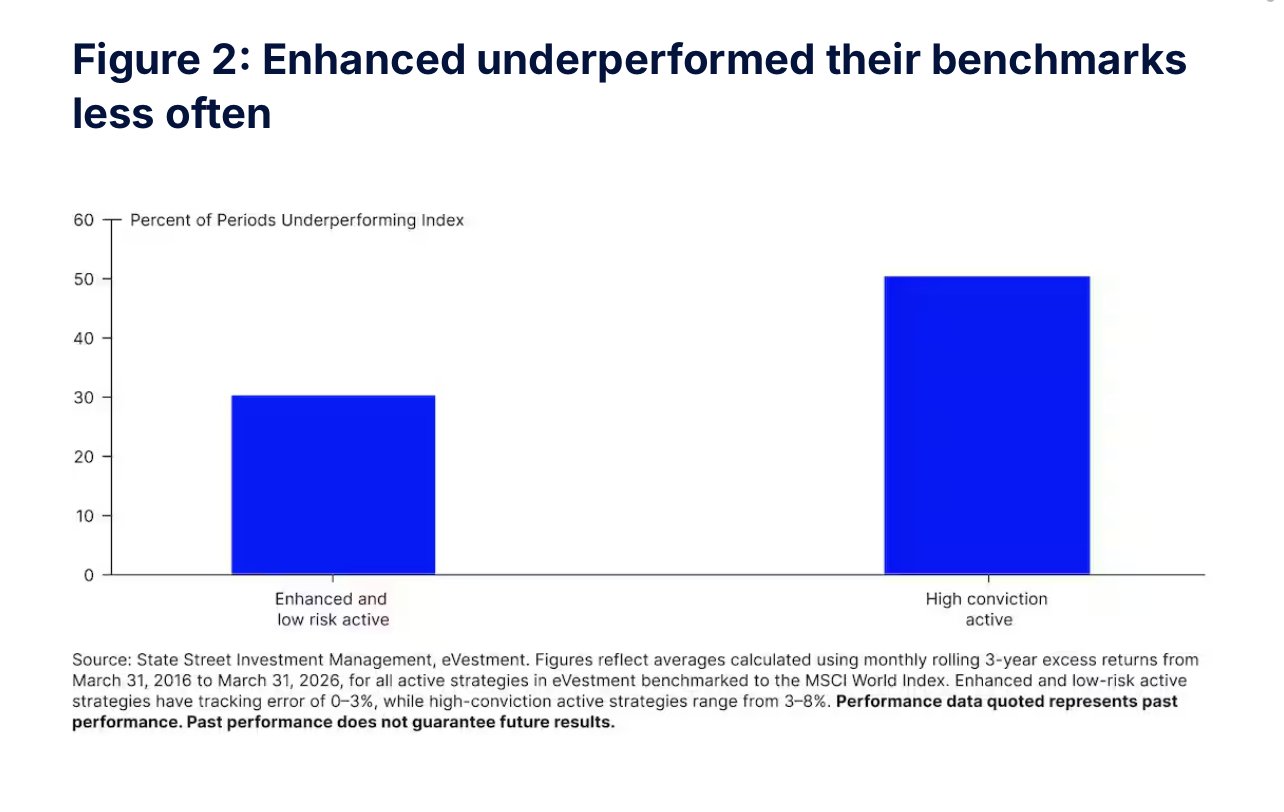
Source: State Street
Over time, consistently adding modest excess returns while avoiding large periods of underperformance may prove more valuable than occasionally generating spectacular gains followed by significant disappointments. Consistent base hits turn into runs.
Making Enhanced ETFs the Core of Your Portfolio
The question is what to do with this information and how investors can use it to their advantage.
Because enhanced strategies remain broadly diversified and benchmark aware, they continue to provide the characteristics investors expect from a core holding. They maintain exposure across sectors and industries, avoid excessive concentration, and generally exhibit relatively low tracking error compared with traditional active funds.
This creates a stronger foundation for the overall portfolio.
Rather than use a traditional core and satellite strategy, replacing the passive core with enhanced active ETFs allows the entire equity allocation to work more efficiently, instead of confining active management to a small portion of the portfolio.
Some investors may even find they no longer need multiple expensive satellite managers if an enhanced core can deliver a portion of the desired excess return with considerably less active risk.
The rapid growth of active ETFs has been instrumental in making enhanced strategies more accessible.
Historically, many enhanced strategies were available primarily through institutional separate accounts or mutual funds. The ETF wrapper now offers daily liquidity, competitive expense ratios, greater tax efficiency, and improved transparency, while retaining the flexibility active managers need to implement systematic investment processes.
Enhanced Active ETFs
These ETFs provide exposure to enhanced or fundamental strategies with an active touch. They carry expense ratios between 0.17% and 0.28% and assets under management between $3.3B and $21B. Their YTD total return ranges from -0.4% to 6.2%.
| Ticker | Name | AUM | YTD Total Ret (%) | Yield (%) | Exp Ratio | Security Type | Actively Managed? |
|---|---|---|---|---|---|---|---|
| DFUV | Dimensional U.S. Marketwide Value ETF | $8.5B | 6.2% | 1.5% | 0.21% | ETF | Yes |
| DFAC | Dimensional U.S. Core Equity 2 ETF | $20.9B | 5.7% | 0.8% | 0.17% | ETF | Yes |
| FELC | Fidelity Enhanced Large Cap Core ETF | $4.5B | 3.3% | 1.04% | 0.19% | ETF | Yes |
| FELG | Fidelity Enhanced Large Cap Growth ETF | $3.3B | 2.4% | 0.46% | 0.19% | ETF | Yes |
| AVUV | Avantis U.S. Small-Cap Value ETF | $6.7B | 0.80% | 1.4% | 0.25% | ETF | Yes |
| DFAT | Dimensional U.S. Targeted Value ETF | $8.2B | -0.4% | 0.8% | 0.28% | ETF | Yes |
As long-term equity return expectations grow more modest and market uncertainty remains elevated, simply capturing market beta may no longer be enough for many investors.
Enhanced equity ETFs offer a thoughtful middle ground between passive indexing and high-conviction active management, maintaining broad market exposure while systematically seeking modest, repeatable excess returns through disciplined security selection and rigorous risk management.
By using them as a core allocation, investors can eliminate many of the drawbacks of satellite investing, achieve better results, and ultimately meet their end goals with less risk.
Bottom Line
Rather than treating active management as a small satellite allocation, investors can use enhanced strategies to strengthen the very foundation of their portfolios, creating a more efficient core with the potential to improve long-term risk-adjusted returns without sacrificing the diversification, stability, and cost advantages that have made index investing so successful.
1 State Street (May 2026). Consistency as a compass in developed market equities

