Active exchange-traded funds have taken the investment world by storm. What was once a relatively small corner of the ETF industry has become one of its fastest-growing segments, attracting hundreds of billions of dollars as investors embrace professional portfolio management in a more flexible, accessible structure.
However, the active ETF boom hasn’t been evenly distributed across asset classes. Some markets offer managers more opportunities to add value than others, with municipal bonds emerging as one of the clearest examples.
Investors are increasingly turning to active municipal ETFs for the potential combination of better security selection, tax-efficient income, and easier access to a historically difficult-to-navigate market, and fund flows tell a compelling story.
Active Muni ETFs Are Capturing a Growing Share of Flows
When it comes to active ETFs, municipal bonds are quickly becoming the go-to asset class for investors of all sizes. The proof is in fund flows, with the sector commanding the lion’s share of assets among active ETF varieties.
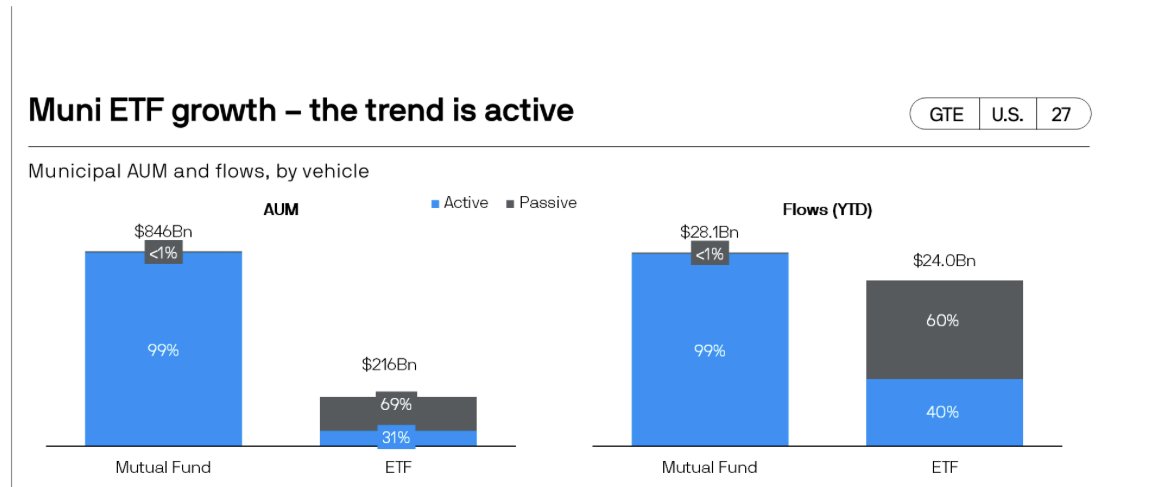
According to J.P. Morgan Asset Management, municipal bond ETFs attracted approximately $24 billion during the first five months of 2026, representing nearly half of all municipal fund inflows, with roughly 40% of those ETF inflows going into active strategies. 1
This chart from JPM highlights fund flows into the asset class.
Source: J.P. Morgan
That represents a meaningful shift for an asset class historically dominated by mutual funds. Traditional mutual funds still account for more than 80% of municipal fund assets, but ETFs are capturing an increasingly large share of new investor dollars.
Municipal bond ETFs have also benefited from the recent bond-market selloff. Investors appear increasingly willing to use periods of weakness to establish positions at more attractive yields, with active funds leading over passive vehicles like the iShares National Muni Bond ETF (MUB) and Vanguard Tax-Exempt Bond ETF (VTEB).
Why Active Management Works Particularly Well in Municipals
The appeal of active management within municipal bonds is understandable. Active managers benefit from rising muni demand while offering additional value through credit research, security selection, and portfolio positioning.
J.P. Morgan estimates the municipal market includes more than 50,000 issuers and over one million individual securities, financing everything from schools and highways to hospitals, utilities, airports, and water systems. The key is that this market is fragmented, complex, and frequently inefficient.
Even bonds issued by the same municipality can differ in maturities, coupons, call provisions, repayment structures, and credit characteristics.
That complexity creates opportunities for professional managers.
J.P. Morgan’s research found that active intermediate municipal bond managers outperformed their benchmarks by an average of approximately 40 basis points annually across trailing one-, three-, and five-year periods, while passive managers generally lagged.
That doesn’t mean every active manager consistently outperforms. Higher fees, poor security selection, and unfavorable interest-rate positioning can undermine results. Nevertheless, the historical evidence suggests that municipal bonds offer meaningful opportunities for managers to add value.
Municipal indexes can be heavily influenced by issuance from states, such as California and New York, where large borrowing programs and substantial investor demand create significant benchmark weights. Active managers aren’t required to replicate those allocations and can search elsewhere for more attractive yields.
Credit research also matters. Revenue bonds backed by hospitals, transportation systems, or utilities can behave differently from general obligation bonds supported by state or local taxing authority.
Active managers can evaluate those distinctions rather than relying exclusively on credit ratings or index eligibility.
Tax efficiency and liquidity also help explain why active ETFs have surged in popularity with muni investors.
Traditional municipal bonds can be difficult to trade. Many individual securities change hands infrequently, and investors selling smaller positions may encounter substantial bid-ask spreads. Municipal ETFs provide exchange-traded shares that investors can generally buy or sell throughout the trading day.
Likewise, ETFs enhance the tax efficiency of their holdings through the creation-redemption mechanism, eliminating capital gains from inside the fund.
What Comes Next for Active Muni ETFs?
Several developments suggest active municipal ETFs could continue gaining market share.
First, elevated yields are making municipal bonds more competitive with taxable fixed-income alternatives. Even after the recent selloff, the potential to earn attractive tax-free income remains an important incentive for investors.
Second, the municipal market’s complexity isn’t disappearing. New issuance, changing credit conditions, and differences in bond structures continue to create opportunities for active security selection.
Third, the ETF structure is becoming increasingly familiar to investors and financial advisors. As more asset managers introduce active municipal products, investors gain additional choices across maturities, credit categories, and investment styles.
All of this supports continued expansion of active muni ETFs.
Active Municipal Bond ETFs
These ETFs were selected for their ability to provide low-cost, active exposure to the municipal bond market. Sorted by YTD total return, they range from -1.8% to 3.1%, carry expense ratios of 0.12% to 0.65%, and have assets under management of $418 million to $3.4 billion. Current yields range between 2.8% and 4%.
| Ticker | Name | AUM | YTD Total Ret (%) | Yield (%) | Exp Ratio | Security Type | Actively Managed? |
|---|---|---|---|---|---|---|---|
| SMMU | PIMCO Short Term Municipal Bond Active ETF | $890M | 3.1% | 2.9% | 0.35% | ETF | Yes |
| MEAR | iShares Short Maturity Municipal Bond Active ETF | $1.1B | 2.8% | 2.8% | 0.25% | ETF | Yes |
| IMNU | iShares Intermediate Muni Income Active ETF | $919M | 1.7% | 3.6% | 0.41% | ETF | Yes |
| HMOP | Hartford Municipal Opportunities ETF | $576M | 1.7% | 3.5% | 0.29% | ETF | Yes |
| CGMU | Capital Group Municipal Income ETF | $3.36B | 1.6% | 3.9% | 0.27% | ETF | Yes |
| MUNI | PIMCO Intermediate Municipal Bond Active ETF | $2B | 1.6% | 3.3% | 0.35% | ETF | Yes |
| MMIT | NYLI MacKay Muni Intermediate ETF | $1B | 1.6% | 3.6% | 0.47% | ETF | Yes |
| DFNM | Dimensional National Municipal Bond ETF | $1.57B | 1% | 3% | 0.19% | ETF | Yes |
| VCRM | Vanguard Core Tax-Exempt Bond ETF | $429M | 0.5% | 3.5% | 0.12% | ETF | Yes |
| SHYM | iShares High Yield Muni Income Active ETF | $370M | 0.3% | 4.4% | 0.41% | ETF | Yes |
| TAXF | American Century Diversified Municipal Bond ETF | $508M | -0.2% | 4% | 0.29% | ETF | Yes |
| FMB | First Trust Managed Municipal ETF | $2.04B | -0.3% | 3.5% | 0.65% | ETF | Yes |
| AVMU | Avantis Core Municipal fixed-income ETF | $148M | -1.8% | 3.9% | 0.15% | ETF | Yes |
The combination of attractive tax-exempt yields, an inefficient underlying market, and growing demand for ETF flexibility provides a strong foundation for continued expansion.
Municipal bonds may not be the flashiest corner of the active ETF industry, but they could prove to be one of its most natural fits. Investors are increasingly recognizing that the ability to select individual bonds, manage taxes, and navigate liquidity challenges can be especially valuable in a market where seemingly similar securities often behave very differently.
Bottom Line
For income-focused investors, active municipal ETFs offer an increasingly practical way to combine the traditional benefits of tax-exempt bonds with the flexibility and potential advantages of professional management.
1 JPM (July 2026). The Muni Story Is in Its Active Flows

