Cryptocurrency has spent much of its history sitting somewhere between an investment and a speculation. Bitcoin enthusiasts saw it as digital gold, skeptics saw little more than a bubble, and many traditional investors simply avoided the asset class altogether. However, the rapid expansion of crypto exchange-traded products has changed that conversation. Digital assets are increasingly becoming something investors can evaluate and allocate to alongside stocks, bonds, commodities, and other alternatives.
And, spot Bitcoin was really only the beginning.
The crypto ETF market has expanded into other tokens, and issuers have developed increasingly sophisticated strategies incorporating options, staking, and multiple cryptocurrencies.
Active portfolio management is now part of the conversation. Investors are no longer simply asking whether they should own bitcoin—they’re asking how to allocate across a rapidly expanding digital-asset universe, and active management is increasingly providing the answer.
Active Management Takes Center Stage
The first generation of crypto ETFs had a straightforward job: track the price of a cryptocurrency as closely as possible. That simple idea opened the floodgates for the asset class. Institutional investors could now comfortably own bitcoin and other digital assets, while retail investors could add them to retirement accounts and IRAs. Global digital-asset ETP assets subsequently surged past $250 billion at their peak, according to CoinDesk Research, and still sat north of $184 billion at the end of 2025. 1
This chart from Morningstar highlights the surge in U.S. digital asset ETFs—which hold the bulk of all AUMs—and the sheer number of fund launches.
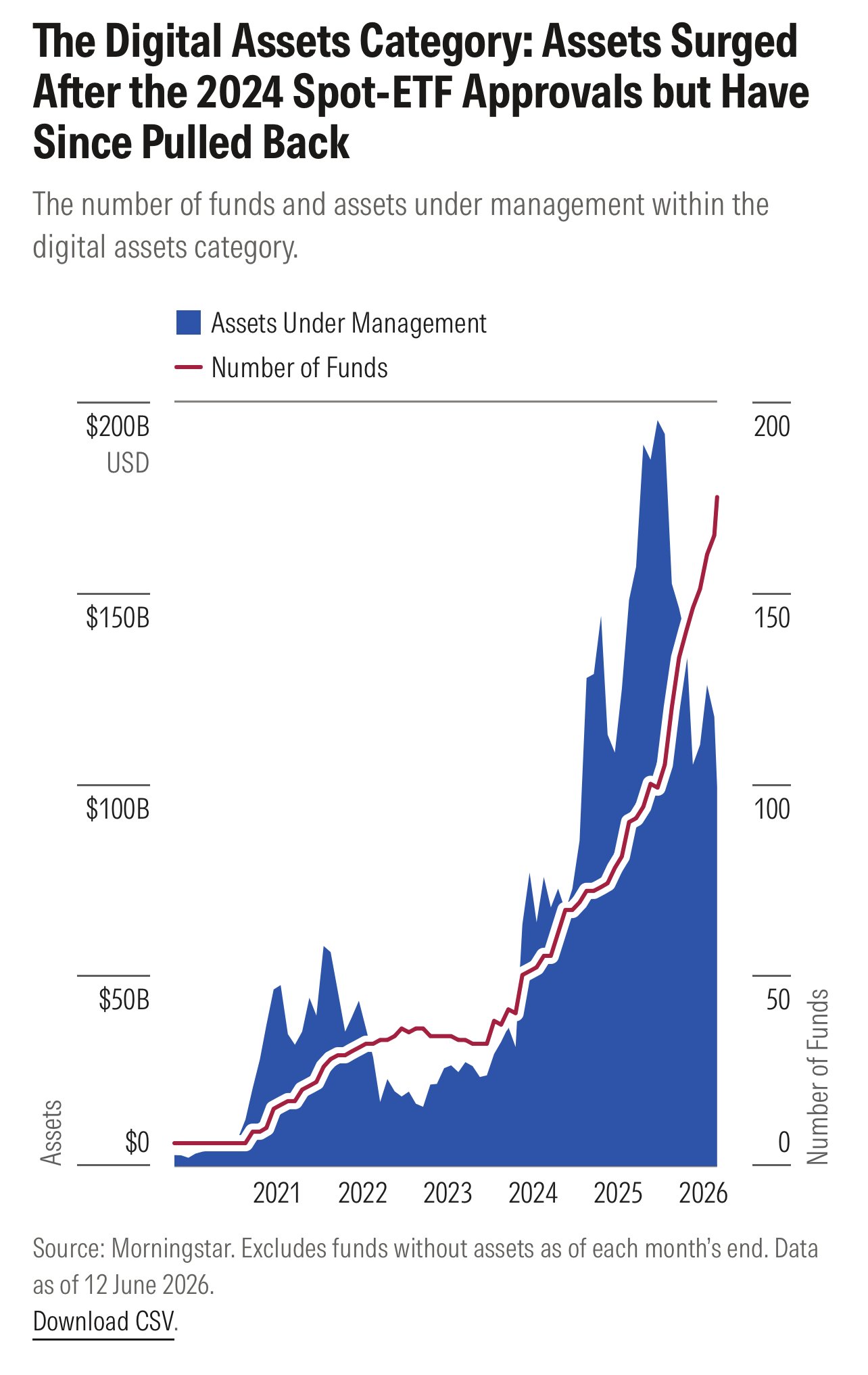
Source: Morningstar
Bitcoin, Ethereum, and other digital assets have gone mainstream on these simple spot-tracking products. The next wave, “Crypto ETF 2.0,” is considerably more ambitious.
Active crypto strategies are designed to manage exposures, move among different digital assets, generate income, or exploit features unique to blockchain networks. This represents an important evolution because cryptocurrency is not one homogeneous asset class—Bitcoin, Ethereum, Solana, XRP, and thousands of smaller tokens can have dramatically different economic characteristics and use cases.
One example is the growing number of options-based strategies. Just as in the broader stock market, investors have turned to derivatives to reduce risk and generate income in crypto. Covered-call crypto ETFs can maintain exposure to bitcoin or bitcoin ETFs while selling call options to generate income. Products, such as the Grayscale Bitcoin Covered Call ETF (BTCC), are designed to turn bitcoin’s high volatility into a potential source of cash flow. Goldman Sachs’s recent purchase of ETF issuer NEOS Investments—and its flagship $1 billion Bitcoin High Income ETF—underscores how strongly investors have flocked to these products.
Staking creates another opportunity. Proof-of-stake blockchain networks allow token holders to participate in validating transactions and potentially earn rewards for doing so. Exchange-traded products are beginning to incorporate that capability, potentially allowing investors to receive some of the economic benefits of staking without personally managing wallets or validators.
In July, T. Rowe Price launched the T. Rowe Price Active Crypto ETF, or TKNZ, which it describes as the first actively managed multi-token spot exchange-traded product in the U.S. Rather than simply tracking bitcoin or mechanically replicating a cryptocurrency index, managers can select and adjust allocations among eligible digital assets based on research, fundamentals, technical factors, momentum, and changing market conditions—including meme coins, such as Dogecoin and Shiba Inu when the opportunity warrants.
That’s a significant milestone from a traditional asset manager overseeing roughly $1.9 trillion. For an industry that spent years fighting to get a spot bitcoin product approved, an actively managed portfolio from a major traditional asset manager represents a dramatic evolution.
Why Active Management Could Make Sense in Crypto
There are good reasons to question whether active management can consistently outperform in highly efficient markets, such as U.S. large-cap stocks. Crypto presents a very different market.
The first advantage is dispersion.
Bitcoin may remain the largest cryptocurrency, but it is far from the only source of returns. Different blockchain networks can experience dramatically different adoption rates, technological developments, regulatory changes, and investor enthusiasm. A passive portfolio has little ability to distinguish between a token gaining fundamental traction and one simply benefiting from temporary speculation.
Active managers can potentially make those distinctions.
Crypto also trades 24 hours a day, seven days a week, and markets can shift dramatically while traditional stock exchanges are closed. New protocols appear, technologies evolve, networks experience outages, and regulatory developments can quickly alter the outlook for individual tokens.
Evaluating these assets requires understanding factors that don’t appear in traditional equity analysis. Investors may need to assess network security, decentralization, token supply, developer activity, programmability, governance, competitive blockchains, and how economic value flows back to token holders.
T. Rowe Price argues that these characteristics make active evaluation particularly relevant. Passive crypto indexes can provide diversification but cannot necessarily respond quickly when fundamentals change. An active manager can potentially reduce exposure to deteriorating projects while increasing allocations to networks gaining adoption or benefiting from emerging trends.
Risk management may ultimately be just as important as return generation.
Crypto has repeatedly experienced enormous drawdowns. An active strategy won’t eliminate that volatility, but managers can potentially diversify among tokens, rebalance positions, avoid excessive concentration, and respond as market conditions change.
That could become increasingly important as crypto expands beyond bitcoin.
How to Play Crypto Through ETFs
For investors interested in crypto, the expanding ETF universe now offers several ways to build exposure.
The simplest approach remains a spot bitcoin product. Investors who view bitcoin as the primary long-term digital asset can use these products as a relatively straightforward portfolio allocation without directly custodying bitcoin.
As noted, the growth of active management within the bitcoin and digital asset space could be the game changer for portfolios. Multi-token and actively managed strategies can provide exposure to Ethereum, Solana, and other blockchain ecosystems while reducing the burden of selecting and rebalancing individual cryptocurrencies. Covered-call strategies attempt to monetize crypto volatility by selling options, and staking products can potentially provide both token exposure and staking rewards.
Active Bitcoin ETFs
These ETFs were selected based on their exposure to Bitcoin using a buffered, staking, or active strategy. They carry expense ratios between 0.61% and 1.3%. Sorted by one-year total return, which ranges from -4% to -57%, they currently pay no dividends.
| Ticker | Name | 1-year Total Ret (% | Exp Ratio | Security Type | Actively Managed? |
|---|---|---|---|---|---|
| CBOJ | Calamos Bitcoin Structured Alt Protection ETF - January | -4.01% | 0.69% | ETF | Yes |
| CBXJ | Calamos Bitcoin 90 Series Structured Alt Protection ETF - January | -20.78% | 0.69% | ETF | Yes |
| CBTJ | Calamos Bitcoin 80 Series Structured Alt Protection ETF - January | -30.7% | 0.69% | ETF | Yes |
| QBF | Innovator Uncapped Bitcoin 20 Floor ETF - Quarterly | -35.3% | 0.79% | ETF | Yes |
| MAXI | Simplify Bitcoin Strategy PLUS Income ETF | -57.55% | 1.3% | ETF | Yes |
Standard Bitcoin ETFs
These ETFs were selected based on their exposure to spot Bitcoin, with AUM between $730M and $87B. Sorted by one-year total return, which ranges from 88% to 93%, they carry expense ratios from 0.19% to 1.50% and currently pay no dividends.
| Ticker | Name | AUM | 1-year Total Ret (%) | Yield (%) | Exp Ratio | Security Type | Actively Managed? |
|---|---|---|---|---|---|---|---|
| BITO | ProShares Bitcoin Strategy ETF | $2.76B | 92.7% | 0% | 0.95% | ETF | No |
| IBIT | iShares Bitcoin Trust | $86.7B | 90.9% | 0% | 0.25% | ETF | No |
| HODL | VanEck Bitcoin Trust | $1.3B | 90.9% | 0% | 0.25% | ETF | No |
| FBTC | Fidelity® Wise Origin® Bitcoin Fund | $19.2B | 90.7% | 0% | 0.25% | ETF | No |
| ARKB | ARK 21Shares Bitcoin ETF | $4.75B | 90.7% | 0% | 0.21% | ETF | No |
| EZBC | Franklin Templeton Digital Holdings Trust | $732M | 90.7% | 0% | 0.19% | ETF | No |
| BTCO | Invesco Galaxy Bitcoin ETF | $856M | 90.5% | 0% | 0.39% | ETF | No |
| GBTC | Grayscale Bitcoin Trust | $21B | 88.4% | 0% | 1.50% | ETF | No |
Crypto’s journey into mainstream portfolios has accelerated sharply since spot bitcoin products arrived in 2024. What began as a simpler way to access bitcoin has expanded into a rapidly developing ecosystem of multi-token portfolios, options strategies, staking products, and actively managed exchange-traded vehicles.
The arrival of T. Rowe Price’s active crypto strategy—with an eligible universe spanning bitcoin and Ethereum all the way to Dogecoin and Shiba Inu—shows just how far the market has evolved.
Active management could be particularly well suited to an asset class characterized by extreme volatility, rapid technological change, wide performance dispersion, and enormous quality differences among individual tokens.
Bottom Line
The next phase of crypto investing may be less about simply owning bitcoin and more about actively deciding which digital assets to own, how much to hold, and how to turn crypto’s unique characteristics into a more deliberate portfolio strategy.
1 Coindesk (February 2026). Digital Asset ETP Landscape: Past, Present and Future

