Private markets have long attracted endowments, pension funds, and high-net-worth investors with promises of extra alpha, lower volatility, and non-correlated returns. For regular investors, private equity ownership remained a dream—until now.
A new wave of active ETFs increasingly incorporates private company exposure, either directly through pre-IPO holdings or indirectly through crossover investments straddling public and private markets.
After decades allocating to private companies via mutual funds and internal programs, managers have laid the groundwork for more “private-like” ETF exposure. As non-transparent and semi-transparent ETF frameworks mature, investors can expect strategies blending public and private assets.
A Focus on Private Equity
Private equity has historically enhanced institutional portfolios by offering return profiles distinct from public markets. Private companies avoid daily pricing, short-term sentiment, and short horizons, which insulates them from public-market volatility. This lets management focus on operations, growth, and reinvestment instead of quarterly earnings. Over full cycles, this orientation has produced returns less correlated with public equities, boosting diversification.
It has also produced higher returns.
Private equity’s exposure to early corporate growth stages has long delivered higher returns than public counterparts. A recent MSCI Private Capital Solutions study illustrates that private equity generated a net annualized time-weighted return of 13% since 2000, versus 8% for the Russell 3000. Overall, private equity investors achieved 19.9x net returns on their capital compared to public market investors. 1
Investors clearly want private equity assets in portfolios, but access has always been the problem. Private equity traditionally required limited partnerships, long lockups, irregular valuations, and accreditation hurdles. That excluded all but university endowments, insurance funds, pension funds, or those with a private banker; otherwise, you were out of luck with this asset class.
Active ETFs Change the Game
Regular investors may soon access private equity through active ETFs. A recent launch has shifted views on private assets, and new ETF structures now enable exposure to them.
Baron Capital has long championed growth investing. Founder and lead manager Ron Baron pioneered high-conviction growth in mutual funds. Over time, Baron’s funds have excelled, with 98% of assets beating benchmarks.
That success stems partly from access to early-stage and private firms like SpaceX in its mutual funds. Now, such private exposure is entering active ETFs.
At the end of 2025, Baron Capital launched its first five active ETFs, positioning the Baron First Principles ETF (RONB) as its flagship. RONB features large private-company holdings: as of January 2026, it allocated 21.5% to SpaceX and 5.4% to xAI, for nearly 27% total private exposure.
27%.
Baron uses the ETF wrapper to deliver a “public-private crossover” strategy once confined to mutual funds and closed-end vehicles.
Morningstar reports that between 2014 and 2024, U.S. mutual funds invested at least $30 billion in private companies. Fidelity and T. Rowe Price have long included private equity and early-stage growth firms in their funds. One Fidelity fund once valued its SpaceX stake above $2.7 billion, while T. Rowe Price New Horizons held stakes in over 50 private firms. 1
This Morningstar chart highlights the growth of private firms in mutual funds.
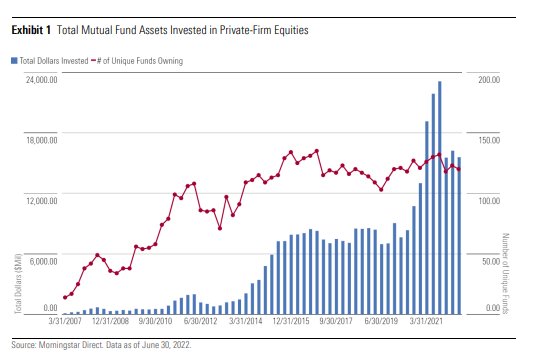
Source: Morningstar
Active ETFs suit private firms thanks to their structure.
Active ETFs’ biggest historical barrier to illiquid or informationally sensitive holdings was not just liquidity but daily transparency. Traditional ETFs disclose full holdings daily, risking front-running for managers and complicating illiquid trades.
That’s why the emergence of semi-transparent and non-transparent active ETF models proved so important. In 2019, regulators approved multiple “semi-transparent” approaches that used proxy or tracking portfolios—models from firms, including T. Rowe Price and Fidelity.
Second, the ETF creation and redemption mechanism enables efficient functioning even with less liquid underlying holdings. This mechanism allows greater incorporation of private and private-adjacent assets into active ETF portfolios. For portfolios with private assets, managers structure baskets so least liquid holdings trade infrequently, while more liquid public securities handle daily creations and redemptions.
Investors Should Expect More Going Forward
Baron’s new ETFs could serve as the litmus test for private equity and non-public assets in portfolios. Normally, ETFs hold up to 15% in illiquid securities. However, RONB pushes limits thanks to SpaceX’s healthy secondary market. Recent policy discussions on private assets in retirement portfolios could also ease restrictions.
Either way, active ETFs are likely to gain more private asset exposure.
Most ETFs will not turn into full private equity funds. Investors will likely see partial private exposure in diversified portfolios—late-stage companies, pre-IPO rounds, or secondary-market positions—blended with public equities. With proven active ETF suites and mutual fund experience, Fidelity and T. Rowe Price are expected to soon add private assets to their ETFs. This could benefit investors with non-correlated returns.
However, it also introduces more risk. For every SpaceX or ByteDance—the owner of TikTok—several WeWorks, DiDi Globals, and Juul Labs exist. Due diligence, manager and ETF selection, and monitoring thus become critical for investors.
Active ETFs are expanding into private markets as demand grows for differentiated returns and ETF structures evolve to handle complex portfolios. Baron’s lineup, especially RONB’s SpaceX stake, demonstrates how fast this trend advances from concept to reality.
Bottom Line
Private equity has long eluded regular retail investors. Active ETF structure changes now make private assets available to the average investor. Baron Capital’s recent launch puts private firms within everyone’s reach. This could transform active ETFs.
1 Institutional Investor (March 2025). Why Private Equity Wins: Reflecting on a Quarter-Century of Outperformance
2 Morningstar (August 2025). A Brief History of Private Asset Investing in Mutual Funds

